
Farewell
Directed by Christian Carion
Real journalism.Trusted by millions.
Unlimited access to in-depth reporting, expert analysis, and the stories that shape our country.
Already a member? Log in
Remember the parody paperback craze of the early 1980s, stimulated by The Official Preppy Handbook and a remarkable piece of mimicry called Not the New York Times? In 1983 I wrote up a proposal for a parody to be called Not TV Guide that was to spoof both the tropes of network television and the magazine itself, then the most popular in the world. One bit was a listing for what network announcers would then have called a “very special made-for-television event” on CBS Tuesday night at 9: ‘We’re Gonna Beat This Thing’: The Alexander Solzhenitsyn Story, starring Ed Asner as Solzhenitsyn and Cloris Leachman as his lovely wife Madelyn.
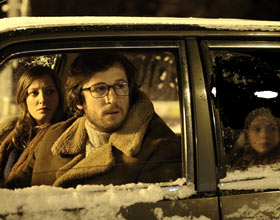
I thought of my fantasy TV movie while watching the new French thriller Farewell, which purports to tell the real story of a Soviet intelligence official who began passing vital secrets to the West in the early 1980s. Farewell is being released in art houses, and its highfalutin’ pedigree is enhanced by the fact that its two lead characters are played by two distinguished European film directors. One is Guillaume Canet, who plays the Frenchman to whom the intelligence officer passes his information. The Serb Emir Kusturica, who made the spectacular anti-Communist film When Father Was Away on Business in 1985 before becoming a disgraceful cinematic toady of Slobodan Milosevic’s, is the Russian double agent.
Farewell has a great and sobering true story to tell, but it tells that story in such a falsified and cartoonish way that it resembles nothing so much as a “very special” TV movie from the 1980s: simplified, vulgarized, and flattened into meaninglessness.
The real “Farewell” was, according to most accounts, a highly unstable man named Vladimir Vetrov whose purposes were impossible to discern and who ended up killing a fellow KGB officer and wounding his own mistress in a Moscow park in 1982.
None of this is in the movie, and what is there is far less dramatic and interesting. Vetrov is renamed Sergei Gregoriev, and he is portrayed as a decent and calm guy who only wants a better Russia for his son, mutely accepts how his wife is cuckolding him with his boss, and seems to be motivated by a love for French poetry.
The movie does reflect the reality of the “Farewell” material: that it revealed to Western intelligence the extent to which Soviet economic development in the 1960s and ’70s was almost entirely the result of industrial espionage. Paid agents inside companies throughout the West had been delivering technical information of a highly sensitive nature to the Soviets, who were using that information to do what they could to advance their own economy and military might. The obsession in the early 1980s with the problem of “technology transfer” arose as a direct result of the Farewell dossier, and in a 1983 National Security Decision Directive, preventing technology loss became a key element of American foreign policy.
More interestingly, the network revealed by Farewell was (it is said) used against the Soviet Union. Buggy computer equipment was sent behind the Iron Curtain, and according to some accounts, its integration into a Soviet oil pipeline caused a mammoth industrial accident in 1982.
Almost none of this is in the movie, either. Instead, it becomes the story of the agent’s relationship with a French engineer who becomes his conduit almost entirely by happenstance. The motivation of the French engineer is entirely puzzling: He’s placing himself in danger, his wife doesn’t want him to do it, and he’s not getting paid for it. So why does he risk it? The movie tells us it’s because he cares about the agent and the agent’s family, but since there’s nothing in the movie that would give him any reason to care, this seems bizarre.
The obvious choice would have been to make the engineer commit to this dangerous course out of a loathing of the Soviet system and a desire to help the West, but the film’s director and cowriter Christian Caron apparently thinks such a thing would be too vulgar and warmongery. Instead, Farewell displays an old-fashioned French loathing for all things American that is almost as quaint as the Walkman the engineer smuggles into Moscow for his son.
The actors playing Francois Mitterrand (then France’s president) and the French intelligence chief narrow their eyes with disgust at the reptilian game-playing of the Americans they encounter in the person of a CIA director named Feeney (William Dafoe) and, especially, Ronald Reagan. He is played by Fred Ward in what may be the worst performance in the history of acting, and I am including the work of Paris Hilton in that unforgettable epic The Hottie and the Nottie. Except that Farewell also includes David Soul—yes, Hutch from Starsky and Hutch. And Soul might be worse than Ward, which is not just saying something, it’s saying everything.
What’s even more amazing is that Carion clearly wanted their performances to be lousy, to reflect badly on the characters they were playing. At least Ed Asner would have tried to be a good Solzhenitsyn. He would have failed, but he would have tried. And doubtless Cloris Leachman would have been just wonderful as the long-suffering Madelyn. I think I would have preferred that movie to this one.
John Podhoretz, editor of Commentary, is The Weekly Standard’s movie critic.