

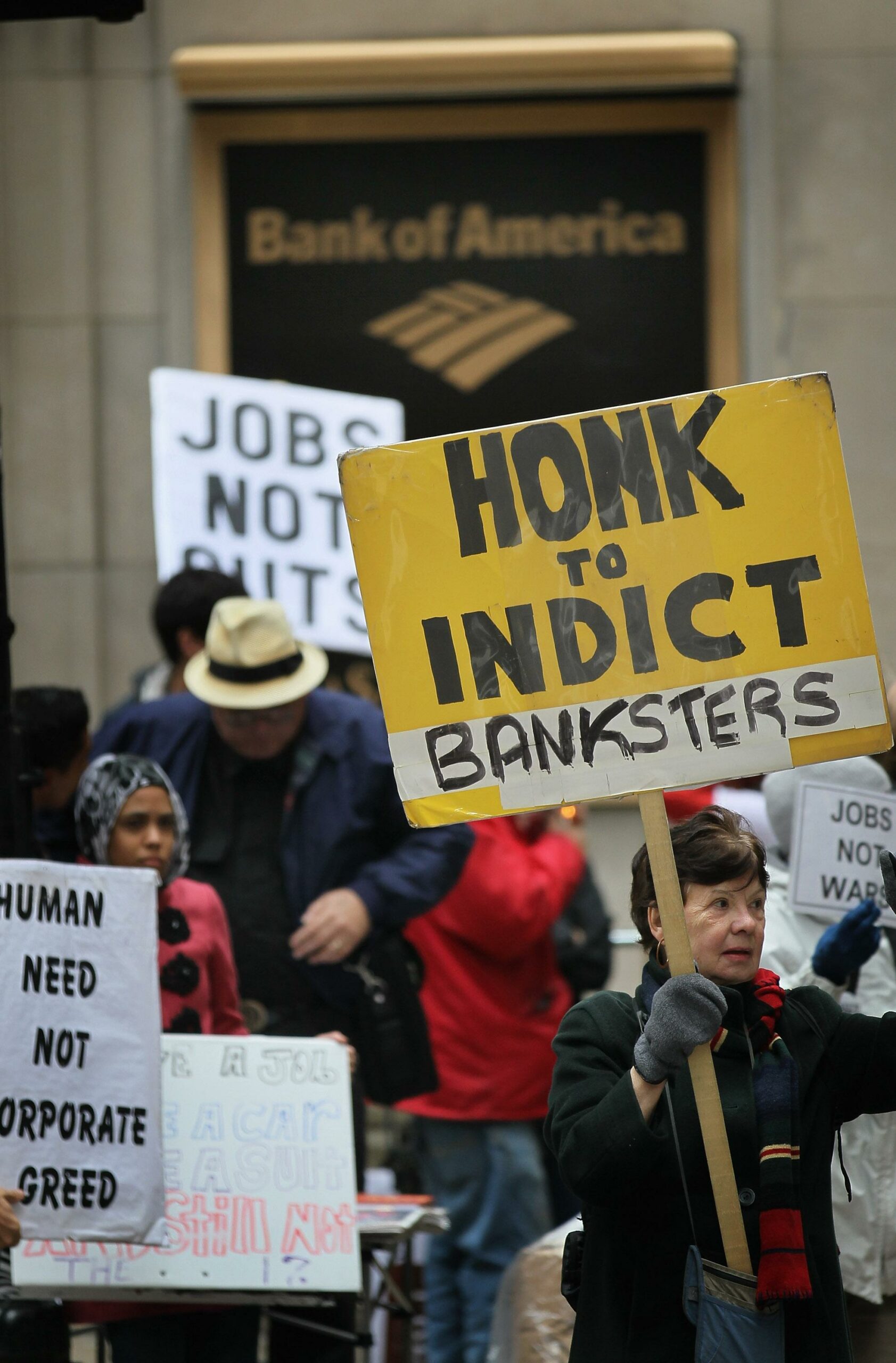
Liberal protesters “occupying” Wall Street hate the big banks, which they see as the engine of capitalism. But conservatives ought to hate the big banks because they are the enemies of capitalism.
Three events last week cemented how the bailed-out subsidy sucklers of Wall Street continue to profit, not from the free exchange and risk-taking that embodies the market, but from cronyism and offloading their risk onto the taxpayer.
First, Bank of America, which would have collapsed if not for the 2008 taxpayer-funded bailout, moved a reported $55 trillion in derivatives from its investment banking arm, Merrill Lynch, to a subsidiary that is backstopped by taxpayers through the Federal Deposit Insurance Corp.
Bloomberg news reported that FDIC officials don’t like the move, which puts depositors’ money at risk and taxpayers ultimately on the hook if risky derivatives blow up. But Wall Street insiders like the move for precisely that reason: If Bank of America melts down, these hedge fund managers or other big-time investors want their money in a division of the bank propped up by government.
In short, big-time investors in risky financial products want taxpayers to bear some of their risk, and Bank of America has come up with a clever way to do that.
Banks play the same public-risk-private-profit game in the mortgage industry, where lenders and Realtors have successfully pushed a measure to expand taxpayer insurance for mortgages to include big-dollar homes. Sens. Johnny Isakson, R-Ga., and Robert Menendez, D-N.J., last week passed through the Senate a measure to expand the size of a loan that the federal government can insure, up to $729,750.
The Menendez-Isakson measure would allow government-owned mortgage giants Fannie Mae and Freddie Mac to buy loans of that size off of lenders, and the Federal Housing Administration could insure loans that big. If a loan owned by Fannnie or Freddie (or insured by the FHA) fails, taxpayers take it on the chin while banks still get paid.
Assuming a 20 percent down payment, this proposed new bailout limit would have taxpayers subsidizing homes worth more than $910,000. Even in pricey Potomac, Md. — plush with the wealth of lobbyists, government consultants and dual GS-15 incomes — that sum could buy you a five-bedroom, 2 1/2-bath home with a two-car garage on a cul-de-sac.
Finally, last week we learned how much self-dealing was involved in the 2008 bank bailouts. A Government Accountability Office report highlighted plenty of conflicts of interest at the Federal Reserve. New York Fed official Stephen Friedman was on the board of Goldman Sachs and actively buying up shares of Goldman while the Fed moved to give Goldman special access to its lending windows.
JP Morgan CEO Jamie Dimon sat on the New York Fed’s board while the Fed was pouring billions of bailout dollars into JP Morgan and granting JP Morgan special regulatory exceptions.
Meanwhile, the banks keep hiring the “public servants” who help steer bailouts their way, further corrupting both the market and the government. Fed bailout honcho Brian Madigan, who, according to the New York Times, “played a leading role in the emergency lending programs during the financial crisis,” cashed out to Barclays this year.
Senate Banking Committee counsel Amy Friend, who helped pass the summer 2008 housing bailout (dubbed the “Bank of America Bill”), now works for a leading financial consulting and lobbying firm. And FHA Commissioner David Stevens, who helped craft a handful of mortgage bailouts, cashed out to the Mortgage Bankers Association. That’s just naming a few.
And all of these big banks still profit from an implicit bailout. The credit ratings agency Moody’s recently downgraded Bank of America, Wells Fargo and Citigroup because the agency saw the likelihood of a bailout decrease from certain to “very high.” These banks’ credit is rated higher than they would be in a free market, meaning they profit from the expectation of a bailout, if necessary.
So banks profit largely through activities that do not create value or efficiencies. They profit through financial games that rest on government favors. Many Occupy Wall Street protestors demonize all profit. Conservatives defend profit-seeking as the engine that creates prosperity for all of society.
But the big banks have rigged the game so that they profit without creating value. In fact, they profit from activities that weaken the economy by creating instability.
Today, big banks give capitalism a bad name. Believers in the free market should stop giving banks cover.
Timothy P. Carney, The Examiner’s senior political columnist, can be contacted at [email protected]. His column appears Monday and Thursday, and his stories and blog posts appear on ExaminerPolitics.com.
