

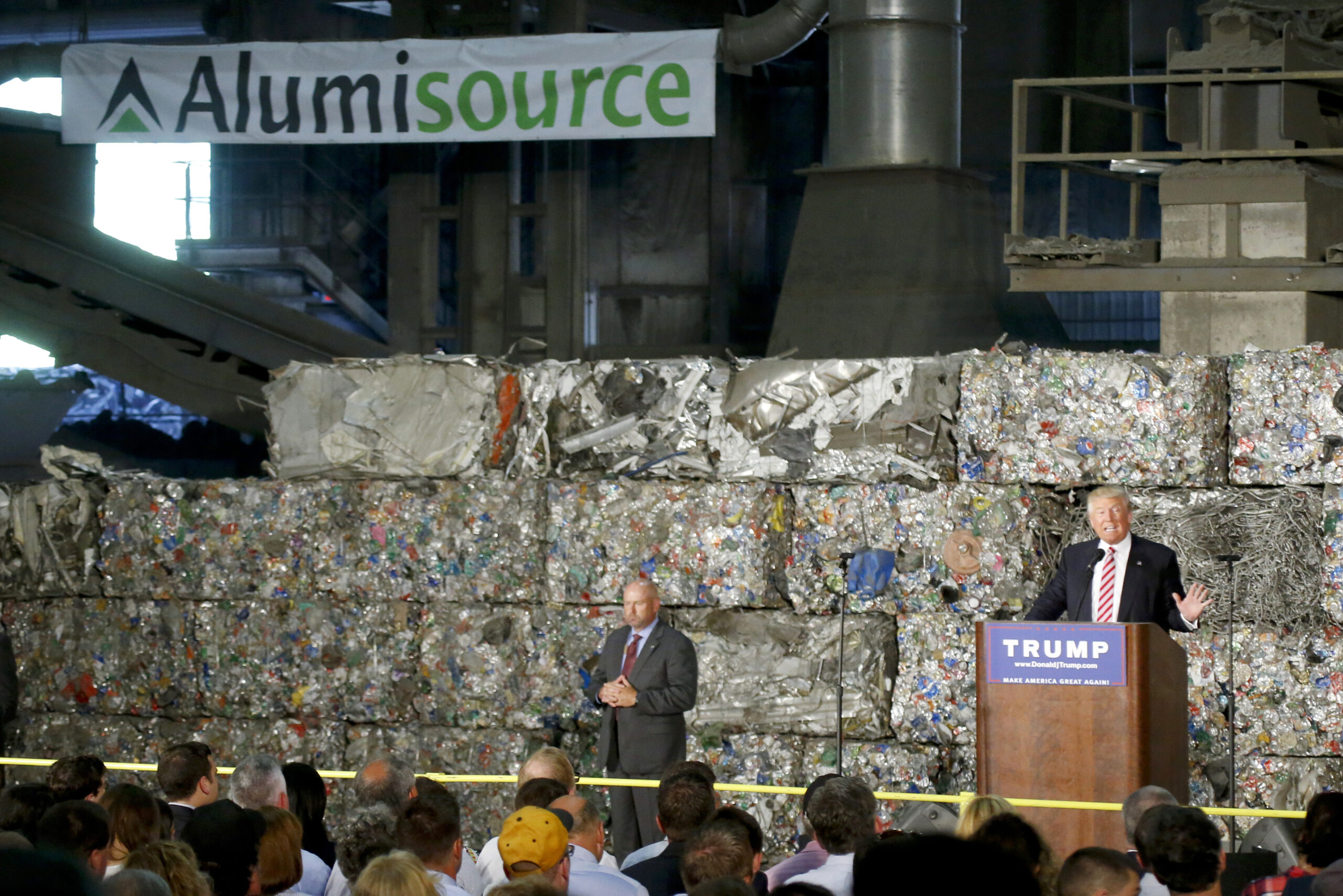
Although Donald Trump has slumped against Hillary Clinton in head-to-head polling ahead of the conventions, he nevertheless continues to hold an advantage over her in voters’ perception of who would manage the economy better.
Recommended Stories



Election experts do not have ready-made explanations for why the would-be Republican nominee is lagging in the polls despite being perceived as better on voters’ top issue. He could very well lose the general election even while getting better ratings on the economy, as Mitt Romney did in 2012.
Through late June, Trump’s polling support dropped under 40 percent, while Clinton’s went above 46 percent in the RealClearPolitics average of polls.
In many of the same polls that showed him dropping versus Clinton, however, Trump still gets higher approval on economic issues.
For instance, an NBC/Wall Street Journal poll conducted in June showed that voters favored Trump when it came to dealing with the economy, 47 percent to Clinton’s 37 percent. In the same poll, respondents said job creation and economic growth were tied for the most important issue.
In an Economist/YouGov poll, Trump cracked 50 percent when respondents were asked who they favored on the economy, while Clinton got only 43 percent.
One obvious explanation for why voters trust Trump on the economy is that he is a businessman, rather than a career politician.
“I think Trump is seen as better on the economy simply because he is a businessman and makes claims about his business expertise and making deals,” said Robert Erikson, a Columbia University political scientist.
Trump’s background, of course, is not in politics but in reality TV and New York real estate, among other diverse business ventures. On the campaign trail he has touted his credentials as a businessman, saying that he will put those skills, and his profit-seeking prowess, to work for the American people.
“Under a Trump presidency, the American worker will finally have a president who will protect them and fight for them,” Trump said last week in his speech on economics in Pennsylvania that mostly focused on trade deals.
But while his business-based pitch might have convinced a lot of potential voters that he would provide good stewardship of the economy, evidence suggests that that won’t translate into electoral victory.
“This phenomenon of candidates being seen as better only on specific issues is not new,” University of Rhode Island political scientist Brian Krueger told the Washington Examiner. Instead, Democrats and Republicans generally “own” certain issue areas. “So Trump can trail in the polls overall but do better than HRC even on the big issue of the economy.”
In fact, in several polls Trump leads Clinton not just on the economy but also on other specific concerns, such as responding to terrorism or setting policy on guns.
Clinton, on the other hand, has the advantage on immigration, foreign policy and others.
But the larger problem Trump faces is that voters may prefer her for reasons beyond her stance on any given policy subject.
In terms of ultimate support, “economic concerns and anxiety about trade deals are taking a backseat to anxiety about Islam, diversity and immigration — at least so far in this election,” Krueger said. “If Trump could pivot and allow some of those with more moderate racial and identity views to feel even ‘just OK’ in his camp, then his advantage on the economy could still emerge as decisive. But as of now he has shown a general inability to firmly pivot.”
One instructive example for Trump would be that of Mitt Romney, who led Obama in multiple issue areas, including the economy, and still lost, despite the fact that the U.S. economy was in significantly worse shape in 2012.
In final polling by Gallup, more than half of voters thought Romney was better on the economy.
But he ultimately lost, conservative political analyst Henry Olsen has argued, because he lost on empathy. Exit polls suggested that voters overwhelmingly thought that Obama cared about them, even though in other ways they preferred Romney.
Asked to explain Trump’s underperformance, however, Olsen demurred. “I have no idea on why this is happening,” he said.
