

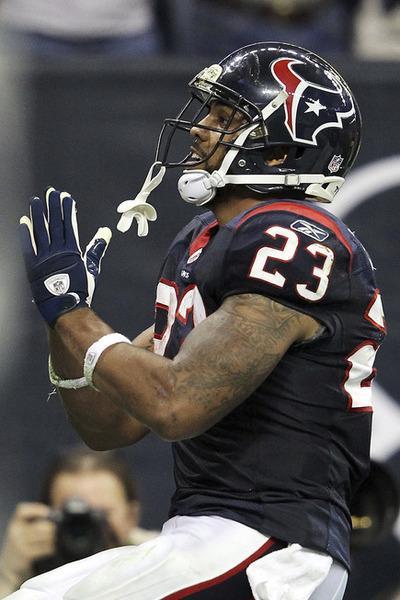
You’re hearing a lot about how the NFL is changing. Offenses are becoming pass-heavy, uptempo, no-huddle and spread. This all may be true, but the results from the NFL wild-card round show that the most basic, old-school axiom still applies: The formula for success in the playoffs is to run the football and stop the run.
Here’s what this weekend’s first three winners accomplished on the ground. The Texans outrushed the Bengals 188-76. The Giants outrushed the Falcons 172-64. Even the supposedly pass-happy Saints outrushed the Lions 167-32.
Recommended Stories


The only game that went against the trend was Denver’s victory over Pittsburgh in which the Steelers outrushed the NFL’s No. 1 rushing team 156-131. Then again, making sense of the success of the Broncos and Tim Tebow is like trying to explain crop circles. So we’ll stick with the other three games.
As it applies to rushing success, there’s more than one way to skin a cat, a Bengal or a Lion. Houston almost exclusively used Arian Foster (24 carries, 153 yards). New York employed a tandem: Brandon Jacobs (14 carries, 92 yards) and Ahmad Bradshaw (14 carries, 63 yards). New Orleans did it by committee: Pierre Thomas (eight carries, 66 yards), Darren Sproles (10 carries, 51 yards) and Chris Ivory (13 carries, 47 yards).
In each of these games, run-heavy drives set the tone. Houston’s first touchdown came on a 59-yard march that featured five Foster runs and one pass. In the New York win, neither team moved the ball until Jacobs bolted for 34 yards in the second quarter to loosen up the Atlanta defense. The Saints’ first touchdown was set up by a 31-yard burst by Thomas.
The Giants’ ability to stop the run was key as well. The Falcons failed on a pair of fourth-down quarterback sneaks.
The one factor that held through all four games was that the home team won. It was the first time that happened in the wild-card round since 2006.
So here are our trends for this year’s playoffs: rushing success, stopping the run and playing at home. Yawn. The more the NFL changes, the more it stays the same.
– Kevin Dunleavy
