

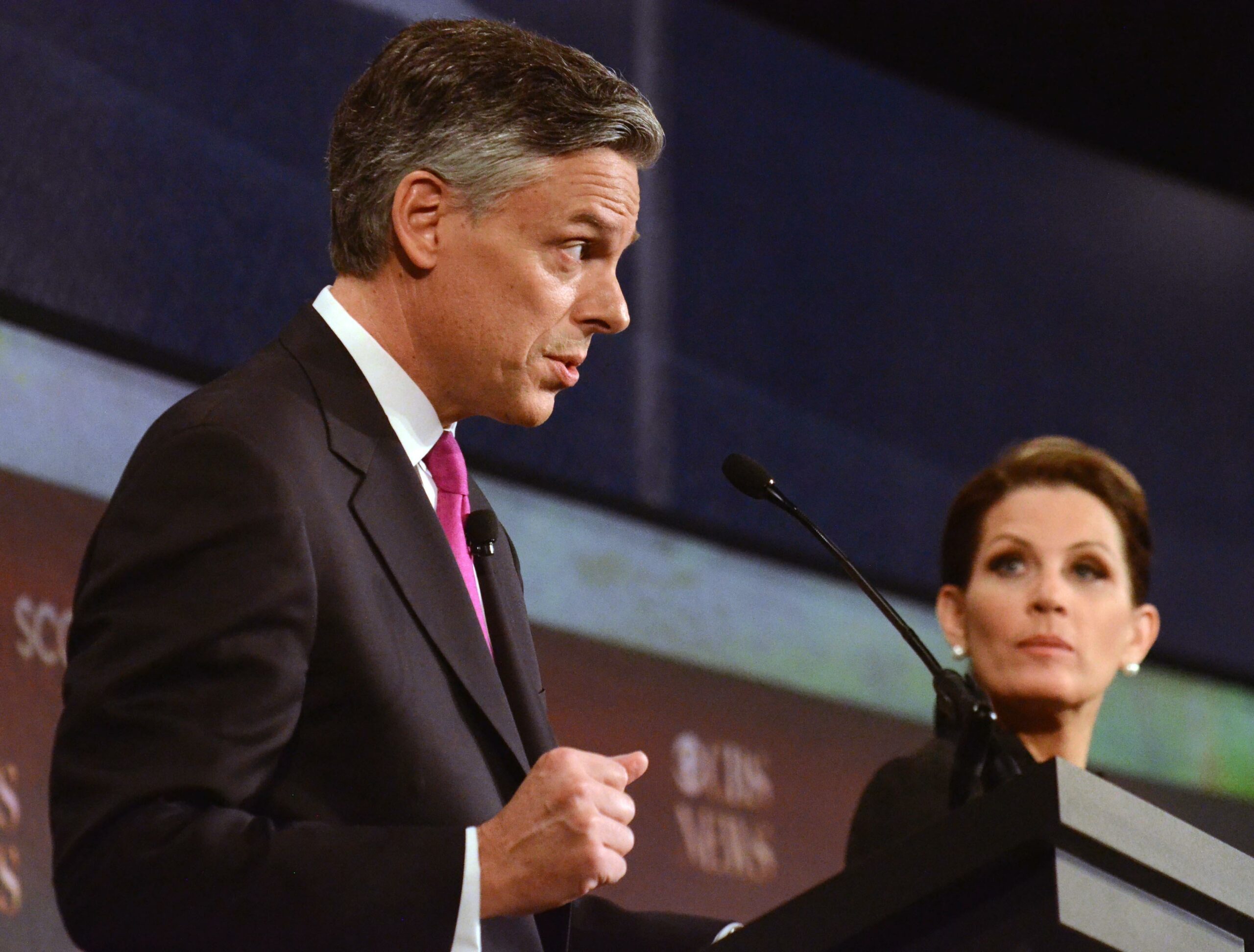
Well, we have finally had a Republican presidential debate on foreign policy, and there were some surprises from the candidates.
Herman Cain came out with more specifics than he has on the few previous occasions when he has been asked questions on foreign policy. The candidate who didn’t seem to know that China is and has been for 47 years a nuclear power told us that there were nine—he resisted the temptation to say 9-9-9—nations with nuclear weapons and that Pakistan was one of them. He called for non-military assistance to the opposition in Iran. “A lot of clarity is missing” in our relationship with Pakistan: well, yes. But most of his responses were conclusory and not studded with revealing detail. He’d have multiple groups making recommendations to him and would consider all the facts and alternatives when making decisions. But he sowed a little confusion. He said he would trust the judgment of military leaders as to what is torture, but it is CIA not military interrogations that have been the subject of controversy, and when asked whether he would limit questioning to the Army Field Manual, as Barack Obama has, he replied that he did not consider waterboarding torture. Overall, I think his performance did not refute any previous impression that he would be over his head in dealing with military and foreign policy issues as president.
Recommended Stories


Newt Gingrich, who has been surging (but not enormously: we’re talking about rising out of single digits) in some recent polls, by contrast was brimming with interesting and provocative replies. Targeting the media as he always does, he had it out with CBS’s Scott Pelley (and I think clearly had the better of it) on whether it is a violation of the rule of law for the president to target a U.S. citizen who has been waging war on the United States. On Iran, he agreed with Romney in supporting military action to block the Iranian regime from obtaining nuclear weapons—probably the headline of the night, since they may be the only candidates likely to be nominated, the Republican nominee may win and a Republican nominee prepared to do what George W. Bush, admittedly at an earlier stage in Iran’s nuclear weapons development, was not willing to do: all that is news. In Tehran if not in Iowa or New Hampshire. But Gingrich added more, advocating “covert and deniable” operations to take out Iranian scientists and, more than once, called for non-military tactics similar to that deployed by Ronald Reagan, Pope John Paul II and Margaret Thatcher to undermine Communist rule in Eastern Europe, to be used against the Iranian regime. Gingrich may have surprised some when, following Rick Perry’s Jacksonian pledge to start every country’s foreign aid budget at zero, said he agreed—and then in the process of explaining his position suggesting that Perry’s position was not as startling a departure in policy as Perry’s Texan rhetoric suggested. Start at zero, Gingrich said, and examine arguments for going higher. Perry, in a later colloquy, suggested he’d do the same for Israel, and that it wouldn’t take much persuading to get him above zero.
Rick Perry came to this debate better prepared than for the first three or four debates he participated in. He made two genuinely funny references to his failure in last week’s debate to remember the third federal department he had proposed to eliminate—he’s done about the best damage control possible on this, and the important part of it is that he is showing that he’s still willing to appear in public and hold his head up after a blunder that, if we had made it, many of us would have hidden out from ever appearing in public again. Making a virtue of necessity, Perry also came across as the uber-Texan, an unmistakable son of Haskell County—and finally told us that he had volunteered to serve in the United States Air Force in 1972. I’m not sure he gets enough credit for this. The draft was over by then: Perry, born in 1951, didn’t have to volunteer as a pilot to avoid the infantry. In addition, the U.S. military was arguably headed toward defeat and deterioration: Perry joined up anyway, and perhaps with a view to moving things in the other direction. Anyway, aside from Ron Paul—whom I assume was conscripted via the doctor draft of the 1950s, though if I’m wrong I would be happy to do so—Perry is the only candidate with service in the United States military.
My view is that Perry nonetheless struck too many false and too few true notes to revive his candidacy. He clearly came in primed to project himself as a Jacksonianially forceful leader. His proposal for zero-based budgeting for foreign aid was clearly poll-driven; any policy maven knows there’s no real money here. His analogy of those who say China will dominate the 21st century with those who said Russia would dominate the world in the 1980s is not quite right: the argument was that the Japanese would, somehow, overtake us while the Cold War with the Soviets would go on forever. Saying China will end up on the ash heap of history is thus a little off key—though not perhaps as off key as Michele Bachmann’s suggestion that because China has no government program for old age pensions, no “AFDC” and no food stamps program, we should follow the same policies.
Mitt Romney continues to demagogue on China, smoothly arguing that we won’t really get in a trade war if we bring a WTO case against their currency manipulation—Jon Huntsman, who I suspect is right on this, say such a case wouldn’t fly—and he was deft in getting in his talking points. “This century must be an American century.” Sounds good to me. We gotta cut the National Endowment for the Humanities and the National Endowment for the Arts because while they’re nice things we can’t afford them. OK, I think we’ll survive that. But he also took some daring stands. He as much as said he’d order military action to prevent Iran from getting nuclear weapons. I think that’s a big deal. George W. Bush didn’t order such action and Barack Obama seems supremely unlikely to do so. It’s a high risk business, as even those of us inclined to agree must admit. But there’s a reasonable chance that a year from today Romney will be president-elect, in a position to order an attack some two months later. I think that’s a big deal and the biggest news of the night. And I would add one thing. In 1979 Iran committed an act of war against us by imprisoning our diplomats—a violation of diplomatic immunity, the first rule of international law, and a justification for going to war under rules understood by all national governments going back at least to the eighteenth century. We chose not to do so and Iran continued to hold our diplomats. But in December 1980 President-elect Ronald Reagan made a careful statement calling the Iranians “barbarians,” and a month later, within moments of his inauguration, the diplomats were released. Reagan had in effect threatened to respond to an act of war with war; the Iranians caved, never mind that Reagan might well have never followed through on that threat. I think that, a year from now, we may look back and say that Romney made such a threat tonight and that the Iranians—well, I don’t know what they’ll do. Maybe they had as much trouble as I did getting a smooth Internet feed from cbsnews.com of the last 30 minutes of the debate, not broadcast as the first 60 minutes was on CBS TV stations.
In contrast, by the way, Romney was careful to say it would be irresponsible to promise to send in troops contrary to Pakistan government officials’ wishes to retrieve a lost nuclear weapon there. Similarly, Rick Santorum, something of a fire breather on foreign policy in the few brief chances he’s had to comment on it in previous Republican debates, said it was necessary to work with and not against Pakistani authorities. His complaints that he does not receive many questions in debates (like Jon Huntsman’s complaint that was in “Siberia”) can get tiresome. I thought both Santorum and Huntsman, and Michele Bachmann as well, had chances to make intellectually serious points and took advantage of them. But I doubt that their responses will move them ahead in the contest. Ron Paul was, as usual, Ron Paul. He seems to have a pretty large claque in Spartanburg.
Bottom line: I see this as reinforcing the recent downward movement for Cain and upward movement for Gingrich in the polls, without any significant damage for Romney and without a significant boost for the others. In any case it was interesting to see more questions than in previous debates on foreign policy, though the questioners didn’t get to Europe until the very end and never got to the Western Hemisphere at all.
