

If a new Washington Post poll is correct, a majority of Republicans now believes the war in Afghanistan is not worth fighting. Fifty-two percent of GOP voters — long the war’s most resolute supporters — have lost faith in the effort, along with 72 percent of Democrats and 66 percent of independents.
Not surprisingly, when Americans don’t think a war is worth it, they want to get out — especially when that war is in its second decade. Recently pollster Scott Rasmussen found that 53 percent of likely voters support an immediate withdrawal of U.S. troops from Afghanistan. That number includes 42 percent of Republicans and strong majorities of everybody else.
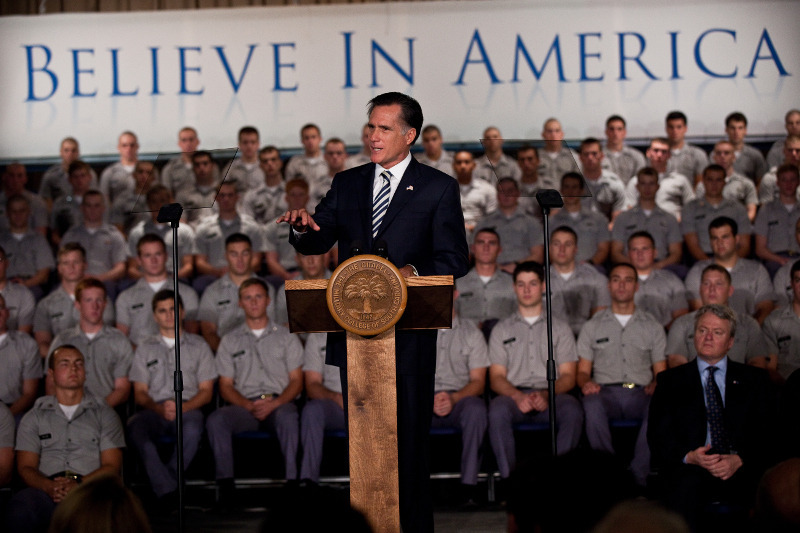
Mitt Romney, the presumptive Republican nominee, has been extraordinarily careful in what he says about Afghanistan. While he has accused Barack Obama of hurrying to the exits, Romney himself has not committed to any particular strategy and has adopted a position that could justify virtually any policy option.
The only thing Romney says he will not do is let politics play any role in Afghan policy. “Governor Romney will never make national-security decisions based on political considerations,” says Romney spokesman Ryan Williams. “The current president has repeatedly ignored his own military commanders to make military decisions based on politics. What will ensure failure in Afghanistan is if President Obama continues to allow his re-election prospects to affect our strategy. Gov. Romney will make decisions on our transition in Afghanistan based upon conditions on the ground and informed by the best advice of our military commanders.”
A President Romney could withdraw all troops immediately or order them to fight for another decade and not violate that commitment.
The question is whether public opinion — the foundation of politics — will push Romney away from the war as the campaign continues. Perhaps the most powerful immediate factor influencing American opinion on Afghanistan is the growing number of attacks on U.S. forces by the Afghan security forces — our so-called “allies” in the war. Last month, CNN reported that one-third of American troops killed in Afghanistan in 2012 have been killed by Afghan security forces. If that keeps up, public opinion on the war will undoubtedly fall even more.
It already seems poised to do so. In the Washington Post poll, respondents were asked, “Considering everything, do you think most Afghans support or oppose what the United States is trying to do in Afghanistan?” Sixty-two percent said most Afghans oppose the U.S.; just 22 percent think most Afghans support U.S. efforts.
The reason Romney has been free to remain noncommittal is that during the primary season, the war has been a relatively low priority for Republican voters. In mid-January, as the Republican primary battle raged, another Washington Post poll asked voters to name the single most important issue in determining their vote for president. Fifty-one percent said the economy and jobs. One percent said Afghanistan.
But the issue has taken on new prominence with the killings of U.S. soldiers by Afghan security forces, the rampage in which a U.S. Army sergeant killed 16 Afghans, and, in recent days, a new round of Taliban attacks across Afghanistan. The war isn’t going away and could at any moment finally intrude on the campaign.
Only two Republican candidates wanted to get out of Afghanistan. One, Ron Paul, ran a movement more than a campaign. The other, Jon Huntsman, went nowhere. The most effective route for the rest of the candidates was to sound a bit more hawkish than Obama without committing to anything.
In his March poll, Rasmussen asked voters if they believe the war in Afghanistan is a vital national interest of the United States. Just 39 percent of Republicans said yes, along with 27 percent of Democrats and 22 percent of others. While Romney will no doubt continue to pledge not to allow “political considerations” to influence his decision-making on Afghanistan, public opinion certainly qualifies as a “political consideration,” and if current opinion trends continue, Romney may well be forced to take a more definite position.
Romney was a strong supporter of the Iraq War for many years. But now he says that if we had known that there were no weapons of mass destruction in Iraq, then “obviously we would not have gone in.” Romney allowed conditions on the ground to change his view. Will he do so again when it comes to the war in Afghanistan?
Byron York, The Examiner’s chief political correspondent, can be contacted at [email protected]. His column appears on Tuesday and Friday, and his stories and blogposts appear on washingtonexaminer.com.
