
PARSING THE POLLS: Final Iowa edition

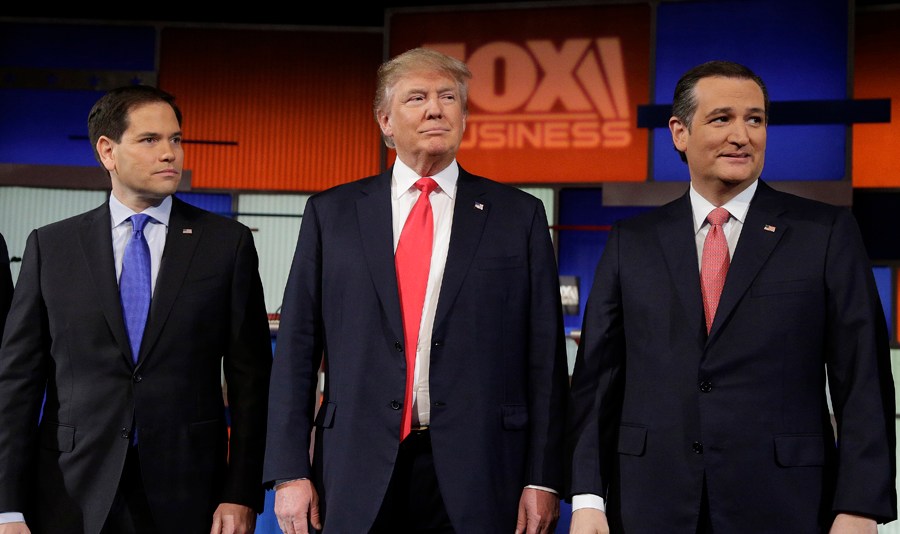
COUNCIL BLUFFS — Donald Trump is the legitimate front-runner in Iowa polls, with a lead in most polls beyond any reasonable error or any small-to-moderate turnout effects.

But two last-minute polls — outliers from lesser-known pollsters — show Trump basically tied with Cruz, and Rubio surging.

The bottom line after reading all the polls is this: If statewide turnout is high (above 150,000 Republicans), expect Trump’s poll lead to hold; If it’s low (below 120,000), Trump’s poll lead evaporates. Also, a Rubio surprise is a real possibility.

The Numbers

The two most recent surveys from major pollsters — Des Moines Register and Quinnipiac — show very similar results: Trump around 30 percent, Cruz 5 to 7 points behind, and Rubio 7 or 8 points behind him.

These are seasoned pollsters with very large samples (602 and 890 likely Republican Caucus-goers, respectively).

Two other last-minute polls — from Opinion Savvy and Emerson — show a much smaller Trump lead: 20 percent-19 percent, and 27 percent-26 percent, respectively. Opinion Savvy used robocalls for landlines and online surveys for mobile phones. These surveys could turn out to be closer to the truth, but anyone leaning solely on them in order to say Trump won’t win is probably engaging in wishful thinking.

The RealClearPolitics average — including these four, and three others — is Trump 28.6 percent, Cruz 23.9 percent, Rubio 16.9 percent.

Why the difference?

Opinion Savvy could be so different from the others (Trump 9 points below the others and Rubio 4 or 5 points higher) because robocalls are less reliable. Likely contributors to the difference include their tighter screen on likely voters, and the later date of their calls.

Opinion Savvy, pulling from a list of registered voters, asked voters if they would caucus. If voters answered maybe or no, they were excluded. The second screen was for them to describe their polling place: is it a church, a school, or something else. If they said they didn’t know, they were excluded.

Dramatically restricting the sample to only the most informed, most likely caucus goers is probably what brought Trump down to 20 percent in Opinion Savvy’s poll. Quinnipiac, for instance, showed Trump’s lead dependent on first-time caucus-goers.

A more restrictive screen doesn’t mean a more correct screen, though. Trump’s whole appeal is reaching out to voters who were otherwise turned off from politics. If he is who he says he is, he’ll get these people out.

Momentum?

Momentum is an impossibly vague term in election analysis, but it’s not always meaningless. In 2012, for instance, the late polls showed Santorum surging, but still in third place. In the final 48 hours, he seemed to overtake Gingrich and tie with Romney for first. That was momentum.

What did it mean? In that case it meant that voters were looking for a conservative anti-Romney. They had earlier supported Michelle Bachman, but were happy to switch to Herman Cain, and then willing to switch to Gingrich. But once Santorum appeared in the polls as a very viable alternative to Romney, the anti-Romney vote landed on him. It was momentum because his support begat more support.

Trend lines this year are harder to discern. Cruz has dropped since mid-January highs, but we lack the data to tell whether that’s a fade, or simply that about 5 percent of Iowans were pried away by birther attacks and the Goldman Sachs loan.

You could argue Rubio is climbing, but it is very subtle. For instance, in the Q polls going back to October, his numbers are 13 percent, 13 percent, 14 percent, 15 percent, 13 percent, 17 percent — a soft upward trajectory.

Over a shorter timeframe (more analogous to Santorum’s surge) Rubio has gone from 10.8 percent in the RCP average 10 days ago to 16.9 percent today. That 16.9 percent includes his record-high 19 percent from Opinion Savvy and 22 percent from Emerson, with its very small sample size. If you exclude those, Rubio is at 15.4 percent.

Opinion Savvy showed Rubio trailing Cruz on Friday, but overtaking him on Saturday. This could have been thanks to Cruz’s unpopular “VOTING VIOLATION” mailer that posed as an official document.

So if Rubio does have “momentum,” where would any late gains come from? One possibility is a continued Cruz fall. Quinnipiac shows that of current Cruz supporters, the plurality (29 percent) choose Rubio as a second choice, while 16 percent choose Trump.

A more likely source of new support for Cruz or Rubio would be the supporters of minor candidates.

Late changers

None of these Iowa poll headline numbers adequately reflect how fluid and changeable the Iowa voters are.

If you talk to voters, and if you look deeper into the polls, you see the flexibility. As I wrote after the DMR poll, about 13 percent of their sample was voters weakly attached to minor candidates. Those voters, in many precincts, will be convinced to join a stronger candidate — Trump, Cruz, or Rubio.

Similar voters went Santorum in 2012, and Obama in 2008 (where the Democratic caucus rules force supporters of a minor candidate to choose sides).

What do the other polls tell us about who might move where at the last minute?

When asked whom they would definitely not support, only 9 percent say Rubio (only Carson is lower), and the anti-Rubio group is weighted towards men with no college degrees and lower-income workers — Trump supporters. The anti-Cruz crew is higher, at 15 percent, and it’s weighted towards higher income, more moderate voters.

The more moderate voters are divided between Trump and the minor candidates like Bush and Christie. These are prime Rubio targets.

Bottom line

There are six permuations of the relative position of the Top 3. None of them would be shocking — meaning I put the least-likely one (Rubio, Cruz, Trump) above 5 percent.

Timothy P. Carney, The Washington Examiner’s senior political columnist, can be contacted at [email protected]. His column appears Tuesday and Thursday nights on washingtonexaminer.com.

Related Content