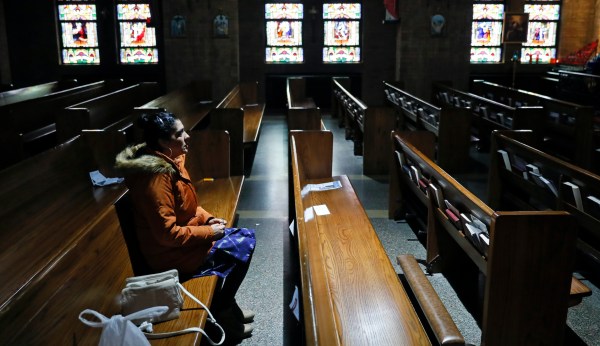
Korean-Americans own hundreds of small businesses throughout the region. It?s a close-knit community dominated by family, job, school and church. But that?s beginning to change, as political awareness is opening new doors.
Stroll into the crowded Lotte Plaza supermarket some weekend, after you?ve fought for a parking space, and you?ve crossed into another country ? although you may not be sure which one.
In the store, located where Route 40 meets Route 29 in Ellicott City, the signs are both in the geometric Korean script called Hangul and in English. The produce is fresher, cheaper and more varied than in most standard grocery stores, and it is stocked mainly by Spanish-speaking Latinos. The packaged goods have limited English subtitles, the cashiers can are fluent in Korean and English, cash or credit, and the customers are not just Asian. There is a smattering of European-Americans as well. Take your pick of woks and rice cookers, or saunter next door to a food court that offers a mélange of Asian dishes.
What you?ve entered is the commercial outcropping of the third largest Korean-American community in the United States, behind Los Angeles and New York. Down the pike in Catonsville and Woodlawn, there are similar outcroppings at H-Mart and Seoul Plaza.
Phenomenal growth
As many as 250,000 Korean-Americans live in a band that stretches from Timonium through Silver Spring to Arlington, Va.
“That growth has been phenomenal,” mainly over the past 25 years and initially impelled by economic and political woes in their homeland, said Larry Shinagawa, head of Asian-American studies at the University of Maryland, College Park.
There are more than 20,000 Korean-Americans in the Baltimore region.
Few Marylanders have not had at least superficial contact with Korean-Americans in the hundreds of cleaners, convenience stores and carryouts run by first-generation immigrants.
But members of the Korean community, which is often insular and self-contained, tend to keep their heads down ? and concentrate on a few central concerns: family, job, school and church. Only recently have they become more visible in politics and public life.
They are served by a host of their own institutions, with the church at the core. There are more than 75 churches in the Baltimore region, providing a wide array of social services for the most Christianized of Asian immigrants after the Filipinos. Two Korean-language daily newspapers, The Korea Times and Korean Daily, have bureaus in Ellicott City, producing copy for regional editions. There are associations for grocers, cleaners and mechanics and clubs for tennis and golf. A phone book runs more than 800 pages offering a full range of professional services and goods in Korean and English.
Bread on the table
Kap Yung Park, 49, heads the Korean-American Grocers and Licensed Beverage Association of Maryland. KAGRO has about 950 members, almost all mom-and-pop shops and liquor stores, many based in Baltimore City.
Park came with his parents and siblings from South Korea 25 years ago, knowing some English, working first at a 7-Eleven, attending Anne Arundel Community College and then starting his own store in Curtis Bay, which he stillopens at 6 a.m. Park lives in Pasadena and attends a Methodist church in Anne Arundel County.
“Ever since I arrived here, my life has been nothing but adventure day after day, month after month,” Park said, sitting in the meeting room of KAGRO headquarters on North Avenue in the city. “I never had a negative thought concerning my parents? decision to come here.”
As new immigrants, “the first thing we focus on is food on the table,” he said.
Operating a small business in “high-risk” and “underserved” neighborhoods is a reliable way for immigrants with poor language skills to put bread on the table. “The competition is too strong” in the suburbs, Park said.
Dae Yung Kim, a University of Maryland sociologist who studies the Korean community, said many of the shop owners “had been professionals in Korea,” but when they came to the states, “they were already aware what kinds of jobs” they could get, since “they lacked English and their credentials were not transferable.” The fastest way up the economic ladder in the U.S. is a small business, Kim said.
Like many a fledgling American entrepreneur, Park financed the opening of his first store by turning to “friends and family,” primarily his brothers and sisters. Others “work for a couple of years and save as much money as possible,” Kim said. They often sell their businesses to other Koreans and finance the sale themselves.
Maryland KAGRO, part of a national organization, was founded in 1995 to help Korean-American business owners navigate the American system and resolve communication problems with customers, law enforcement, government employees and suppliers. The $50-a-year dues are voluntary, but only the 300 members who pay are entitled to courses on the confusing array of rules on selling liquor, cigarettes and food and on keeping business and tax records.
KAGRO of Maryland produces an annual calendar with a practical focus. Each month, it notes the days when welfare and Social Security payments arrive, when food-stamp cards are replenished, and when sales tax, withholding taxes and liquor records are due.
Park and the other officers are all volunteers.
One of the contradictions for Korean business owners is that they put in 12- and 14-hour days, and some work second and third jobs all for the sake of their children. “We want to provide the best thing for our kids” Park said, but then “we hardly have time to communicate with the kids.”
Brand-name schools
Ki Hahm, president of the Korean American Community Association of Howard County, is a quiet, older man who also typifies the Korean business owner. He ran a cleaners in Towson and a food store in the city, but for 30 years he has lived in Ellicott City and sent all three of his children to Centennial High School, once considered the county?s premiere school but now second to Clarksville?s River Hill High School. Korean parents have been moving into the River Hill district.
Hahm is not bashful to brag about his children ? one getting a University of Chicago MBA, another a Columbia University MBA. His third child went to the University of Maryland, College Park and is a teacher.
“Bread and milk is our first priority, but the second thing is education,” businessman Park said. “They just move where the education system is relatively better than others.”
Once they get in those good schools, there is a lot of pressure on Korean children to perform.
“The expectations from their parents is that they have to have the highest score,” said Sue Song, former president of the group Hahm now heads. “They have to go to a brand-name university. It doesn?t matter that they?re not happy.” Go to a prestigious school, “and then be happy after that” is the attitude, she said.
“Every year theKorean papers have huge sections that talk about the ranking of schools,” said Shinagawa, with emphasis on the Top 50 universities. College Park is now among them.
Sociologist Kim said “the popular narrative” is that Koreans have this Confucian culture that values education.
“But if you probe more deeply, their parents were middle class, many of them college-educated,” Kim said. “These are well-educated people who happen to be in small business.”
Church ? cultural hub
The one place that family and community get together is in one of the 75 area churches, mostly Protestant ? Presbyterian, Methodist, Baptist, gospel and nondenominational. There is a Korean-language Catholic Church in Woodlawn. While perhaps a third of native Koreans in the heavily Buddhist country have become Christian in the last century, it is estimated that as many as 75 percent of Korean-Americans follow the faith.
Bethel Korean Presbyterian on St. John?s Lane in Ellicott City has the largest congregation, with as many as 2,000 worshippers, five pastors for the Korean ministry and three for the English ministry, which is mainly for the second generation.
“The church tends to be the cultural hub of immigrant Koreans,” said associate pastor Walter Lee, head of the smaller English ministry team serving about 200 congregants. “It?s a place where they can meet other Koreans” and that?s “a role that the church does embrace.”
Lee said Bethel has “so many different ministries” there is something going on all the time ? outreach programs, evangelization, life-stage groups, a few classes where they teach Korean.
“The services of the Korean church go well beyond the spiritual dimension,” he said.
The church offers communications and connections, KAGRO?s Park said. “It?s not pure religious reasons but more social reasons.”
“Many Koreans who immigrated tended to be Christian,” sociologist Kim said. But “many non-Christians have converted to Christianity” for the business networking and social services.
Pastor Lee said the role of English ministry is different from that for first-generation immigrants.
“A lot of the English ministry [worshipers] have grown up in the church,” Lee said. “The emphasis is a lot less on our identity as Korean-Americans and more on our role as Christians,” but there is also “a sense of familiarity and identification with second-generation Korean-Americans.”
“The second generation is attending the Korean church in very high numbers,” sociologist Kim said. It is “helping them retain the religion but not the culture.”
A political awakening
“The Korean community is really coming of age politically,” said David Lee, executive director of the Governor?s Commission on Asian Pacific Affairs.
For the past three years, Korean-Americans have put on a noon reception with native food and cultural performances for members of the legislature. People like Sue Song have tried to bring the needs of Korean-Americans to the attention of local officials ? problems with youth, with isolated seniors and with domestic violence against women.
“In our culture, we?re still very shy to let our elected officials know,” Song said. Her group has also set up a hotline in Korean that residents can call when trouble strikes.
A 2005 consultant report for Howard County Citizen Services said: “There is a common perception that the Korean in Howard County tends to be relatively successful and affluent with no major problems. On the contrary, there are small groups of low-income Koreans whose critical needs are frequently overlooked. This is one of the reasons why Korean community leaders have gone out of their way to organize and establish several support institutions, although the majority of Koreans still will turn to family and friends first before asking a stranger for assistance.”
But Lee said “what really forced their hand” was an incident last year, when then-Comptroller William Donald Schaefer engaged in a rant associating Korean immigrants with missile attacks on the United States.
Representatives of various Korean groups met with Schaefer, who refused to apologize, despite his own long-term association with the Korean business community and his establishment of a sister-state relationship with a Korean province when he was governor.
“Koreans, compared [with] other ethnic groups, tend to organize themselves more,” Lee said. But on the other hand, “the tendency is to be quiet and not raise a ruckus.”
While Koreans as a whole are not a large or powerful voting block, the business community has been taking a more prominent role in government and politics. After attending a track meet that KAGRO sponsored with the Police Athletic League, Mayor Sheila Dixon said, “They?ve gotten a lot more active.” The track meet was part of an effort by the Korean merchants to engage with members of the black community who are their urban customers.
This year?s KAGRO calendar in January and October features two different photos of then-Mayor Martin O?Malley, one at a scholarship-award event and the other at a fundraiser the group hosted for him.
“The small businesses are very well organized,” sociologist Kim said. “They are interested in defending their small-business interests.”
Local governments have taken a strong interest in them. Dixon has continued a Korean-American liaison in her office and the police have a Korean officer handling community relations. Anne Arundel County has a contact person for Koreans as well.
The importance of Korean-Americans and Latinos in Howard County is signified by County ExecutiveKen Ulman?s greeting in Patuxent Publishing?s “Official Guide to Howard County.” The headline says: “Welcome! Bien venidos!” and a greeting in Hangul.
BY THE NUMBERS
Korean-American population estimates, 2000 census
>> Anne Arundel: 3,603
>> Baltimore County: 5,249
>> Baltimore City: 1,826
>> Carroll: 267
>> Harford: 801
>> Howard: 6,188
>> Montgomery: 15,130
>> Prince George?s: 6,198
>> Maryland?s Asian population: 260,455 (of that total, 45 percent live in Montgomery County, 12 percent in Prince George?s County and 11 percent each in Howard and Baltimore counties.