

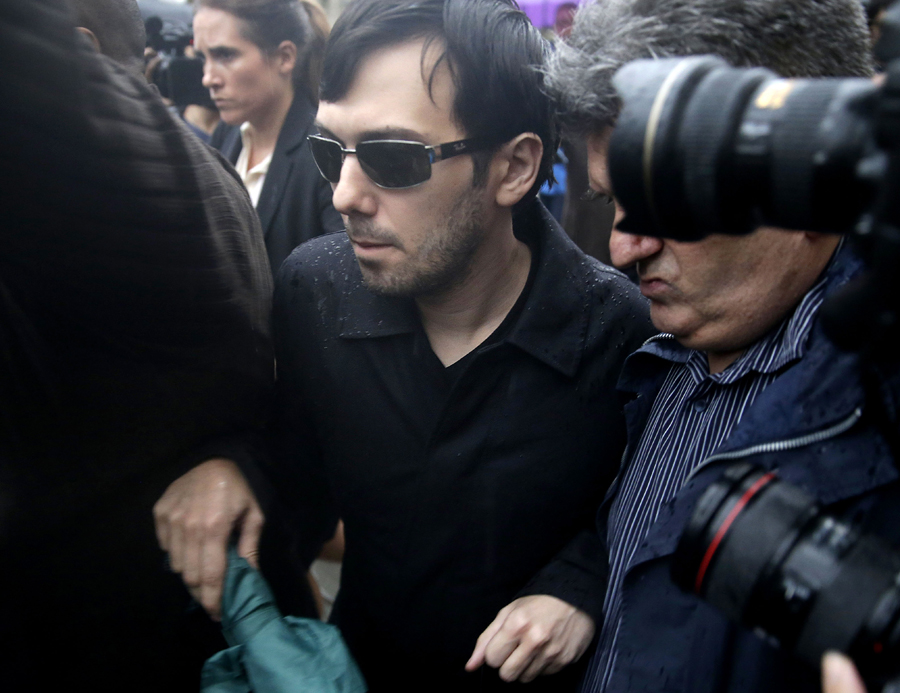
Internal documents revealed how two drug makers purposefully raised prices in an attempt to wring as much money as possible from older generic drugs, and weren’t afraid of any backlash in their quest for more profit.
“Very good. Nice work as usual. $1 [billion] here we come,” read an email from former Turing Pharmaceuticals CEO Martin Shkreli to the company’s board chairman.
Real journalism.Trusted by millions.
Unlimited access to in-depth reporting, expert analysis, and the stories that shape our country.
Already a member? Log in
Shkreli wrote the email in August, soon after the company acquired the decades-old generic drug Daraprim. Turing raised the price of that drug from $13.50 a pill to $750, drawing outrage from both political parties. Since then, Shkreli has faced federal securities fraud charges stemming from prior business dealings.
The documents, released Tuesday by the Democratic staff on the House Oversight Committee, detail price hikes for Turing and Valeant Pharmaceuticals, which jacked up the price of two heart medications. Shkreli and Valeant’s interim CEO Howard Schiller were expected to attend a Thursday House hearing on high prices.
The documents, detailed in a memo from the committee, imply that Shkreli and Turing knew that the price hike for Daraprim, used by AIDS patients susceptible to a parasite because of a weak immune system, would spark a backlash.
But the company didn’t believe it would be major because of the low patient population that uses Daraprim to treat the condition toxoplasmosis, according to a memo from the Democrats.
“Many feel the number of toxoplasmosis patients is too small to generate a significant lobbying effort were the cost of therapy to become an issue,” according to a July 2015 company presentation.
Documents detailed in the Democrats’ memo also seek to puncture Shkreli’s defense that people who needed access to Daraprim would receive it. One such e-mail back in August from Walgreen’s said that two patients are having difficulty paying for Daraprim. One patient had a co-pay of $6,000.
“She is not a Medicare Part D but has a federal funded insurance plan so wouldn’t quali[f]y for co-pay assistance or be covered under whatever Medicare Part D plan you are working on right now with Turing,” the email said.
Meanwhile, Valeant is in hot water for jacking up the prices of the heart drugs Ispurel by 525 percent and Nitropress 212 percent almost overnight. The committee staff concluded in a separate memo that profits were the main objective for Valeant, as the two heart drugs didn’t have much competition on the generic marketplace.
“Although Valeant officials anticipated that both drugs would eventually face competition from generic manufacturers, the documents obtained by the committee show that they sought to exploit this temporary monopoly by increasing prices dramatically to extremely high levels very quickly,” the memo said.
Neither Turing nor Valeant could be reached for comment.
Turing and Valeant aren’t the only drug makers to face congressional scrutiny. An earlier Senate investigation into Gilead Sciences’ hepatitis C cure Sovaldi concluded that profit was a big motivator for the $1,000-a-pill price tag.
