
“Attempts at humor usually fall flat.” This concise admonition from the official guide for lawyers arguing before the Supreme Court makes clear that jokes are not the prescribed oratorical device for winning cases. This guidance, however, does not extend to the nine justices, who quite liberally inject levity from the bench. In fact, in the 70 cases heard by the Court during the 2007-08 term, the notation “(Laughter.)” appears 187 times in official Court transcripts. Justice Antonin Scalia: “I wish you had said that in your brief because we could have saved ourselves a lot of reading. (Laughter.)”
The justices are not using the oral arguments as auditions for a guest appearance on David Letterman. Their humor is generally dry and appropriate for the high-intensity atmosphere of the nation’s highest court. A frequent target is the legal profession. Yes, the justices of the Supreme Court tell lawyer jokes! Justice Anthony Kennedy: “There are all kinds of nuts who could get 90 percent on the bar exam. (Laughter.)” Justice Scalia: “Cannot communicate coherently? I sometimes-I sometimes think that the lawyers cannot communicate coherently. (Laughter.)”
Recommended Stories


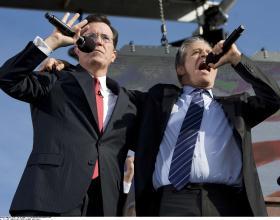
Several times this term the Court heard cases involving politics. A subject that every Supreme Court justice knows as well as a late-night comic will lend itself to wry observations.
Chief Justice John Roberts: Libertarians have a lot more rules than the other parties. (Laughter.)
Or:
Mr. McKenna: Well, the example of Senator Lieberman comes to mind, where he said I really prefer the Democrats and I’m running as an independent. (Laughter.)
Justice Souter: There’s always one.
That last is a rare instance of a lawyer, contrary to the Court’s strong suggestion, using humor to support a point-generally only when a lawyer is engaged by a justice who opens the door for a witty response. “The unheralded role of the oral advocate is to play straight man for the justice,” observes recently departed Solicitor General Paul Clement, who has argued 49 cases before the court. He says a lawyer can’t go wrong by keeping humor out of the oral argument and advises against it for any lawyer making his or her first appearance before the Court.
Often the justices tell “jokes” that few outside the courtroom can appreciate: inside baseball variety observations that make for comic relief for a very select audience. Justice Souter: “As a dissenter in Carbone, I naturally do not find that the worst answer you could give. (Laughter.)” Justice Samuel Alito: “Well, as a dissenter in United Haulers, I also don’t think it’s a good distinction. (Laughter.)”
No lawyer wants to hear a barb pointed at him (or fail to laugh at the jokes of a justice weighing his argument), yet multiple times throughout the term, justices did just that. It is unlikely that any law school moot court prepares lawyers for this kind of barrage:
Or:
Or:
There is no question that Scalia outshines the rest in courtroom jocularity. “That is who he is. He’s not trying to perform,” says former Scalia clerk and George Washington University law professor John Duffy. “He knows that in order to engage people and to be understood sometimes humor makes the point clearly. I learned from him that there is power in the way you convey thoughts.”
Scalia’s humor tends to come out during the extended questioning of a lawyer. While it may be difficult to predict the timing of his humor, there are certain issues sure to draw his ire in a way that only he can express.
I don’t think Congress had the slightest idea. (Laughter.)
Do you think we should trust our incumbent senators and representatives to level the playing field for us? (Laughter.)
What if some-one candidate is more eloquent than the other one? You make him talk with pebbles in his mouth or what? (Laughter.)
Are there any psychiatric studies that show how accurate psychiatric studies are? (Laughter.)
It would be folly to suggest that Scalia is not serious about his work. It’s just that humor is a part of his being, and it clearly comes across in the courtroom. “It’s [a part of] life and he wants to enjoy life. He enjoys his job and takes pleasure in what he does,” says Duffy. Clement, who also clerked for Scalia, says that when “you interact with Justice Scalia in any format-as a clerk, at a cocktail party, or speaking extemporaneously to student groups-he’s somebody who has a good sense of humor and can tell a good joke.”
Scalia is not the Court’s only jester; other justices toss out their own droll perspectives on certain matters. Clement particularly cites Justice Breyer’s use of humorous or even fantastical hypothetical examples to make his point, though sometimes Breyer himself loses track of where he’s going:
And:
Only one time during the past term did Justice Ruth Bader Ginsburg say anything that produced (Laughter.). She firmly maintains a no-nonsense approach to asking questions. Justice Clarence Thomas said nothing humorous during the term because he said nothing at all during the time. Despite his notorious aversion to asking questions during oral arguments, he is often seen actively engaged in side discussions with Justice Breyer, who sits to his right. And sometimes they can be seen sharing a hearty albeit muted laugh. Those who know Thomas say his personality shines through when he is out of the public eye. “He has a rather rich sense of humor. And often uses it at his own expense,” says former Thomas clerk and Kansas University professor Stephen McAllister. “He has a remarkably deep, almost belly laugh. It is the kind of laugh that roars across the room.”
It is fair to say that the justices probably don’t enter the courtroom with the express purpose of cracking jokes. But it does seem that Justice John Paul Stevens had his final question planned for the end of an argument that included considerable discussion of a decision the Court made in 1990.
Mr. Stewart: The government could not have been better represented, Your Honor. (Laughter.)
Chief Justice Roberts: It is hard to understand how they could have lost the case. (Laughter.)
The reason for all of that laughter? Roberts was the government lawyer who argued and lost that case 18 years ago.
Lee Ross is the Supreme Court producer for Fox News.