

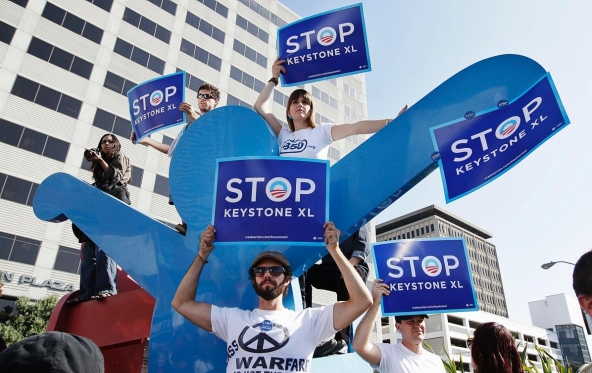
“The score is Job-Killers, two; American workers, zero. We are completely and totally disappointed. This is politics at its worst,” Laborers International Union of North America President Terry O’Sullivan said last week following President Obama’s decision to require more environmental study of the Keystone XL pipeline.
Unions weren’t the only ones roundly criticizing Obama’s transparent cave-in to environmental activists. The Washington Post, the Wall Street Journal, the Chicago Tribune, the Houston Chronicle and USA Today all condemned the decision too.
Only the New York Times sided with Obama, writing that he “made the right call” by not giving in to a timetable that was “rushed and arbitrary.”
Rushed and arbitrary? The State Department first received the application from TransCanada to build the 1,700-mile Keystone XL pipeline in September of 2008. Since that time, the department has conducted 20 scoping meetings, held nine field hearings, reviewed 1,800 comments, and produced a nine-volume, 1,000-page Environmental Impact Study.
All this took place over the span of three years. How much more time does the New York Times think Obama needs to study this thing?
Republicans were right to force Obama’s hand on the pipeline. American consumers have waited long enough for the Canadian oil it will bring to our refineries and the jobs it will bring to our construction industry.
But they are also missing a larger opportunity to highlight one of the biggest impediments to economic growth in this country: the National Environmental Policy Act.
Signed into law by President Nixon in 1970, NEPA requires all federal agencies to conduct a detailed analysis every time they make any decision that could have an impact on the environment.
And if a federal agency (like the State Department in the case of Keystone) fails to follow any step in the process precisely according to regulations, NEPA empowers anyone to sue in federal court to block that agency action.
Thanks to this citizen-suit provision, environmental groups commonly refer to NEPA as the Magna Carta of environmental law. Unfortunately, unlike the real Magna Carta, NEPA has become a major impediment to economic growth.
For federally funded highway projects, the time required to go through the NEPA process has grown steadily. In the 1970s, it took an average of 2.2 years to complete a an EIS (like the one already completed for Keystone). By 2001, that had doubled to 4.4 years. And in 2010 it was almost seven years.
The United States Chamber of Commerce last year studied 351 privately funded energy infrastructure projects (like coal plants, wind farms or power lines) that were either delayed or canceled because of permitting problems, the vast majority of which came from NEPA.
According to the chamber, the delay or cancellation of these projects cost the U.S. economy $577 billion in direct investment and more than 1.9 million jobs.
Environmental activists have become adept at using the law to fight other projects too, like a supercomputer lab in Berkeley, Calif., light rail in Honolulu, and a water pipeline in Colorado.
“NEPA has become a tool activists use to fight projects,” Brigham McCown, former acting administrator of the Pipeline and Hazardous Materials Safety Administration, tells The Washington Examiner. “It is like a filibuster. It allows one group to hold the process hostage.”
McCown worked at the Department of Transportation when activists used NEPA to force one of the largest environmental reviews in history before the North American Free Trade Agreement was implemented. The dispute went all the way to the Supreme Court (the plaintiffs are still fighting DOT over NAFTA today on other grounds).
Federal agencies should consider the environmental impacts of their decisions. But the current NEPA framework makes it too easy for activists to shut down or delay any economic activity they find objectionable. Republicans should take Keystone as an opportunity to force major NEPA reforms that will restore some equity to the process.
