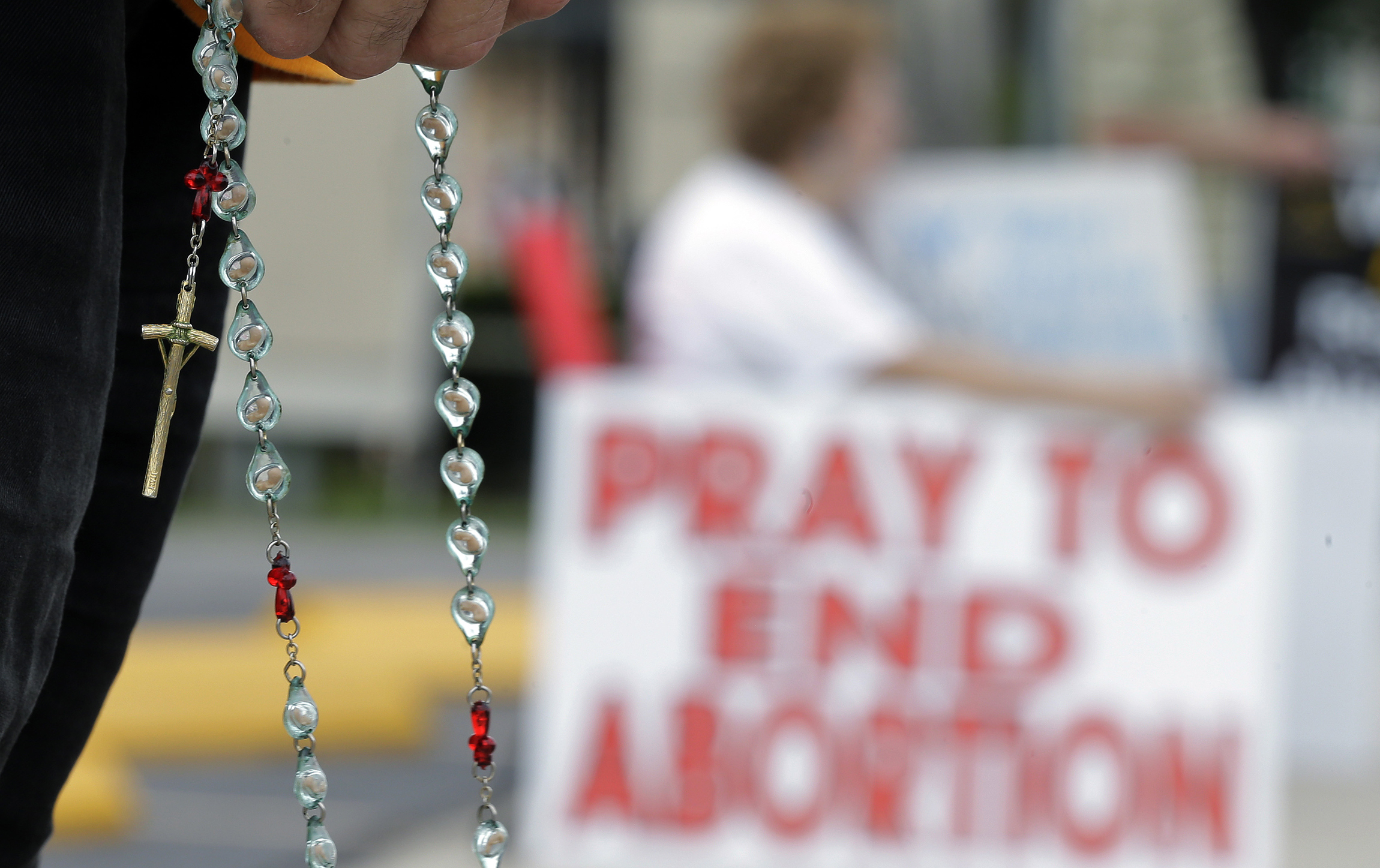
Religion is keeping abortion legal

The annual parade of pro-lifers is a beautiful spectacle to behold, and from 1974 to today they have come and walked, in the tens of thousands, mostly female, mostly young, from the Mall to the Supreme Court building, despite snowstorms and bone-chilling winds.

But what does the movement seeking to save millions of babies from the dismemberment of the suction machine, or the acidy incineration of saline injection, make most people think of?

“It’s a religious thing.” “It’s Catholics and evangelicals, plus a few Hasidic Jews and Muslims.”

Abortion, the blood-drenched safety valve of the sixties’ sexual revolution, is the great moral shame of our time. We have had world wars, and systematic genocides based on religion, ethnicity and class. But it is a chillingly different brand of evil to kill a child within the womb — the most innocent and defenseless among us — in the private comfort of a doctor’s office and under the protection of law within a free country.

Not all that many decades ago it was self-evident to the vast majority of Americans — the agnostic, the lukewarm, elected officials in both parties — that abortion was an unspeakable crime. The abortion lobby’s bete noire wasn’t the rosary but the stethoscope; abortion’s most dedicated opposing force was once the American Medical Association.

The AMA in 1859 unanimously condemned “the procuring of abortion, at every period of gestation, except as necessary for preserving the life of either mother or child … and requests the zealous cooperation of the various state medical societies in pressing this subject upon the legislatures of the respective states.” Nine decades later the AMA signed on to the World Medical Association’s Declaration of Geneva, pledging to “maintain the utmost respect for human life, from the time of conception … A doctor must always bear in mind the importance of preserving human life from the time of conception until death.”

Before the sixties, papal encyclicals weren’t what you turned to for arguments against abortion; the Hippocratic Oath was.

If Trump does what he promised, Roe may well be overturned within the next decade. After that happens the issue of abortion will dominate state politics for years, and right now the public is not nearly receptive enough to the powerful moral case against abortion. People simply don’t see it as the objective evil it is. They see it largely as a faith issue, and that doesn’t help win over the secular.

For one thing, they see moral schizophrenia in the Catholic Church: hundreds of parishes have built shrines to the unborn, yet the Church has granted full funerals (contrary to canon law) and no public chastisement to the likes of Sen. Ted Kennedy and Supreme Court Justice William Brennan.

In Kennedy’s case, Cardinal Sean O’Malley said, “We will not change hearts by turning away from people in their time of need and when they are experiencing grief and loss.” The Church did turn away from murderous mobster John Gotti’s family in their grief, however, forbidding a Requiem Mass, and very rightly so.

If people are to be convinced, they have to witness consistency in the Church’s treatment of Catholics who take innocent human life.

Although he eventually became a Catholic, the former abortionist Dr. Bernard Nathanson had his mind, as well as his heart, changed by science, not faith; the new technology of ultrasound allowed him to view abortion as it was happening. For many years, as an unashamed atheist, he was one of the most prominent and effective activists against abortion in America. His films “The Silent Scream” and “Eclipse of Reason” fought abortion by showing abortions.

One of the most eloquent polemicists in the movement against abortion today is Kristine Kruszelnicki, the atheist president of Pro-Life Humanists. Too many pro-life politicians make an exception for rape, but listen to the courageous Kruszelnicki: “While the rape victim did not choose and is unfairly put into this position, her basic obligation to her dependent human offspring is no less real than that of the sailor with an unwanted stowaway.”

She quotes her fellow atheist Peter Singer, the notorious Princeton “bio-ethicist,” who declares that a society accepting abortion must logically accept infanticide. But Kruszelnicki also warns pro-lifers that she and other non-religious activists against abortion are routinely rebuffed by pro-life organizations — even when offering their skills as non-paid volunteers.

These Dr. Nathansons of tomorrow should be brought to prominence in the pro-life movement. The most effective argumentation against abortion, even when the arguer has been religious, has always been when down-to-earth facts are served up straight. Pope Pius XI, for instance, wrote, “It is of no use to appeal to the right of taking away life for here it is a question of the innocent, whereas that right has regard only to the guilty; nor is there here question of defense by bloodshed against an unjust aggressor (for who would call an innocent child an unjust aggressor?)”

When Congress made the public aware of partial-birth abortion, and more recently when the Center for Medical Progress published videos exposing Planned Parenthood’s trafficking in aborted babies’ body parts, this was exactly the kind of fact-based activism that changes minds and hearts — fighting abortion by showing abortion to the people.

It’s powerful enough to turn atheists into pro-lifers. So let us pray to end abortion, and let a lot more of the non-faithful be the hand of God.

Thomas McArdle is humorist for the new app ElectionWarz, was Senior Writer for Investor’s Business Daily, and was a White House speechwriter for President George W. Bush.Thinking of submitting an op-ed to the Washington Examiner? Be sure to read our guidelines on submissions.

Related Content
