
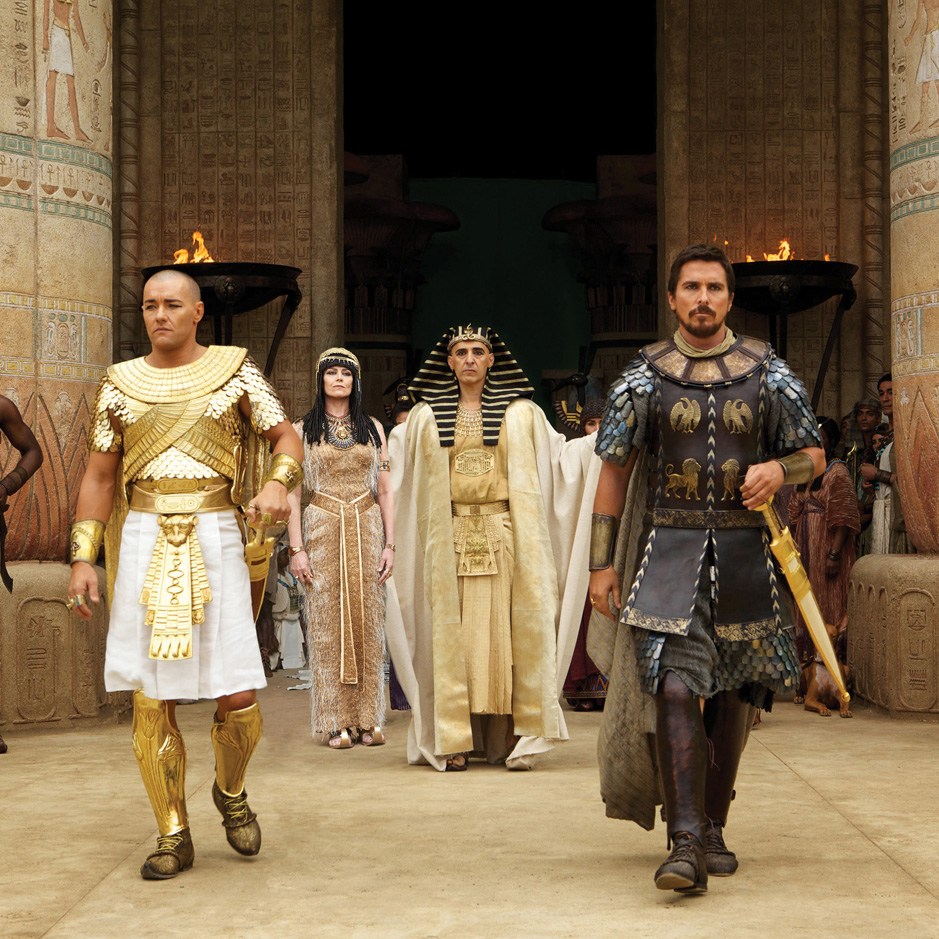
Raise your hand if you want to see Moses portrayed as an insurgent lunatic terrorist with a bad conscience, the pharaoh who sought the murder of all first-born Hebrew slaves as a nice and reasonable fellow, and God as a foul-tempered 11-year-old boy with an English accent.
All right, I see a few hands raised, though maybe they belong to people who are still demonstrating about Ferguson. So let me ask you this: How many of you want to see how Hollywood has taken the story of the Hebrew departure from ancient Egypt—by far the most dramatic tale in the world’s most enduring book—and turned it into a joyless, dull, turgid bore?
Real journalism.Trusted by millions.
Unlimited access to in-depth reporting, expert analysis, and the stories that shape our country.
Already a member? Log in
I don’t know when I’ve seen a movie as self-destructively misconceived as Exodus: Gods and Kings, the director Ridley Scott’s $200-million retelling of the Moses story that has as much chance of making $200 million at the American box office as Ted Cruz has of winning the District of Columbia in the November 2016 election.
For one thing, Exodus: Gods and Kings is jaw-droppingly offensive in the way it bastardizes its source material. The God of Sh’mot, the second book of the Torah, manifests Himself in many ways—as the burning bush, as a cloud that follows the Hebrews on their journey, as rain and fire, even as a trumpet blast. But he most certainly does not manifest as a human being, since the incorporeality of the divine is a central feature of Jewish theology, the third of Maimonides’ 13 principles of faith. I know Jews make up only 2 percent of the U.S. population and are therefore not collectively a box-office consideration—but if you’re going to make a movie out of their holy book, shouldn’t you, I don’t know, be careful not to throw the holy book into the garbage can?
Oh, and, by the way, it’s possible that the unpleasant kid-God of Exodus: Gods and Kings doesn’t even exist. Moses encounters the boy only after he’s been buried in mud up to his neck, has had his leg broken, and is delirious. Repeatedly, in the course of the film, Moses’ brother Aaron watches in horror as he goes to talk to this boy but appears, at a distance, to be talking to himself—which is another complete betrayal of the Torah’s account, since, like Moses, Aaron actually talks directly to God. Thus, we are given reason to question whether the God of Exodus: Gods and Kings is only a psychotic delusion.
All in all, the movie just cannot make up its mind about the whole God thing. (Later in the film, Moses slightingly refers to the boy as a “messenger,” a sure sign that Scott realizes he’s gotten himself on shaky ground with this surly preteen business and wants to dial back his would-be divinity into a mere angel.) A title at the beginning says, “God has not forgotten” his people. And, because you sure do need some cool special effects, the plagues come sweeping through Egypt in a manner that certainly seems supernatural.
But Scott and his team of four screenwriters make absolutely certain that we see no direct connection between God and Moses and the working of the plagues, perhaps in order to establish a plausible deniability with the New Atheist types. Indeed, they do away entirely with Moses’ staff, the means by which God causes all of the plagues but the slaying of the first-born. (They replace it, inexplicably, with a sword presented to Moses by his pal, the old pharaoh—you know, the one who had ordered him and all Hebrew male babies killed.)
Most striking, Moses all but disappears during the plagues, rather than continually demanding that Pharaoh let his people go. Instead, we spend a lot of time among the Egyptians as they debate the causes of the plagues in rationalist terms, as though these magicians (whom the Bible portrays as having supernatural powers themselves) are all Neil deGrasse Tyson.
Even worse, perhaps, is the movie’s complete lack of interest in Moses as a Jew. In the Bible, he makes common cause with his people when he kills an Egyptian who is beating a Hebrew slave—and then flees Egypt because he fears the wrath of Pharaoh for having done so. Aaron has maybe six lines of dialogue; Joshua has three. And there is no sense of triumph at the slave victory over Egypt. In the book of Exodus, when God parts the Sea of Reeds and then drowns the Egyptian army, Moses and his sister Miriam sing a joyous song. In Exodus: Gods and Kings, the dour-faced Moses turns into a lobbyist for J Street. He sits on the sand and worries about what will happen to his people when they reach Israel “and stop running.”
One thing they, and most everybody else, won’t do is see this worthless piece of dreck.
John Podhoretz, editor of Commentary, is The Weekly Standard’s movie critic.