

Coral Gables, Florida
Stay informed.Stay ahead.
Join Washington Examiner for unlimited access to the news, analysis, and commentary that matter most.
Already a member? Log in
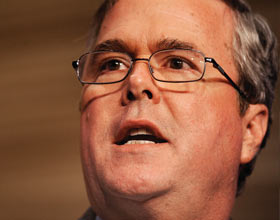
Jeb Bush is not running for president in 2012. He may never run, though he doesn’t think the Bush name has been poisoned by his brother’s turbulent presidency. “I’m not one of the 5, 10, 15 people who wake up each day and say, ‘What do I need to do today to position myself to run for president?’ ” And Bush notes he passed up the chance to run for both senator and governor in Florida this year.
His office is in a wing of the elegant Biltmore Hotel in Coral Gables. It’s a mile from his home and 15 minutes from Miami International Airport. There’s a relaxed atmosphere, and Bush, 57, greets me in a casual shirt and no tie. After two terms as a popular governor of Florida (1999 to 2007), he seems unhurried, comfortable in his consulting business and speechmaking.
Yet the Jeb Bush political saga hasn’t come to an end. He remains active in the Republican party and conservative circles. “I am involved,” he told me last week. He’ll address the New York Republican convention next week. “People seek my advice out, which is really flattering. The fact that I’m not running for something puts me in a position where I might be listened to more.”
His advice to Republicans for the midterm elections: Pursue a bold, policy-oriented campaign. “I completely disagree with the idea that you rope-a-dope,” he says. “If we just are trying to be against the president’s efforts to redefine who we are as a nation, eventually . . . you can’t score many touchdowns playing defense the whole game.”
For Republican candidates, “This is a good time to be a little less constrained in your thinking,” Bush says. “Candidates that win will be a little emboldened. They’re not going to take the traditional point of view that we can’t be too provocative because we’re going to upset the population. Think big and bold. Fill the space. Paint in Britto-like colors, not pastels. My man Romero Britto. He’s our favorite artist, a Brazilian artist.” Britto paintings hang on the walls of Bush’s office.
“My guess is, post-November, should things go well, you’re going to see the emerging Cantor-Ryan wing of the Republican party—the policy activists—in their ascendency,” Bush says. “They’ll be in the ascendency in the Senate as well. And you’ll have activist conservative governors. In 2011, I think you’re going to see all sorts of efforts to act on the belief in entrepreneurial capitalism and limited government.”
He’s read Paul Ryan’s “Roadmap” for reform, “all 95 pages of it. It’s fantastic. Paul Ryan is the only elected official that’s actually laid out a plan. He has a very thoughtful, realistic approach to dealing with this fiscal crisis, and he’s the only guy out of 300 million people that I’ve seen that has done so.”
For the country to prosper, Bush thinks a dramatic increase in immigration is needed. He’s sympathetic to Arizona’s tough response to a surge in illegal immigrants and also supports “comprehensive reform,” code for stiffer border security and a path to citizenship for illegals living here. But, he says, “This whole debate in Washington is missing one key ingredient, the real world ingredient. How are we going to grow to create jobs, real jobs, private sector jobs that aren’t created out of fiat money?”
Bush’s answer is to reject President Obama’s economic plan and adopt “sustained economic growth as a policy. Part of that would be to create a new immigration system that allowed us to have a guest worker program . . . and would open our country to capitalists, entrepreneurs, technologists, researchers. They would come. The only way you can grow is to have a meaningful immigration strategy that says growth is good.”
But that—and especially amnesty for illegals—can’t occur until the border with Mexico is secure. “More fence, sure,” Bush says. “It’s just no one trusts Washington until you show the good faith of protecting the border.”
Bush has done a back-of-the-envelope calculation about what an economic growth strategy could produce. Obama’s policy won’t generate more than 1.5 percent growth annually, he says. But with “lower taxes, more rational regulation, limiting the power of government in general, particularly in Washington, investing in research, innovation, education—and get out of the way, trust capitalism to work and you can achieve easily 2 percent more per year,” Bush insists. “You end up with $3.5 trillion of extra economic activity, more than the entire economy of Germany.”
Not bad, and there’s an additional benefit: unifying conservatives. “We have all these factions inside the conservative cause, people focused on social issues, or libertarian leave-me-alone issues or paleocons or neocons or traditional conservatives,” Bush says. “It seems to me if you ask what is the one thing that we all agree on, [it’s] that we passionately agree that entrepreneurial capitalism works.”
There’s a “common thread,” among the Republican candidates he’s supporting in 2010. They have “a real passion for policy reform, particularly education.” He’s endorsed some in primary contests: Scott Walker in Wisconsin, Bradley Byrne in Alabama, Meg Whitman in California, Brian Sandoval in Nevada, Tom Corbett in Pennsylvania.
He’s particularly close to Florida Senate candidate Marco Rubio. Bush is also critical of Governor Charlie Crist, who abandoned the race against Rubio in the Republican primary to run for senator as an independent. “It’s all about him,” Bush says. “It’s not about anything else. . . . Governor Crist organizes his life around his personal ambitions. . . . He doesn’t have a set of guiding principles to share with people. This is a year where people want you to say what your core beliefs are, and painting in brighter, bolder colors instead of pastels is the way to go. Which is very encouraging to me personally.”
Bush figures Crist will finish third behind Rubio (“Marco wins going away”) and Democrat Kendrick Meek. Rubio, the former Florida House speaker, is Bush’s ideal candidate. “He’s unique in the sense that he’s very eloquent and he’s cheerful and joyful. He has a wonderful attitude, and people are depressed, and he lifts people’s spirits up.” In short, Rubio is a lot like another Florida politician, one who’s not running for anything this year.
Fred Barnes is executive editor of The Weekly Standard.
