
Observers are beginning to notice that anonymous Internet users are not always credible.
The group of computer hackers known as Anonymous has said it would launch cyberattacks against the Islamic State, but some are saying those attacks aren’t nearly as effective as they could be, and instead are hitting non-Islamic State users online.
“Anonymous’ online battle with the Islamic State is starting to look like much ado about nothing,” The Daily Dot reported over the weekend, quoting an unnamed Twitter spokesman who said the company wasn’t paying much attention to Anonymous. The organization has been curating lists of Twitter accounts that it claims are affiliated with the Islamic State, publishing them and then targeting them for cyberattacks.
“We don’t review Anonymous lists posted online, but third party reviews have found them to be wildly inaccurate and full of academics and journalists,” the spokesman told The Daily Dot.
On Friday, an Anonymous member posted a video claiming the group had removed more than 20,000 Twitter accounts affiliated with the Islamic State. That would equate to around 40 percent of all the Islamic State-affiliated accounts estimated to exist in January, according to an estimate from the Brookings Institution.
However, the claim is hard to verify, and if the accounting were wrong, it wouldn’t be the first time.
In April, the group published a list of websites used by the Islamic State, and said certain cybersecurity firms were turning a blind eye for the sake of “blood money.” One Twitter user renewed that fight with Los Angeles-based CloudFlare last week, with an account called “TheAnonMovement” saying, “Anonymous demands CloudFlare to [sic] remove their protection for pro ISIS websites. If you do not, we will do it for you.”
Anonymous demands @CloudFlare to remove their protection for pro #ISIS websites. If you do not, we will do it for you. #OpParis #OpDaesh
— Anonymous (@TheAnonMovement) November 19, 2015
The company’s CEO, Matthew Prince, said that April list was inaccurate and that it accentuated the fact that people on the Internet aren’t always right. “They alleged that a number of sites were ISIS-related when in fact a number of the sites were actually Kurdish rebel sites, Syrian rebel sites, both of which are obviously anti-ISIS, in addition to pro-Palestinian sites and pro-Chechen sites which had no affiliation with ISIS,” Prince told the Washington Examiner.
“Not only have we not received any requests by law enforcement organizations to terminate these accounts, in some cases we’ve been asked politely if we would mind not terminating the accounts. I don’t think it takes a ton of imagination to imagine why law enforcement may do that,” Prince added, noting that the Federal Bureau of Investigation and the State Department are also both clients of his company.
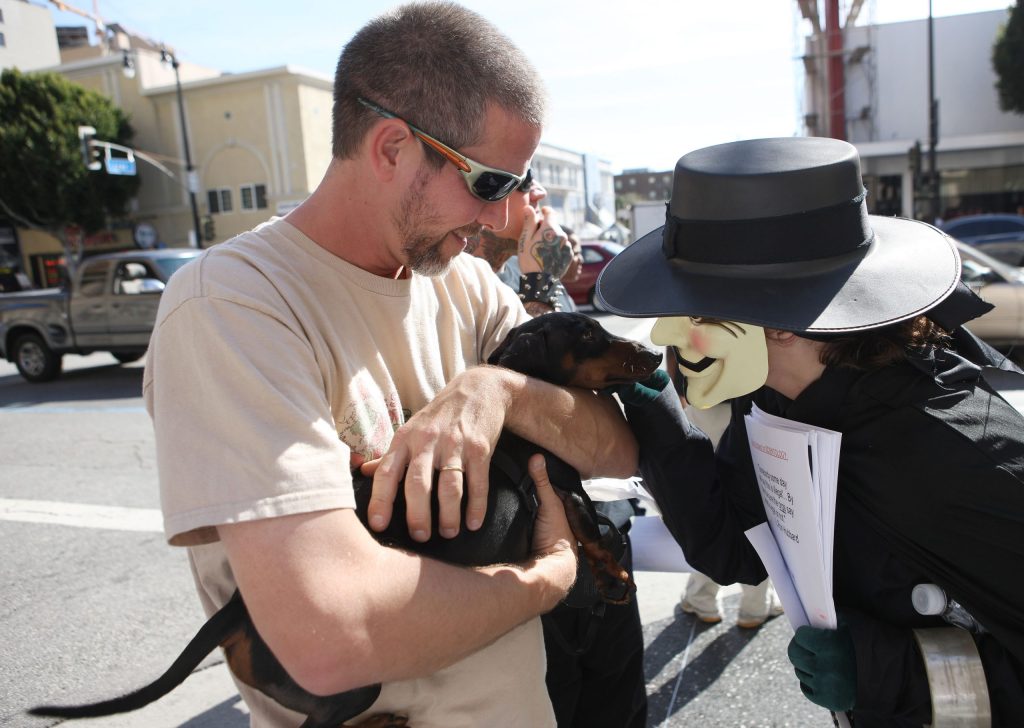
“It shows the risk of letting 15-year-old kids in Guy Fawkes masks set foreign policy as opposed to official law enforcement organizations or organizations like the State Department,” Prince said, in a reference to the masks that Anonymous members often use to represent the organization.
When the squad is fighting for a revolution but you have to take a group photo first. pic.twitter.com/CCUMIgVPoa
— Anonymous (@TheAnonMovement) November 21, 2015
Dr. Herbert Lin, a senior research scholar for cyberpolicy and security at Stanford’s Center for International Security and Cooperation and research fellow at the Hoover Institution, said another problem with the group’s effort is the “destroy-exploit tradeoff,” or the determination of whether to destroy or exploit enemy infrastructure.
“Knowing which is better depends on knowledge that goes beyond knowledge of the individual account in question — and Anonymous is less likely to have that knowledge compared to the U.S. government,” Lin told the Examiner.
“So the choice is this: Is it better to conduct harassment that has a high probability of a modest short-term impact and almost surely a limited long-term impact, or to leave an account alone so that intelligence services can take advantage of it and possibly have a larger long-term impact?” Lin said.
However, Lin also said that he sees a value in what Anonymous is doing. “In any conflict, harassment is a useful thing to be doing, even if it’s not necessarily a game changer, and all else being equal (a big qualifier), it’s better to harass terrorists than to not harass them,” he added.
The solution in this situation, Lin said, would be to consider “how it might be possible for Anonymous to coordinate their work with the relevant government authorities in helpful ways that take into account that tradeoff.”
Anonymous’ vigilante targeting of the Islamic State is currently illegal under the Computer Fraud and Abuse Act, though federal authorities have never prosecuted anyone for doing so.
Related Story: http://www.washingtonexaminer.com/article/2576607
The group began targeting the Islamic State after the Nov. 13 terrorist attacks in Paris. It is the second time this year, following the Charlie Hebdo attacks in January, and is shaping up to be on of the group’s largest campaigns to date.
