

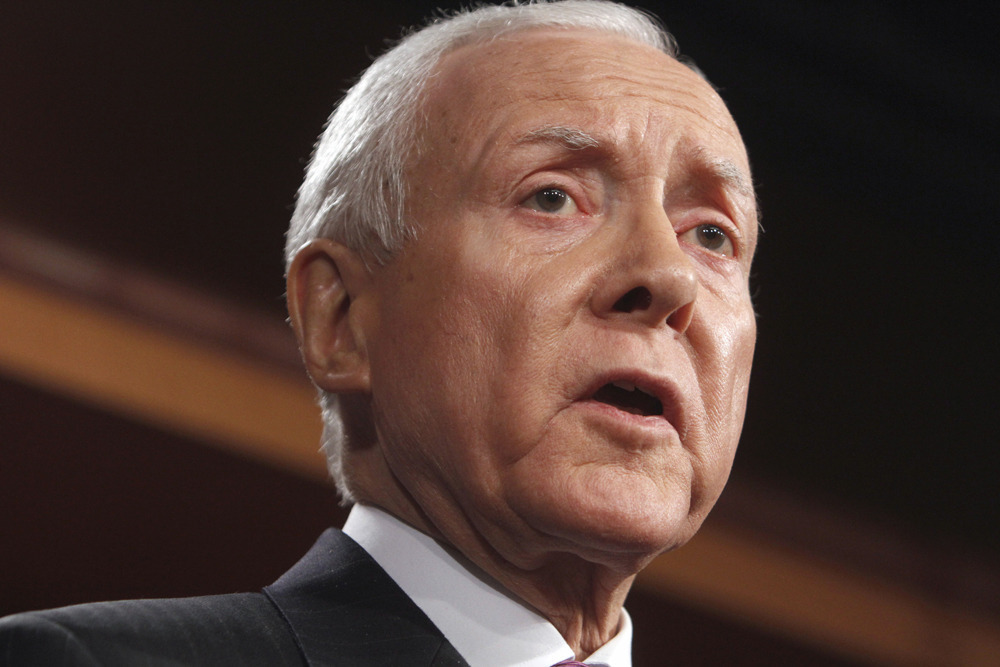
When Orrin Hatch, R-Utah, was sworn in to office as senator on Jan. 3, 1977, Jimmy Carter was weeks away from being inaugurated, the first “Star Wars” movie was months away from being released, Barack Obama was 15 years old, and the national debt was about 1-25th its current level.
In Tuesday’s Indiana Republican Senate primary, Tea Party activists successfully ousted Richard Lugar, who was sworn into the Senate the same day as Hatch over 35 years ago. Though polls suggest Hatch is in a stronger position than Lugar was, there are still seven weeks before Hatch’s June 26 primary against former Utah state Sen. Dan Liljenquist. Utah Republicans should look beyond Hatch’s recent conservative-sounding rhetoric and instead focus on his big-government record.
Hatch touts his past support for a balanced-budget amendment, but the concept is often an easy way for politicians to speak about fiscal restraint without doing the difficult work of shrinking government. In 1997, the same year Hatch fought for the amendment, he worked with Ted Kennedy to enact the State Children’s Health Insurance Program, which the Left saw as an incremental step toward national health care after the failure of President Clinton’s health care push in 1994. Hatch voted to extend SCHIP again in 2007, before voting against it when it was introduced in January 2009, at the start of the Obama administration.
Last June, I asked Hatch about his support for SCHIP and he said, “We created this limited, state-based insurance just for children of the working poor. But lo and behold, a liberal takes the White House and turned it into another Washington-dictated health monstrosity, leaving states with almost no input.”
Putting aside the fact that even at the time it first passed it was a major expansion of government, somebody with Hatch’s decades of experience as a lawmaker should know that any new government program is destined to grow over time well beyond its original intent.
Hatch has also touted his conservative voting record during the Obama administration. But the 99 percent rating he received from the limited-government Club for Growth in 2011, as he geared up for a primary challenge from the Right, contrasts with his 78 percent lifetime rating.
It’s easy for Republicans to talk a big game about shrinking government when a Democrat is in the White House. A much better test of a lawmaker’s commitment to limited-government principles is how he or she behaves when a Republican president is in office, pushing a big-government agenda.
As President Bush worked with Congressional Republicans to explode government when they were in power, Hatch voted with him every step of the way. He voted to expand the federal role in education with “No Child Left Behind” and for the biggest expansion of entitlements since LBJ’s Great Society in the form of the Medicare prescription drug plan.
In 2005, Hatch voted for the $286 billion highway bill, which contained 6,376 earmarks, including the infamous “Bridge to Nowhere.” He then voted against an amendment that would have diverted funds earmarked for the bridge to help pay for Hurricane Katrina relief. In the fall of 2008, Hatch went on to vote for the Wall Street bailout.
Ousting Hatch isn’t merely about payback for these past deviations from limited-government philosophy. With the ideologically malleable Mitt Romney as the Republican nominee, it will be more crucial than ever to stock Congress with conservatives who will push his agenda to the right.
Should Hatch survive his Republican primary, he will feel secure until 2018 (when he’ll be 84 years old). If Romney wins this fall, Hatch will likely revert to form, enabling the former Massachusetts governor’s big-government tendencies.
After decades of votes to expand the size and scope of government, it’s time for Hatch to go.
Philip Klein is senior editorial writer for The Examiner. He can be reached at [email protected].
