

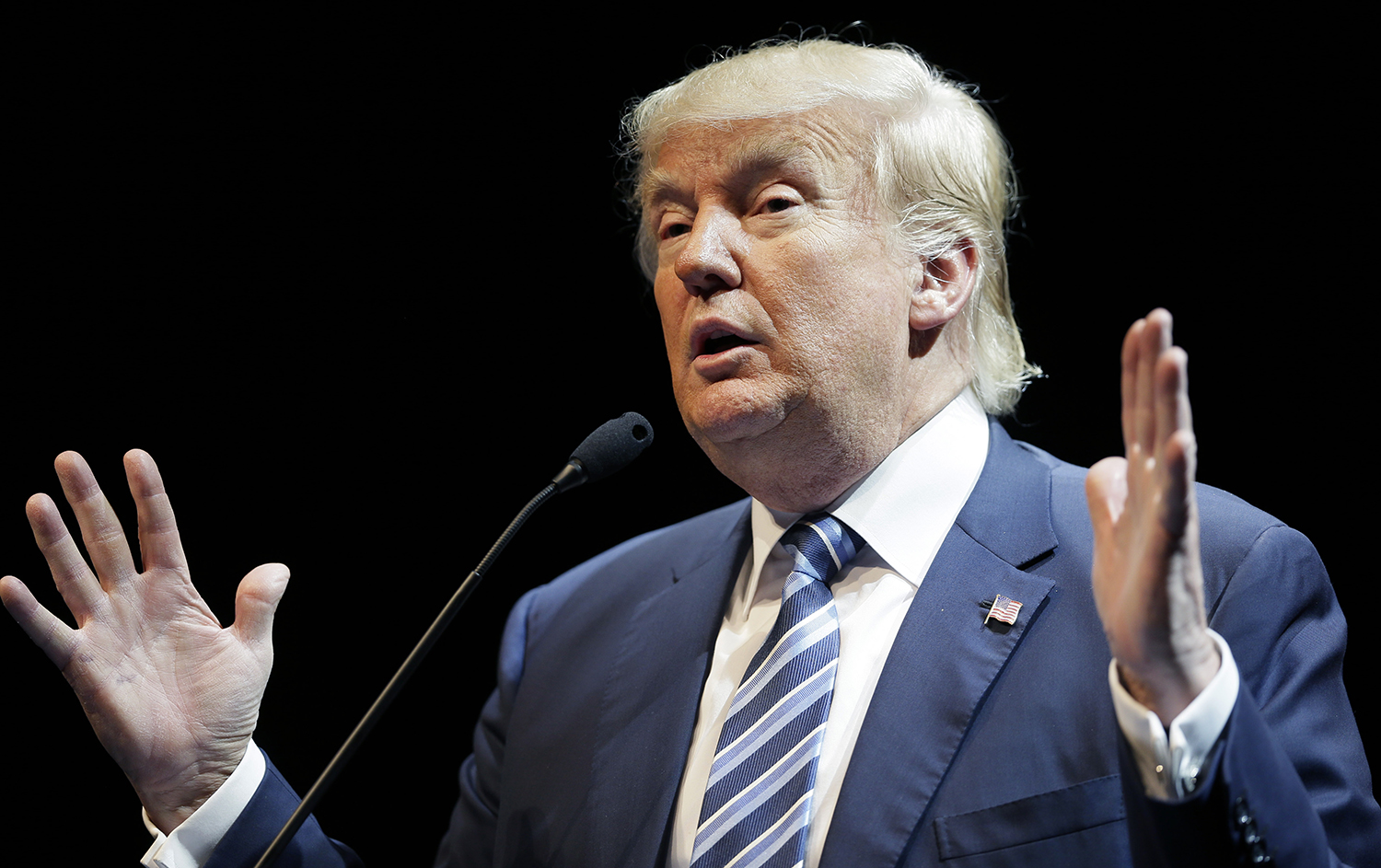
Hillary Clinton’s accusation that Donald Trump wants “trumped-up trickle-down” Monday night was a standard attack line for a Democrat, but Trump’s response was unusual for a Republican.
Rather than deflect or disagree with the charge that he wants to give tax cuts to wealthy individuals, Trump amplified Clinton’s suggestion, saying that he is seeking an enormous tax cut and that the wealthy would use it well.
Recommended Stories


Trump’s debate maneuvering is a departure from the positioning of Republicans in past elections.
Typically, Republicans want nothing to do with the time-tested Democratic criticism of proposals to reduce tax rates, namely that they are premised on giving money to the wealthy and hoping that the benefits are passed on to others.
Supply-side economists have argued that the point of reducing tax rates is to incentivize work.
Republican politicians in general elections tend to avoid talking about lower tax rates for individuals and instead focus on the benefits to small businesses that will create jobs.
But Trump simply accepted Clinton’s “trickle-down” premise.
“I’m really calling for major jobs, because the wealthy are going create tremendous jobs,” Trump replied when charged with favoring trickle-down economics. “They’re going to expand their companies. They’re going to do a tremendous job.”
And he played up the size of the tax cut: “And by the way, my tax cut is the biggest since Ronald Reagan,” he said. “I’m very proud of it.”
Trump’s proposed tax cut may be even larger than Reagan’s as a share of the economy. The Tax Policy Center, a nonprofit think tank, found that an earlier version of Trump’s plan would have been twice as big as Reagan’s. It’s also true that top earners would get much larger tax cuts than lower-income earners, according to outside analyses of Trump’s proposal.
Contrast Trump’s answer with those of past GOP nominees, who have disavowed cutting taxes for the rich or sought to characterize their tax plans as helping small businesses.
For example, in his second debate with President Obama in 2012, Mitt Romney vowed that he would “not, under any circumstances, reduce the share that’s being paid by the highest-income taxpayers.”
“I’m not looking to cut taxes for wealthy people. I am looking to cut taxes for middle-income people,” he later explained.
Romney explained his support for lowering the top individual rate to 28 percent as support for small businesses. Many businesses, enough to constitute a majority of employment in the U.S., file taxes through the individual side of the tax code, and many pay the top income tax rate. Such businesses, including sole proprietorships, partnerships and S-corporations, are sensitive to the top individual tax rate. Explaining that quickly on the fly, however, is a difficult task in the high-pressure environment of a nationally televised debate.
In 2008, John McCain was gifted a helpful real-world example to work with in explaining how small businesses are affected by individual tax rates. Three days before the final debate, Sen. Barack Obama had run into a small business employee while campaigning in Ohio, a man who would become known as “Joe the Plumber.”
Joe the Plumber told Obama that he was planning to buy a small business that he feared might see increased taxes under Obama’s plans. As part of his response, Obama said that he wanted to “spread the wealth around,” a comment that generated criticism.
McCain used the example of Joe the Plumber and his business during the debate to explain why he favored lowering rates. He also said explicitly that he wanted it to “be very clear to you I am not in favor of tax cuts for the wealthy. ”
Even George W. Bush sought to cast his tax policies as anything other than a tax cut for the rich, before and after he lowered the top individual rate from 39.6 percent to 35 percent.
“Most of the tax cuts went to low- and middle-income Americans. And now the tax code is more fair,” Bush said in 2004, when John Kerry accused him of cutting taxes for the wealthy at the expense of the country. Bush also mentioned the benefits to small businesses as a justification for the tax cuts.
While running for president in 2000, Bush had cast his tax plans as “relief” for all income earners.
“Everybody who pays taxes ought to get tax relief,” he said in a debate with Al Gore. “After my plan is in place, the wealthiest Americans will pay a higher percentage of taxes then they do today, the poorest of Americans, six million families, won’t pay any tax at all.”
Trump, however, eschewed such rhetoric Monday night. He straightforwardly promised tax cuts for the wealthy, and even suggested that it was smart for him, as a wealthy person and business owner, to avoid taxes altogether and that the government wastes his tax dollars.
“I’m going to cut taxes, big league, and you’re going to raise taxes, big league, end of story,” he said in summarizing the tax portion of the debate.
