

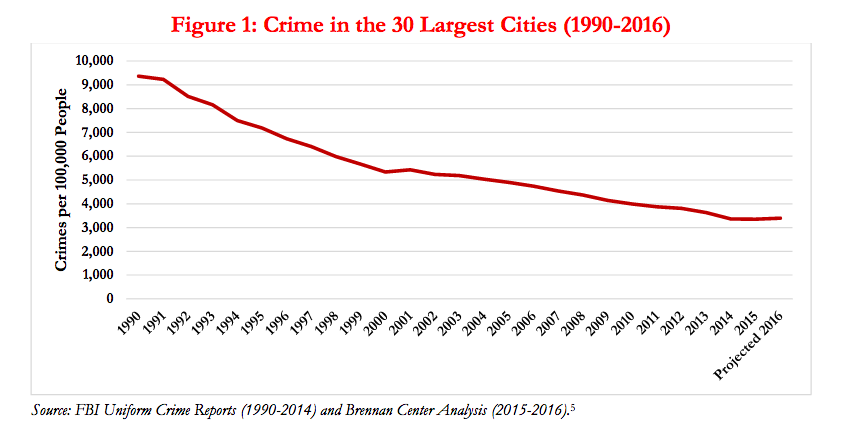
The overall crime rate in 2016 is projected to be nearly the same as last year — but both violent crime and the murder rate are expected to rise, according to a new report.
A report by NYU Law School’s Brennan Center for Justice projects only a slight increase in overall crime in America’s 30 largest cities — 1.3 percent — though 12 cities are expected to see drops. The decreases are offset by spiraling crime in Chicago (+9.1 percent) and Charlotte (+17.5 percent).
“Very few cities are projected to see crime rise uniformly this year, and only Chicago will see significant, back-to-back increases in both violent crime and murder,” the report said.
Violent crime is expected to rise in 2016 by 5.5 percent. Half of the increase is driven by Los Angeles (+17 percent) and Chicago (+16 percent).
Despite the findings, overall crime remains at an all-time low and violent crime remains near the bottom of the nation’s 30-year downward trend. But, murder is also up nationally, projected to increase by 13.1 percent, with “nearly half of this increase attributable to Chicago alone (234 of 496 murders).”
The good news is that other cities that caused the national murder rate to increase in 2015 are projected to see significant decreases in 2016, including Baltimore (-9.9 percent) and Washington, D.C. (-10.9 percent).
The Brennan Center still struggles to make sense of the crime rate in Chicago, as no other large U.S. city is expected to see a comparable increase in violence.
“The causes are still unclear,” the report said, “but some theories include higher concentrations of poverty, increased gang activity, and fewer police officers.”
Some have argued that a “Ferguson Effect” may have lead to an increase in crime, but Laura Dugan, a professor in the Department of Criminology and Criminal Justice at the University of Maryland, says making that argument is “premature.”
“In anticipation of that kind of backlash, anecdotal stories are leading some to argue that a Ferguson Effect has lead to an increase in crime,” Dugan told the Washington Examiner in an email exchange. “Yet, this requires that crime rise for more than one year. Unfortunately at this time, we cannot know if crime is rising or if this year is simply an unusual year (a blip in a downward or flat trend).”
The Brennan Center’s analysis also found “no evidence of a national murder wave,” despite claims by Republican presidential nominee Donald Trump, who has billed himself as the “law and order” candidate who will take care of the “out of control” crime rate.
Dugan acknowledged that in the past crime statistics and events to scare the electorate into voting for the “get tough on crime” candidate, pointing to George H.W. Bush beating Michael Dukakis in 1988, and warned that Trump too is using that fear to his advantage.
“Donald Trump is using the public’s fear of rising crime and terrorism in order to be the “get tough on …” candidate,” Dugan said. “Further, some people are trying to create a public story around the backlash of police shootings of unarmed black men. While those events are horrific and call for reform measures, there is no need to generalize that behavior to all police officers.”
“These findings undercut media reports referring to crime as ‘out of control,’ or heralding a new nationwide crime wave,” said the report, authored by researchers Matthew Friedman, Ames Grawert and James Cullen.
