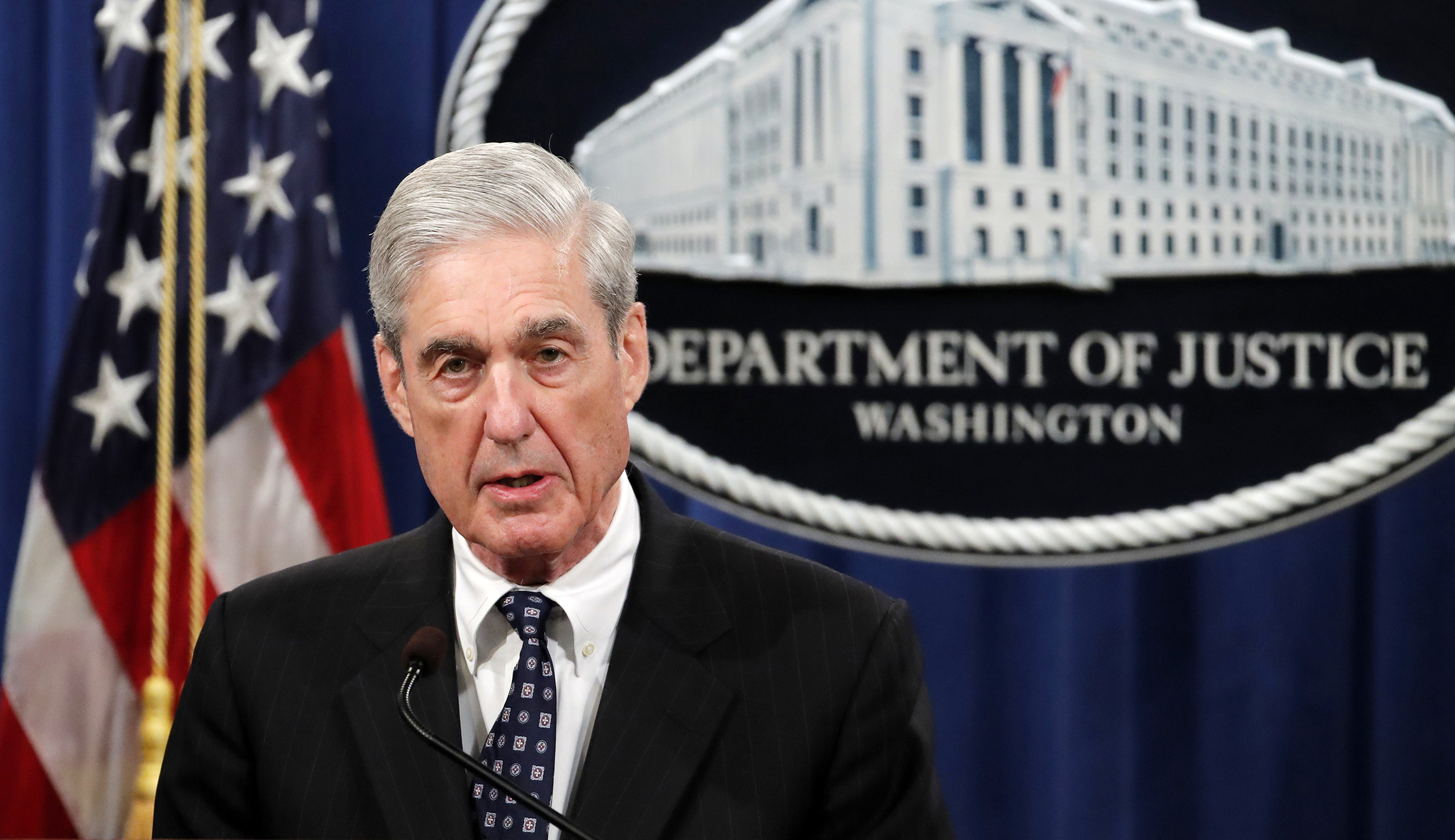
Robert Mueller spoke publicly for the first time since being appointed in May 2017 to be special counsel in charge of the investigation into Russian interference in the 2016 election, closing the door to congressional testimony that would reveal further details about his 22-month long investigation.
In defiance of President Trump’s declaration of total exoneration after the release of his report, Mueller also stressed that while he did not accuse the commander in chief of trying to obstruct the investigation he did not absolve him either.
“I hope and expect this to be the only time I will speak to you in this manner,” Mueller said Wednesday at the Justice Department. “I am making that decision myself. No one has told me whether I can or should testify or speak further about this matter.”
The special counsel acknowledged efforts by Democrats in the House to have him testify about the investigation, but Mueller said he would decline to discuss anything further than what is detailed in the 448-page report he released last month and made clear he does not want to speak out again in public.
“There has been discussion about an appearance before Congress,” he said. “Any testimony from this office would not go beyond our report. It contains our findings and analysis and the reasons for the decisions we made. We chose those words carefully and the work speaks for itself and the report is my testimony. I would not provide information beyond that which is already public in any appearance before Congress.”
With his work finished, Mueller said he will be closing up his office and is leaving it up to the Justice Department to decide what to declassify from the redacted documents associated with the investigation, including grand jury and counterintelligence material.
“I am speaking out today because our investigation is complete. The attorney general has made the report on our investigation largely public. And we are formally closing the special counsel’s office and as well, I’m resigning from the Department of Justice to return to private life,” Mueller said on Wednesday.
Mueller’s report, which was released with redactions in April, concluded that Russia interfered throughout the 2016 election but did not find that any members of the Trump campaign coordinated or conspired with them in these efforts. Mueller did not reach a determination on whether Trump had obstructed justice, but laid out 10 scenarios that his team examined.
There has been fierce debate over whether Attorney General William Barr improperly represented Mueller’s findings in his letter to Congress and in his public testimony and statements. While most Republicans say Barr’s framing of Mueller’s main conclusions was accurate, many Democrats, as well as Rep. Justin Amash, R-Mich., insist Barr was misleading, especially regarding whether Trump had potentially obstructed justice.
Mueller offered some cover to Barr, who was in Alaska as he delivered his roughly eight-minute address.
“At one point in time, I requested that certain portions of the report be released,” Mueller said. “The attorney general preferred to make the entire report public all at once. We appreciate that the attorney general made the report largely public, and I certainly do not question the attorney general’s good faith in that decision.”
Prior to the release of Mueller’s report, in a letter to Congress on March 24, Barr wrote that Mueller did not find that anyone associated with Trump, or any Americans, had conspired with Russia. Barr stated that he, in conjunction with then-Deputy Attorney General Rod Rosenstein, made the final determination that Trump had not committed obstruction of justice.
After Barr released his four-page summary, Mueller communicated his dissatisfaction to Barr, stating that he believed Barr’s memo “did not fully capture the context, nature, and substance of this office’s work and conclusions.”
“There is now public confusion about critical aspects of the results of our investigation,” Mueller said to Barr in a letter. “This threatens to undermine a central purpose for which the Department appointed the Special Counsel: to assure full public confidence in the outcome of the investigations.”
Barr sent another letter to Congress on March 29 emphasizing that his March 24 letter wasn’t meant to be a “an exhaustive recounting of the Special Counsel’s investigation or report” but was rather meant to communicate “a summary of its principal conclusions” or its “bottom line.”
Mueller explained on Wednesday why his team did not make a determination on obstruction while also refusing to clear the president completely.
“The order appointing the special counsel authorized us to investigate actions that could obstruct the investigation. We conducted that investigation and we kept the office of the acting attorney general apprised of the progress of our work,” he said. “And as set forth in the report after that investigation, if we had had confidence that the president clearly did not commit a crime we would have said so. We did not, however, make a determination as to whether the president did commit a crime.”
Citing longstanding DOJ policy, Mueller said charging a sitting president with a crime was not an option his team could consider and noted doing so would be unconstitutional. “Even if the charge is kept under seal and hidden from public view, that, too, is prohibited,” he said.
But moments after Mueller’s address, Trump insisted he was in the clear. “Nothing changes from the Mueller Report. There was insufficient evidence and therefore, in our Country, a person is innocent. The case is closed! Thank you,” he tweeted.
Democrats, who argue that Mueller left the obstruction issue open to Congress to decide, have been conducting negotiations with the Justice Department to set up a hearing with Mueller, but the special counsel has resisted Judiciary Chairman Jerry Nadler’s demand that he testify in public. Nadler took Mueller’s comments as further reason for Congress to investigate whether the president attempted to obstruct the investigation.
“Given that Special Counsel Mueller was unable to pursue criminal charges against the President, it falls to Congress to respond to the crimes, lies and other wrongdoing of President Trump – and we will do so. No one, not even the President of the United States, is above the law,” the New York Democrat said in a statement.
Mueller’s report, which was released on April 18, concluded that “the Russian government interfered in the 2016 presidential election in sweeping and systematic fashion.” And Mueller’s report also stated that, despite the Russians preferring Trump to Clinton and even though the Trump campaign believed that email disclosures from Wikileaks would help them win, “the investigation did not establish that members of the Trump campaign conspired or coordinated with the Russian government in its election interference activities.”
According to Mueller, Russia’s efforts were carried out through social media disinformation campaigns carried out by Russia-based troll farms, including the Internet Research Agency, as well as through cyberattacks and email hacking carried out by Russian military intelligence. The Mueller report said Russia’s Main Intelligence Directorate of the General Staff, or GRU, stole thousands of emails from the Democratic National Committee and then distributed them through two GRU-operated fronts: the DCLeaks and Guccifer 2.0 websites, who then gave the emails to WikiLeaks.
Trump associates like former campaign manager Paul Manafort, former national security adviser Mike Flynn, former foreign policy adviser George Papadopoulos, former Trump lawyer Michael Cohen, and others were swept up in Mueller’s investigation, although none were charged with crimes associated with collusion with Russia.
The origins of the Trump-Russia investigation as well as any possible misconduct by the DOJ and FBI are being investigated by Barr and U.S. Attorney John Durham. DOJ Inspector General Michael Horowitz is conducting a parallel investigation into possible abuse of the Foreign Intelligence Surveillance Act.
