
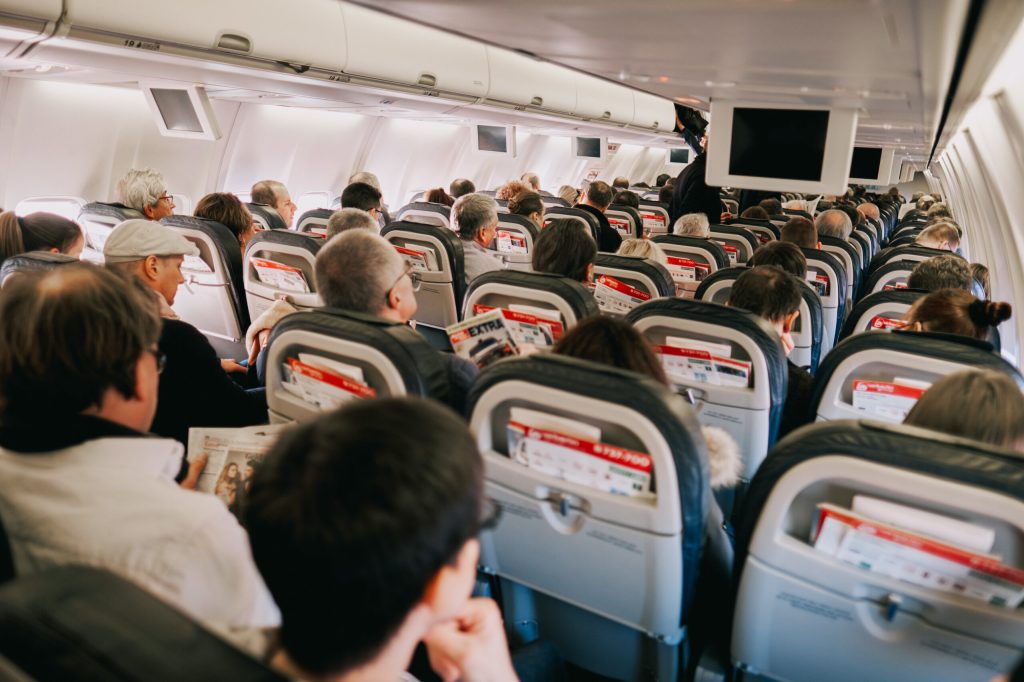
A group of lawmakers is reviving a push for minimum seat sizes on airplanes after a similar proposal couldn’t get off the ground in the previous Congress.
The Seat Egress in Air Travel (SEAT) Act has been introduced in the House and Senate and aims to make the Federal Aviation Administration establish minimum seat size standards for commercial air travel. The bill also would require the FAA to come up with minimum distances between rows of seats on airliners.
Real journalism.Trusted by millions.
Unlimited access to in-depth reporting, expert analysis, and the stories that shape our country.
Already a member? Log in
In the House, Reps. Steve Cohen, D-Tenn, and Adam Kinzinger, R-Ill., are the primary co-sponsors, while a group of Democrats led by Minority Leader Chuck Schumer introduced the bill in the Senate. Other senators attached to the bill include Sens. Ed Markey of Massachusetts, Bob Menendez of New Jersey, Richard Blumenthal of Connecticut and Dianne Feinstein of California.
Cohen said the bill is not being introduced as a matter of passenger comfort. Instead, it’s to keep airlines from stuffing their planes so full of seats that they run afoul of federal regulations requiring all passengers and crew members to be able to safely exit an airplane in 90 seconds in an emergency.
“Planes need to be capable of rapid evacuation in case of emergency. In addition, doctors have warned that deep vein thrombosis can afflict passengers who do not move their legs enough during longer flights,” Cohen said. “The safety and health of passengers must come before airline profits.”
The average airplane seat size and the average amount of legroom on planes have shrunk drastically over the decades.
The lawmakers said seats averaged 18 inches in width and legroom about 35 inches before deregulation began in the 1970s. Now, that width is down to about 16.5 inches, and legroom has shrunk about four inches to 31 inches.
During the same period, the size of the average person increased — men are about 30 pounds heavier now than they were in the 1970s, while women are about 26 pounds heavier, according to the New York Times.
Cohen and Kinzinger introduced a similar measure in 2016, trying to attach the bill to the FAA reauthorization bill that went through the House Transportation and Infrastructure Committee. That measure crashed, and the FAA reauthorization bill flew through Congress, eventually signed by former President Barack Obama.
Kinzinger is the only Republican who has signed on to support the legislation currently. He said his main concern is whether passengers would be able to escape a plane in an emergency if seat sizes continue to go unregulated and more people are crammed onto aircraft.
“The SEAT Act will ensure standards are in place to guarantee effective passageways of evacuation for passenger safety,” he said. “With bipartisan and bicameral support, I’m hopeful we will get this important measure to the floor soon, get the bill signed into law, and make air travel safer for everyone.”
The FAA says it is not concerned about whether seat size is shrinking — as long as passengers are safe and able to move inside an aircraft in case of emergency.
“Safety is the FAA’s priority, and seat size has not been a factor in any safety issue. There are no specific dimensional requirements for aircraft seats, but there are aisle width requirements,” an FAA representative said. “There are also exit accessibility requirements.”
Schumer last year offered the same amendment to the FAA reauthorization as it went through the Senate, but it went down by 12 votes.
“Consumers are tired of being packed into airplanes like sardines while the airlines are cruising on record profits thanks to consolidation and super-low fuel prices,” Schumer said. “It’s just plain unfair that a person gets charged for extra legroom inches that were once standard.”
Schumer’s criticisms were echoed by his Democratic colleagues, who had harsh words for companies they believe are looking to maximize profits at the expense of passenger experience.
“The powerful airline industry will stop at nothing for the almighty dollar,” Menendez said. “Anyone who has flown recently has noticed the seats getting smaller and the legroom getting tighter, and have wondered if they need to go on a diet. The reality is it’s the money-hungry airlines who need to curb their voracious appetite for profit at the expense of the flying public.”
Republicans who voted against the bill last year were mostly opposed to the idea of over-regulating the airline industry. In the House, Rep. Bill Shuster of Pennsylvania — who as chairman of the transportation committee was the top recipient of political contributions from airline companies and the air transport industry over any other politician in the 2016 election, per OpenSecrets — urged Republicans on the committee to vote against the amendment.
One of Shuster’s main priorities for the committee is to pass another FAA reauthorization bill before the current bill expires at the end of September. There’s a possibility the SEAT Act could become part of that legislation.
“We will review the legislation and look forward to working with Reps. Cohen, Kinzinger and other members on their various issues as we draft an FAA reauthorization bill this year,” said Justin Harclerode, spokesman for the committee.