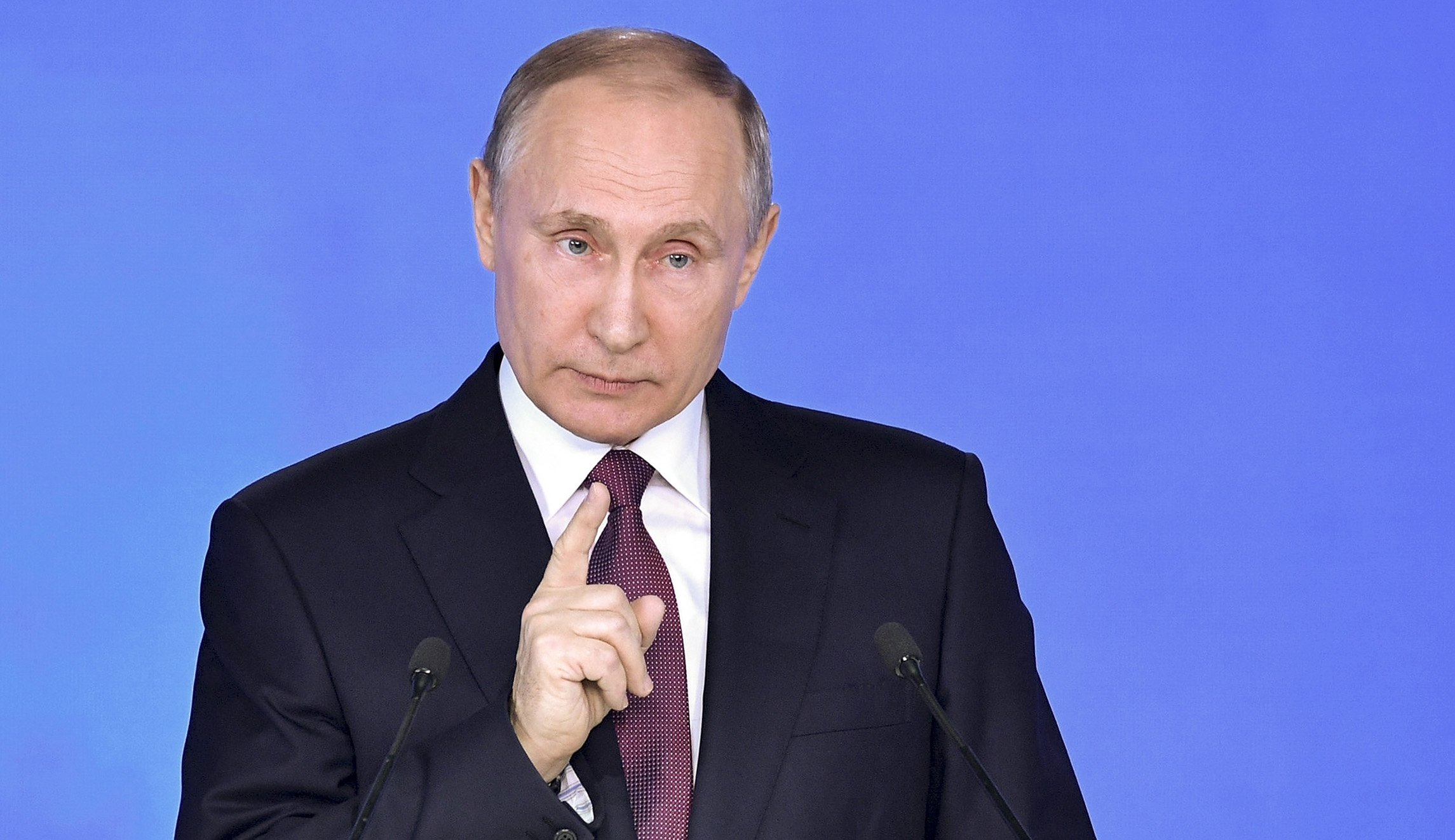
Russian President Vladimir Putin’s dramatic claim on Thursday to have added an array of unstoppable weapons to its already vast nuclear arsenal has alarmed arms control advocates, and sparked new talk of a Cold War-style arms race between the two rival powers.
Putin, in a nationally televised speech coming less than three weeks before a March 18 presidential election, described at least four new weapons, including new long-range cruise missile powered by a small nuclear reactor that supposedly can fly “indefinitely”; a new hyper-glide vehicle that can bob and weave around radars; and an underwater drone armed with a massive nuclear warhead that could be floated to U.S. shores.
The descriptions of the various weapons systems were all accompanied by cartoonish video animations, one depicting a multi-warhead intercontinental ballistic missile descending on Florida, home of President Trump’s Mar-a-Lago estate.
“Welcome to the new nuclear arms race,” tweeted Joe Cirincione, president of the anti-proliferation Ploughshares Fund. “This will not end well.”
Experts seem to agree the threat is real, even as they are unsure the weapons are.
“Do any of these work? Do they even exist?” asks Cirincione, who believes all are in some stage of development. “The time to stop them is now. The time for new talks is now.”
1. Welcome to the new nuclear arms race. Putin announces 4 new nuclear weapons to answer the 3 new nuclear weapons US announced last month. This will not end well.
— Joe Cirincione (@Cirincione) March 1, 2018
“The ‘nuclear-powered’ cruise missile is way out there and the least feasible of the new weapons,” Cirincione said in follow-up comments to the Washington Examiner. “But the rest are in various stages of development and are very real.
“Is he boasting? Sure. But it’s like boasting about your muscle car when you really have a muscle car,” he said. “Many of us warned when President George W. Bush withdrew from the [Anti-Ballistic Missile] Treaty that it would lead to a new arms race. It did not at first, but has now.”
[Russia accuses Trump of getting Europe ready for nuclear war]
Dana White, top spokesperson for the Defense Department, said the U.S. can still rest easy.
“We’re not surprised by the statement,” she said. “The American people should rest assured that we are fully prepared.”
Putin described the new weapons as all having the ability to defeat U.S. defenses, which is a bit of a canard, given that Russia’s ICBMs have always had the ability to overwhelm America’s missile shield, which even if it works perfectly would be able to stop only a small number of incoming missiles.
The dramatic escalation of nuclear rhetoric may be part bluster, but Putin’s boasting matches U.S. intelligence assessments about growing size and capability of Russia’s rapidly expanding arsenal of weapons that, because of their delivery systems, are not covered by the current New Strategic Arms Reduction Treaty signed in 2013.
“I know Russia has been developing hypersonic missiles but I can’t say whether Putin has accurately described their fielding,” said Mark Cancian, a senior adviser at the Center for Strategic and International Studies.
“This does show that [Defense Secretary Jim] Mattis’ notion of long-term competition with Russia, as described in the National Defense Strategy, is prudent since Russia is clearly intent on competing with us,” Cancian said.
[Trump’s new nuclear weapons plan meant to send a message to Russia]
Putin’s showcasing of Russia’s purported new nuclear capabilities comes after the United States released its new nuclear strategy, which emphasized the need to develop low-yield warheads to counter an array of new Russian weapons.
In releasing the 2018 Nuclear Posture Review, Pentagon officials said last month Russia has roughly 2,000 “non-strategic” weapons such as ground, air and sea-launched cruise missiles, torpedoes for surface ships and submarines, and depth charges.
David Albright, a well-regarded nuclear expert who heads the nonprofit Institute for Science and International Security doubts that Russia actually has a nuclear engine to power a cruise missile with unlimited range, even though that’s something both the U.S. and Russia worked on during the Cold War.
“It’s incredibly irresponsible in today’s world to even talk about a nuclear rocket engine. Essentially it’s an unshielded reactor spouting radioactive material out of most designs,” he said.
Albright says while it’s unlikely Russia has miniaturized and tested such a nuclear propulsion system, it’s not impossible, noting that a radioactive cloud was detected over Europe last summer that was never explained.
“It may not be related at all, but the tracking said it came from Russia, so it’s a big mystery,” Albright said.
But the real takeaway from Putin’s nuclear saber-rattling is that there is no effective defense against nuclear weapons, he says.
“It bolsters the idea that countries will try to figure out ways to overwhelm an antiballistic missile system, and if they are technologically sophisticated like Russia, they very well may succeed,” Albright said.
