

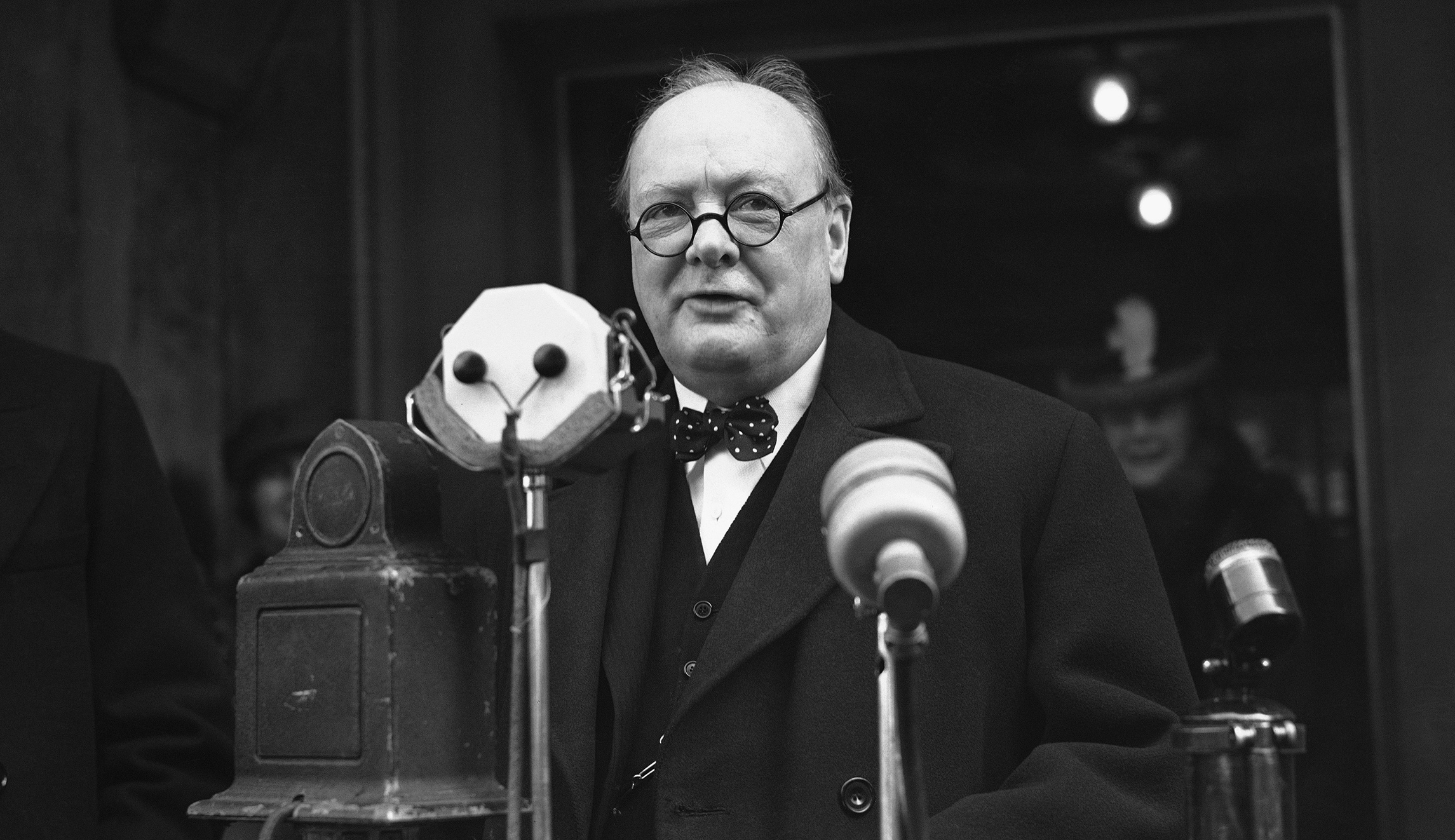
On a warm Fourth of July morning 77 years ago, two British battleships slipped into the Mediterranean harbor of Mers El Kebir. At the personal orders of the prime minister and with two-dozen destroyers in tow, those men-o-war laid waste an undefended French fleet.
In less than half an hour, Her Majesty’s Royal Navy unceremoniously slaughtered more than 1,200 Frenchmen.
Recommended Stories


Years later, one survivor described the unique horror of watching his shipmates drowning while simultaneously burning alive from ignited petrol. “The attack was a betrayal,” he said, “It was a real crime. It was murder.”
In truth, it was Sir Winston Churchill’s finest moment. Despite the darkness and horror, his decision to attack an ally punctuates the prime minister’s career. And what’s more, it was an example of leadership that should be remembered as we celebrate Independence Day.
Like all great things, the attack required Churchill to make a difficult decision. And like all political episodes, it requires context to understand. On July 4, 1940, the island nation stood alone against Hitler’s Germany. His armies had swept the British Expeditionary Force from the continent, sacked Paris, and were held only at bay by the Royal Navy in the English Channel. America was still on the sidelines.
While Hitler’s Kriegsmarine couldn’t beat the Royal Navy by itself, a combined Franco-German fleet could easily win that fight. That’s why Hitler wanted the French fleet anchored off the Algerian coast. And it’s why England couldn’t let him have it.
So, Churchill blew it up.
When the French fleet declined to join the British, Adm. John Summerville’s Naval Force H fired salvo after salvo of massive 15-inch shells against the helpless sailors while dive-bombers strafed them from above. It was violent, it was brutal, and it was the epitome of statesmanship.
In the vacuum of today’s ivory tower, academics would tsk and tut about Churchill’s decision to pull the trigger. Cable news pundits would protest the savagery. And of course, conservative Twitter would cheer that decision as, like, totally alpha.
But an overarching standard and the individual specifics are needed to make a judgment. The question is whether the bombing was prudent.
Prudence defines statesmanship, the political art that produces a choice. Chief among the virtues, it guides the application of the universal to the circumstantial. Greek philosophy calls prudence “right reason applied to practice.” And though Churchill wasn’t classically trained, he was something of an English Aristotle.
In a 1948 treatise disguised as an essay on painting, the prime minister explained how he approached the challenges of the Second World War. He wrote that statesmanship was analogous to painting and argued that before one can fill a canvas, he must possess an “all embracing view…of the beginning and the end, the whole and each part.” Only when the artist understands every facet of his subject can he decide whether to shade here or lighten there. So it is with war and politics.
To win a battle, a general must survey the landscape and the circumstances. To win an argument, a statesman must understand his people, the problems in question, and the underlying principles. He must know how to pressure colleagues here, concede to or collude with opponents there, and advance the good always.
That’s exactly what Churchill did when he sent those Frenchman to their watery graves. He applied principle to circumstance, killing sailors who were previously allies and who never lifted a finger against the British Empire. Though paradoxical, it was good, honorable, and virtuous. In a word, it was prudent.
At that time, President Roosevelt was still questioning whether it was worth reinforcing England. Appeasers inside parliament still wanted to make peace with Hitler. And if the French fleet fell into German hands, Britain could never repel a Nazi armada. In a real sense, Churchill’s career and the fate of the world was anchored at Mers el Kebir.
Aristotle argues the prudence of any choice rests on two equally indispensable pillars. Both an individual’s “reasoning must be true” and his “desires right.” And as the record shows, Churchill was right. Hitler was preparing to seize the ships and to impose an evil nihilism upon humanity, the like of which the world has not seen since.
With hindsight, it’s a lot easier to say all of this now. Scholars understand that without the attack, there would be no D-Day, no V-E Day, and maybe, no more 4th of July. After devouring Europe, who could doubt that Hitler would look to the New World?
With his back against the wall, Churchill didn’t know that. All the prime minister could do was weigh current circumstance against principle. And it worked.
The French fleet sank, Hitler never left the continent, and the United States came to England’s aid. Churchill didn’t throw out arbitrary red lines. Alternatively, he didn’t reset relations and hope to pacify an evil enemy.
In short, Churchill made a prudent decision, and a very hard one. We should remember him for his statesmanship today because, in a very real way, we owe our continued independence to the half-American English prime minister.
Philip Wegmann is a commentary writer for the Washington Examiner.
