

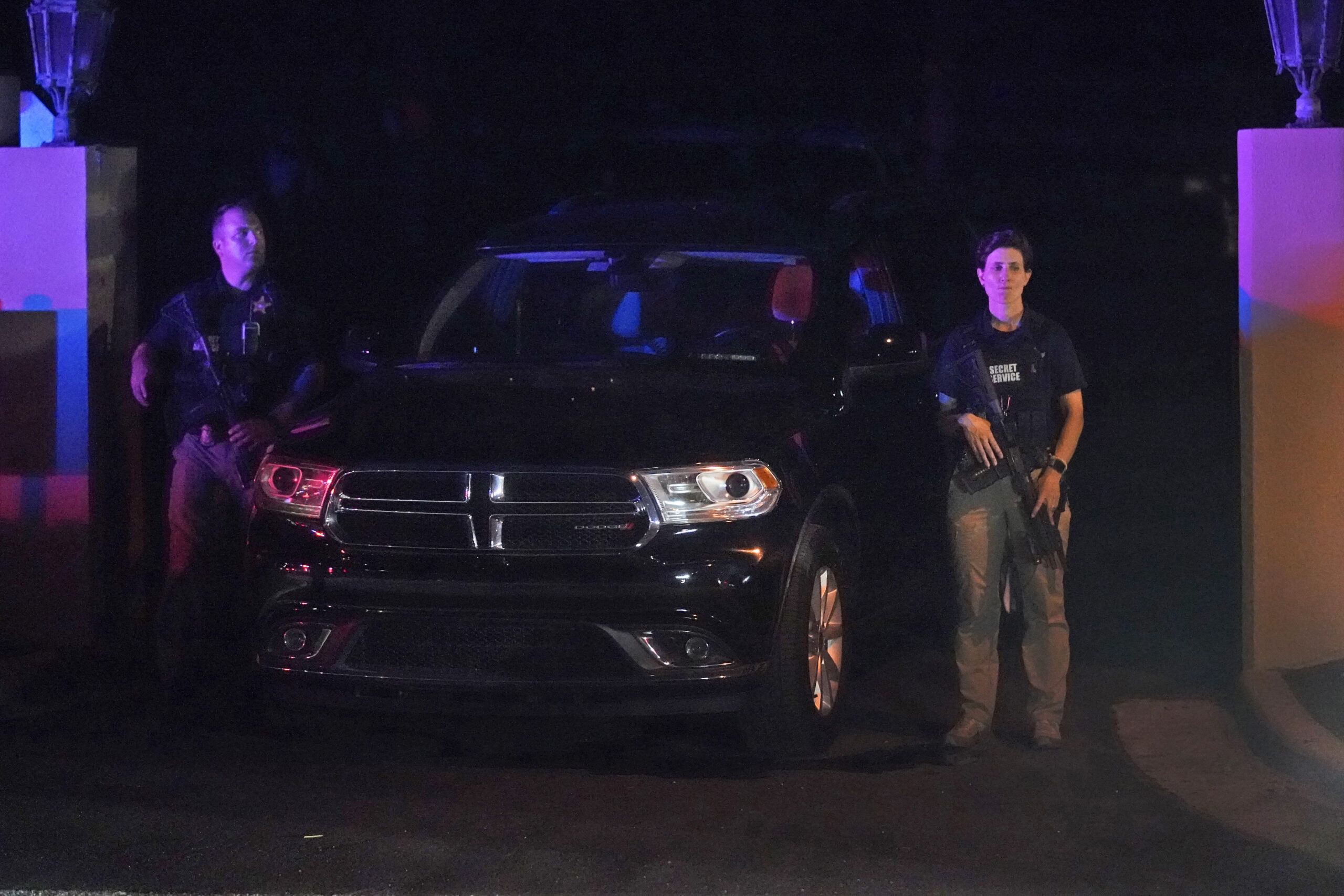
When FBI agents raided former President Donald Trump’s home this week, it was just the latest and most aggressive step in one of the multiple investigations Trump is facing.
Recommended Stories


A grand jury in Georgia is criminally probing Trump’s conduct after the 2020 election. New York’s attorney general is civilly probing his real estate business. A special congressional committee is airing testimony from his former associates in prime time.
And the alleged violation of law that led the FBI to execute a search warrant at his Mar-a-Lago home — a breach of the Presidential Records Act, reportedly — is not even the only thing into which the Justice Department is digging.
THREE QUESTIONS WE NEED ANSWERED AFTER FBI’S TRUMP RAID
Law enforcement officials are also reportedly investigating Trump’s activities leading up to the Jan. 6, 2021, riots at the U.S. Capitol, treading the same ground as the select committee Democrats impaneled in the House last year.
“I think that is the problem. Donald Trump’s status has always been viewed through a political lens. For his supporters, these multiplicitous investigations simply confirm a deep state conspiracy,” Jonathan Turley, a constitutional law professor at George Washington University, told the Washington Examiner. “For his critics, they confirm his status as felon in chief.”
The FBI raid, which Trump announced on social media as it was happening on Monday, reportedly involved material that Trump may have improperly taken to his Florida club upon leaving office last year.
Trump has said he was cooperating with the National Archives and Records Administration to return documents the agency wanted to retain.
The National Archives said Trump had voluntarily handed over 15 boxes of documents covered under the Presidential Records Act earlier this year “following discussions with President Trump’s representatives in 2021.”
But what precisely led the Justice Department to take such extraordinary steps remains unclear. Experts have speculated that Trump may have held back highly classified material, made efforts to stonewall investigators, or otherwise violated the law in a so-far unknown way, triggering the need for a search warrant.
“There’s a disconnect in the accounts,” Turley said. “I mean, the application for the warrant presumably said that a search warrant was necessary at this stage, either because of a lack of cooperation or the danger of document destruction.”
“The factual basis of that application is one of the most intriguing questions following the raid, but the raid itself is something of an anomaly,” he added.
That’s because, Turley said, the Presidential Records Act “does not have a robust enforcement history,” and violations of that statute have rarely led to criminal charges because prosecution requires proof of intent to break the law.
Even if Trump avoids criminal liability in the presidential records case, his other legal entanglements could still bring trouble — and complications for his political future.
The Fulton County, Georgia, district attorney has been investigating Trump since January 2021 over a phone call between Trump and Georgia Secretary of State Brad Raffensperger in which Trump urged Raffensperger to “find” enough votes to change the election results in Georgia. Prosecutors are looking into other contacts Trump had with Peach State officials, including the governor, whom he pressed to fight the 2020 results.
That investigation has put some of Trump’s allies in the hot seat, including Rudy Giuliani, who is presently fighting a subpoena for testimony before the Fulton County grand jury.
In New York, Attorney General Letitia James is conducting a civil investigation into whether the Trump Organization misrepresented the value of real estate assets in pursuit of financial benefits like tax breaks.
Two of Trump’s adult children, Ivanka Trump and Donald Trump Jr., answered questions under oath for that probe in recent weeks after their testimony was delayed due to the death of their mother. Cushman & Wakefield, a firm that appraised real estate properties for the Trump Organization, handed over thousands of documents to James’s team this week.
A federal appeals court ruled this week that the IRS could provide Trump’s tax returns to Democrats on the House Ways and Means Committee, who are working to investigate Trump’s personal financial and business records.
And the Justice Department is investigating whether Trump should be held criminally responsible for the violence that occurred at the Capitol after he spoke to supporters on Jan. 6, 2021 — a probe Democrats had sought for more than a year before news of its existence leaked.
Altogether, the investigations paint a picture of a man either under siege by politicized law enforcement — or one whose profligate criminal activity is finally catching up to him.
Either way, the news of the FBI raid and the context in which it occurred, following years of criminal and congressional probes that consumed his presidency, could have significant implications for whether Trump launches a third bid for the presidency.
Trump supporters have reacted with fierce condemnation of the search, holding it up as evidence that the Justice Department has been irredeemably corrupted by a bias against Trump. Congressional Republicans have vowed to investigate the investigators if they retake majorities in November.
Trump’s critics have argued the fact that the raid occurred at all must mean the FBI already has evidence of a serious violation of the law.
Whatever the basis of the FBI raid, however, the publicly available evidence against Trump in the three known criminal probes — the Georgia investigation, the Presidential Records Act inquiry, and the Jan. 6 riot probe — is far from conclusive.
Turley said the Georgia case could prove difficult to prosecute because lawyers could argue two different and reasonable interpretations of the phone call at the heart of the case. Trump’s lawyers, for example, could argue that Trump was simply noting that he was only a few thousand votes short of victory, while Georgia prosecutors could argue that Trump was demanding the secretary of state conduct illegal activity on his behalf.
CLICK HERE TO READ MORE FROM THE WASHINGTON EXAMINER
Criminal cases have to be proven beyond a reasonable doubt, and competing interpretations of the same phone call could preclude that.
In the Jan. 6 criminal probe, Turley said prosecutors could run into First Amendment hurdles, as Trump’s speech to his supporters and subsequent tweets could be protected as an exercise of free speech rather than a criminal incitement to violence.
