

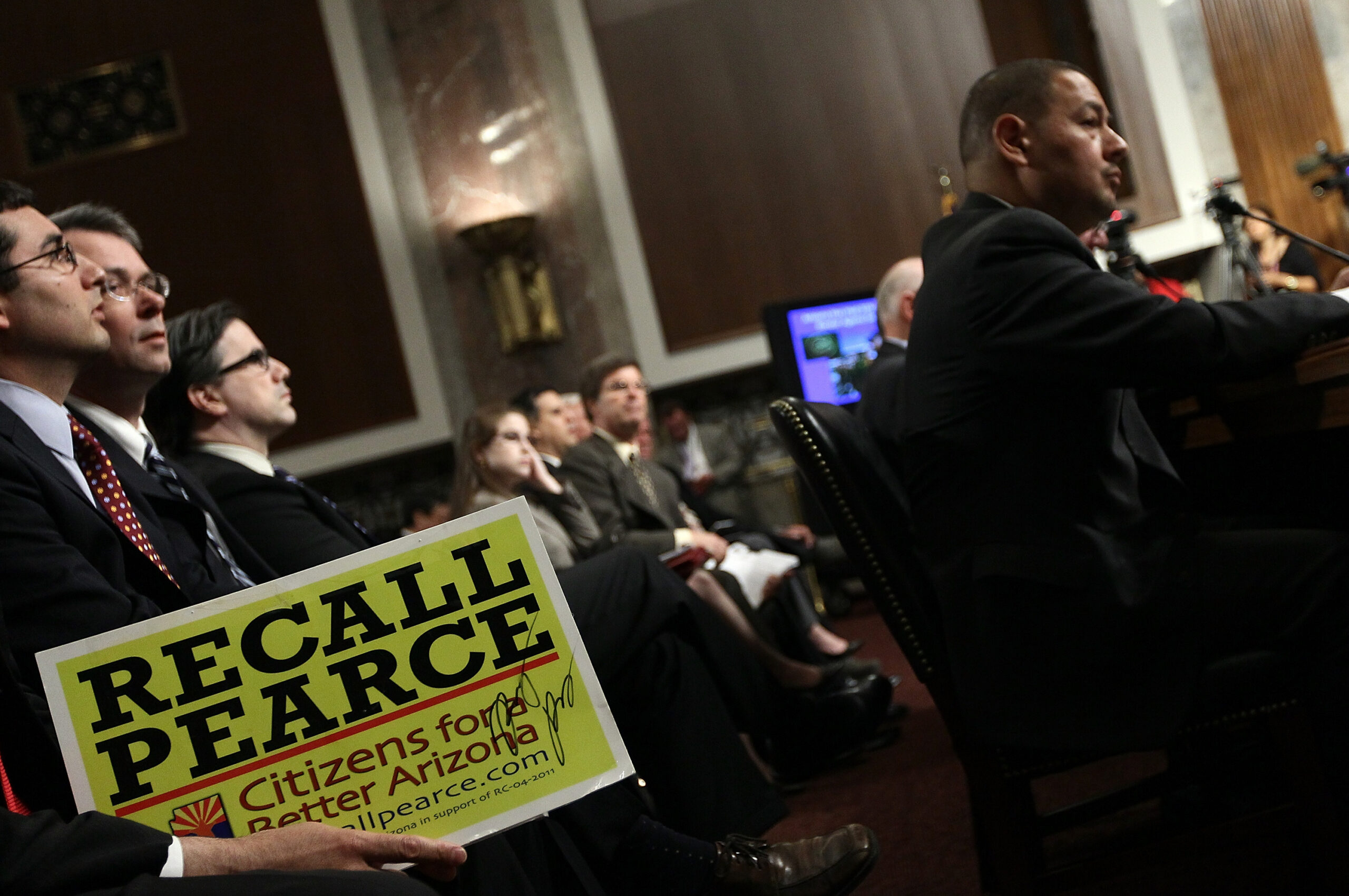
The Supreme Court on Wednesday will take up a case involving Arizona’s contentious immigration law, potentially shaping an issue pivotal to efforts by presumptive Republican presidential nominee Mitt Romney to win over Hispanic voters, whose anger over the law has undercut Republicans everywhere.
The court’s decision, expected in June in the middle of the presidential race, is rife with risk for Romney, who originally took a tough stand against illegal immigrants during the Republican primaries but is now trying to woo Hispanic voters in time for the November election.
The potential court vindication of Arizona’s get-tough solution to illegal immigration, which includes allowing police to question anyone they suspect of being in the country illegally, would be a victory for Republican leaders, but it also could further alienate Hispanics in battleground states — a possibility Romney concedes “spells doom for us.”
Sensing a political advantage, congressional Democrats were already maneuvering Tuesday to ensure the Arizona law and similar measures in other Republican-led states become an issue in the campaign.
“States like Arizona and Alabama will no longer be able to get away with saying they’re simply helping the federal government,” said Sen. Chuck Schumer, D-N.Y., who is proposing legislation that would block such laws even if the court upheld them.
Schumer’s proposal is unlikely to win on Capitol Hill, analysts agree. But it will help force Republicans to defend their secure-the-border stance in a way that makes it more difficult for Hispanics to support them.
Romney’s problems with immigration issues aren’t all coming from Democrats, however.
Sen. Marco Rubio, R-Fla., a rising star in the party who is often mentioned as potential running mate for Romney, is offering his own version of the so-called Dream Act, which would provide legal status and work visas to those brought illegally to the United States as children. President Obama has been pushing a similar measure unsuccessfully for years, but conservatives generally reject the proposal, and any others that provide a path to citizenship for those already in the U.S. illegally, as amnesty for lawbreakers.
Romney hasn’t backed Rubio’s proposal, though some activists and analysts are urging him to do so. It’s one way for him to demonstrate sensitivity to Hispanic concerns, they said.
“Absolutely, he should,” said Alfonso Aguilar of the Latino Partnership for Conservative Principles. “We’ve allowed a small but very vocal group to develop the conservative narrative on immigration. And as a result, Democrats have been very good at spinning that Republicans are anti-Latino. He needs to show a more balanced approach.”
Polls show Obama with a commanding edge over Romney among Hispanics, but Aguilar said widespread dissatisfaction within the Latino community over a record number of deportations and widespread unemployment under the Obama administration provides an opportunity for Romney.
While Republicans would prefer to talk about Obama’s failure to fix immigration, Democrats on Tuesday outlined their likely message to Latinos leading up to November’s election — a message that relies heavily on criticism of the Arizona law that the Obama administration is challenging in court.
“Police offers are trained to profile behavior — behavior, not people,” said former Sen. Dennis DeConcini, D-Ariz. “This law does the opposite. It profiles people. I’m embarrassed of my state.”
