Helping Russia divide NATO, Germany immolates Europe’s security credibility

Recognizing that it is more difficult to defeat 30 nations than it is one, Vladimir Putin has long sought to split the NATO alliance.

As he prepares to reinvade Ukraine, the Russian president is again applying his favored strategy with aplomb.


Russian forces have now amassed on Ukraine’s northern, eastern, and, via occupied Crimea, southern borders. Their number exceeds 100,000 troops, and their equipment includes fighter jets, bomber aircraft, tanks, armored infantry vehicles, missiles, artillery, and advanced electronic warfare and air defense systems. Russia does not appear, put another way, to be simply putting on a show. The temperatures around Ukraine’s borders are now hovering around 16 degrees Fahrenheit. This military deployment carries violent meaning.

Still, Putin wants to subjugate Ukraine under Moscow’s orbit in a way that mitigates the costs to Moscow. That means keeping the West divided and thus ensuring that he avoids the most damaging possible sanctions.

In this regard, Putin’s second line of effort over Ukraine comes via escalated threats to the rest of Europe. To that end, the former KGB lieutenant colonel is deploying his military on aggressive exercises in the Baltic Sea and undersea communications cables in the Atlantic Ocean. Putin is also flying his nuclear-capable bombers and advanced fighter jets along the Polish border. And Russian state media is pumping out increasingly hyperbolic threats, warning that European nations risk annihilation if they stand in Moscow’s way.

The pressure campaign is having an impact.

Croatia now says it will pull its military forces from NATO-allied states if Russia goes to war with Ukraine. France has criticized Britain for warning of a Russian plot to replace Volodymyr Zelensky’s government in Kyiv. And Germany continues to prevaricate over what sanctions could follow a Russian attack on Ukraine.

These concerns paint the picture of a NATO alliance that seems incapable of uniting against territorial aggression, the single defining purpose of NATO’s existence, and reduce NATO’s credibility as a defensive military alliance. A keystone principle of NATO’s credibility is thus its ability to present a unified stance on matters short of war. If Putin knows that NATO stands united, he’s far less likely to risk challenging the alliance in conflict.

But as the United States seeks to present this unity over Ukraine, Putin has a now-familiar ace card up his sleeve.

Germany.

In 2022, Berlin offers the linchpin of Putin’s strategy against the West. It is Europe’s most powerful economy, which sets the tone of appeasement and undermines NATO’s credibility.

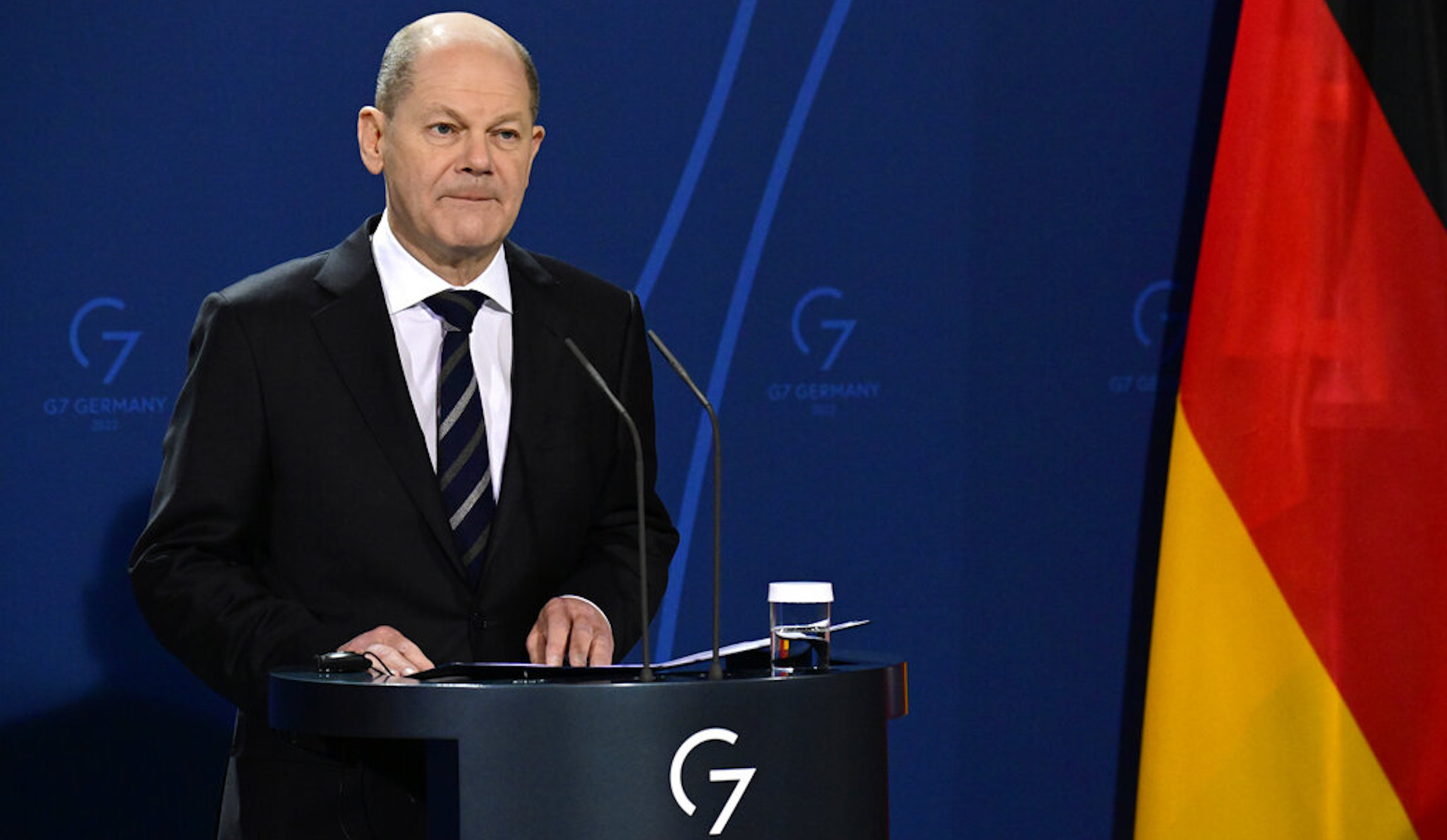
The new government of Chancellor Olaf Scholz has somehow made itself even more sympathetic to Putin than that of Scholz’s predecessor, Angela Merkel. Scholz is ignoring the calls of his foreign minister, Annalena Baerbock, to pledge that Putin’s Nord Stream 2 pipeline won’t pump any gas if an invasion of Ukraine occurs. Scholz’s obstinate dedication to the pipeline matters greatly. Nord Stream 2 is the centerpiece of Putin’s interest in ensuring Europe’s long-term dependency on Russian energy exports. Putin intends to translate that energy dependency into extorting Western Europe into political concessions on other matters — matters, that is to say, such as Ukraine and the security of the Baltics.

Germany’s challenge to NATO gets worse. Scholz refuses to increase defense spending from the paltry 1.5% of gross domestic product that Germany currently invests. (The NATO target expenditure is 2% of GDP.) Instead, the socialist-minded chancellor begs Putin for a meeting and dialogue on a “qualified new beginning.” One assumes this will come after Ukraine receives its unqualified ending.

But the impact is clear: Facing the most preeminent threat to European security, Europe’s most powerful economy would prefer to abandon its allies rather than lose its access to Putin’s favor and his cheap gas. The risk is that what now affects Ukraine might one day soon affect all of Europe.

Related Content
