

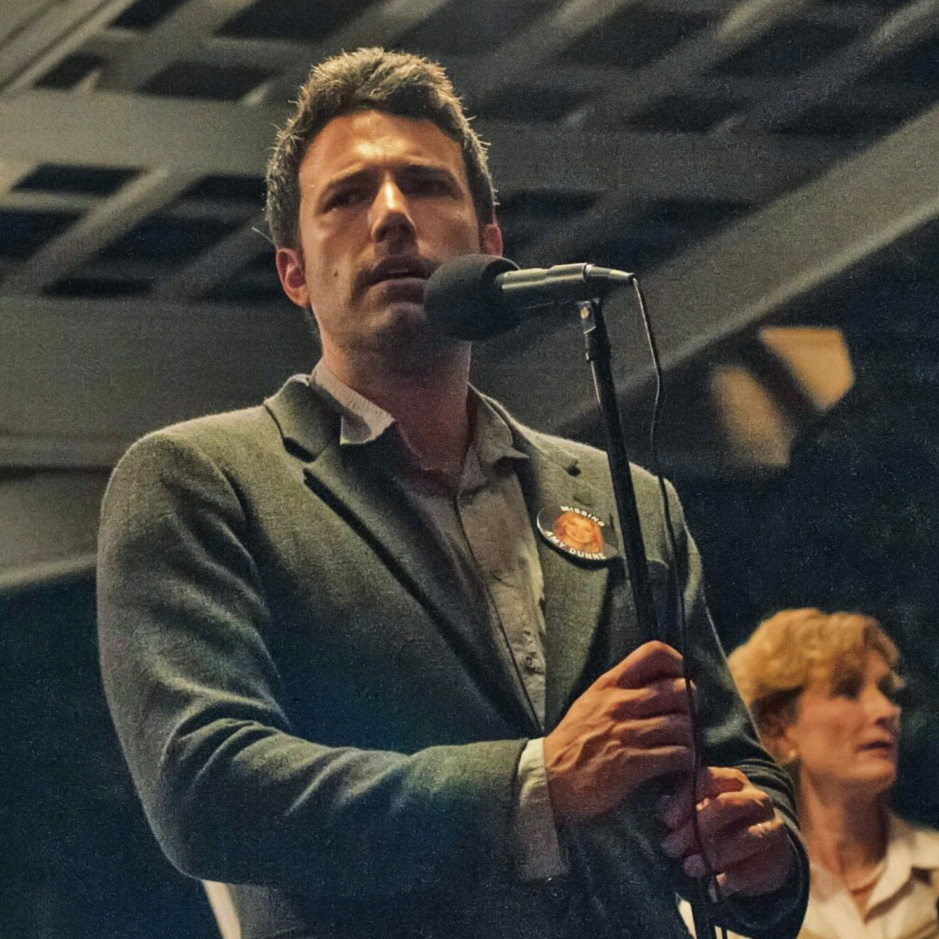
In the universe according to Gone Girl, men are no great shakes: They’re inconstant and weak and foolish. But women . . . ah, women. They’re smart, resourceful, infinitely clever—and profoundly dangerous. It’s lucky for the financiers of this sizzling domestic melodrama on the model of Fatal Attraction (1987) that it was based on a bestselling novel by a woman named Gillian Flynn and that the screenplay was written by Flynn as well—because otherwise it would be ripped to shreds by feminists arguing, with some justice, that it is the most misogynistic work of popular culture since, well, Fatal Attraction.
The “girl” of the title is Amy Elliott (Rosamund Pike). Her husband Nick (Ben Affleck) comes home to their McMansion on their fifth anniversary to find an overturned glass table and no Amy. As the media turn the story into a national sensation, the police find evidence that Amy’s blood had been spilled on their kitchen floor and then mopped up. And as the story progresses, we, the audience, are privy to diary entries written by Amy that detail the degeneration of their relationship.
Stay informed.Stay ahead.
Join Washington Examiner for unlimited access to the news, analysis, and commentary that matter most.
Already a member? Log in
After a few years working in New York media and living high on the hog in a Brooklyn brownstone, the couple had ended up broke in a McMansion in Nick’s depressed hometown in Missouri. He’s running an unsuccessful bar with his twin sister; Amy’s spending her days reading—and she’s getting frightened because it seems like he wants to get rid of her.
Or does he? Gone Girl the novel has been an enormous success since its publication two years ago because of the corkscrew cleverness of Flynn’s plotting. The book features not one, but two unreliable narrators who hide pertinent information from their nearest and dearest—and from the reader as well. Part of the pleasure of reading the book is watching those narratives unravel and reconstitute themselves as the facts start coming clear.
Affleck has played this part before, notably in a terrific 2002 film called Changing Lanes—a curdled pretty-boy WASP whose easy charm masks his soullessness and emptiness. It’s easy to forget what a subtle actor he can be, given that (a) he’s made his name more as a director over the past few years with the Oscar-winning Argo (2012); (b) he seemed to have ruined his good name by starring in horrific junk like Gigli (2003) and State of Play (2009); and (c) he sounds like an inarticulate boob when he talks about anything serious, as he did the other week getting into a fight with Bill Maher on HBO over radical Islam.
Flynn was blessed to have the extraordinarily sharp director David Fincher take the helm of the movie. The immensely controlled Fincher, whose previous work includes The Social Network (2010) and the brilliant Zodiac (2007), properly sees Flynn’s story as an update of a classic film noir and had the movie filmed entirely in shades of gray—until a climactic scene takes place in a house that is suddenly lit up with bright yellow color, which conveys a mood of unmistakable horror. Technically, this is filmmaking of a very high order.
Fincher cast the supporting roles superbly, with the Cheshire-cat comedienne Missi Pyle doing an amazing turn as a Nancy Grace-like TV host and a stage actress named Carrie Coons memorable as Nick’s loving and downbeat twin sister. The revelation, though, is Tyler Perry, the writing-directing-acting mogul responsible for a string of highly successful, somewhat amateurish, and wildly overdone movies aimed at the African-American audience. Perry plays an attention-grabbing criminal defense attorney and is so charismatic and entertaining that he gives the movie a jolt of relaxed energy every second he is on screen.
For a while, it seems as if Gone Girl might achieve classic status, but it runs aground toward the end for two reasons. First, the plot takes two ridiculous turns (as it does in the book) that violate the central quality of Amy’s character: her meticulousness. Second is the casting of Rosamund Pike as Amy. Reese Witherspoon was originally going to play the part, but Fincher didn’t want her and thought she was too old.
That was a terrible mistake, because Amy is supposed to be alternately lovable and cold—Meg Ryan from When Harry Met Sally . . . combined with the bunny-boiling Glenn Close. While Pike excels at the latter, she has no clue how to convey the former. Witherspoon, a far more interesting and resourceful actress, might have. Fincher was apparently so eager to evoke Alfred Hitchcock, down to the blonde hauteur of Grace Kelly and Tippi Hedren, that he went for the surface rather than the chops. As a result, Gone Girl is all ice, no fire, and therefore it never delivers the visceral punch Fatal Attraction still does more than a quarter-century after its release.
This cautionary tale of a sap who faces the death penalty as a result of society’s misunderstanding of the evil that women can do is being sold as a movie about the mysteries of marriage. If it is, it could almost serve as a manifesto for one of those lunatic men’s-rights organizations that claim the deck is stacked against anyone with an XY chromosome.
John Podhoretz, editor of Commentary, is The Weekly Standard’s movie critic.
