

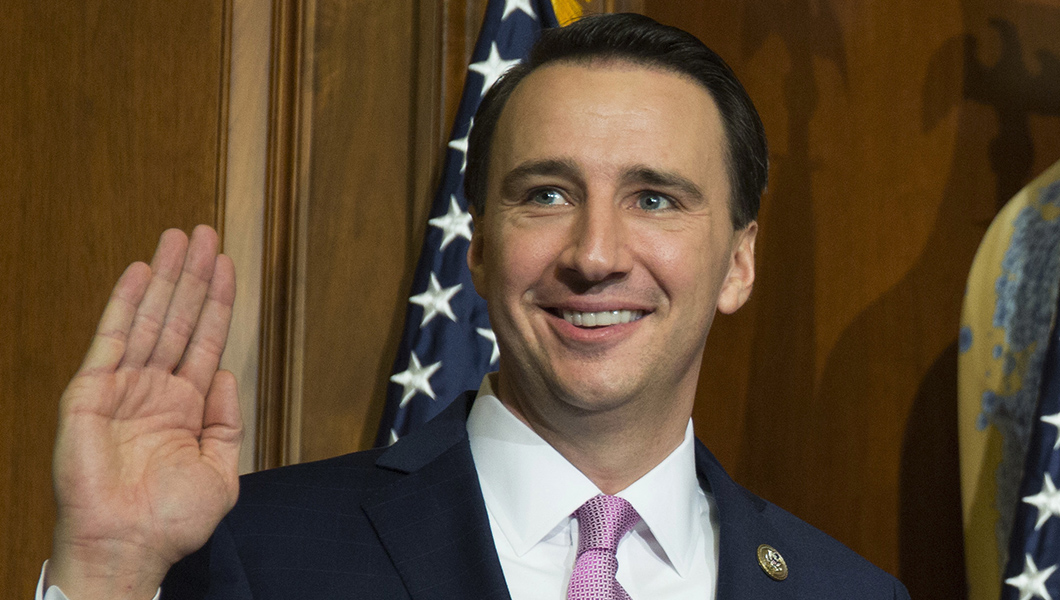
Recently retired Republican Rep. Ryan Costello is joining an advocacy group that promotes a federal carbon tax, as he aims to convince his party to support government policies to combat climate change.
Costello on Tuesday will become managing director of Americans for Carbon Dividends, an advocacy organization established in June to lobby Congress to support a carbon tax plan proposed by the Climate Leadership Council, a group led by two former Republican secretaries of state, James Baker III and George Shultz.
Recommended Stories


“Climate change should be a top priority of Republicans in Congress, and that is why I am leaning in on this,” Costello told the Washington Examiner in an interview. “The Republican Party needs to have a plan and lead on this issue.”
Costello, 42, first elected in 2014, retired from Congress last year rather than run for re-election, partly because of the challenges he would have faced winning in a moderate district during the era of President Trump.
During his four years in Congress, Costello was a rarity among House Republicans in that he led efforts to pass legislation to mitigate climate change.
He belonged to the bipartisan Climate Solutions Caucus and opposed Trump’s decision to exit the Paris climate change agreement. In prioritizing climate change post-Congress, Costello joins his good friend Carlos Curbelo, the centrist Florida Republican and co-founder of the Climate Solutions Caucus.
Curbelo, who lost re-election in a Democratic-leaning district, is joining Columbia University’s Center on Global Energy Policy, where he will help its work on carbon pricing policy.
Americans for Carbon Dividends, the advocacy group Costello is joining, is promoting a carbon tax plan proposed by the Climate Leadership Council that is more politically palatable to some Republicans, because it is revenue neutral and has the support of oil and gas companies.
The so-called carbon-fee-and-dividend model preferred by the group distributes all of the revenue from the tax as a rebate to American households, protecting them from higher energy costs.
Houston-based oil and gas giant ConocoPhillips last month donated $2 million over two years to Americans for Carbon Dividends, becoming the second energy company after Exxon Mobil to provide money to the group.
The Climate Leadership Council proposal would impose a carbon tax beginning at $40 per ton and give the proceeds to the public through rebates, while scrapping carbon regulations imposed by the Environmental Protection Agency.
It would also protect oil and gas companies from state and municipal lawsuits blaming them for climate change.
Costello views the approach as a market-based solution, one that would encourage energy producers to switch to cleaner nonfossil fuel alternatives if doing so costs less than paying the tax.
“Any time you talk about solving a really big complicated issue, a lot of Americans ask how will you get into my pocket on this one,” Costello said. “The response here is we will actually put money in your pocket and over the long-term address climate change.”
Congress is unlikely to pass carbon pricing legislation anytime soon because of strong conservative resistance.
But there are signs of momentum. A coalition of House members recently introduced the first bipartisan carbon tax legislation in nearly a decade, with a plan that is broadly similar to the Climate Leadership Council proposal.
Sen. Chris Coons, D-Del., and former Sen. Jeff Flake unveiled a nearly identical bill last month.
Costello wants to grow Republican support by combating the perception of most conservatives who view any form of carbon pricing as a tax increase.
A carbon-fee-and-dividend model does not allow the government to spend proceeds of the tax.
“I don’t see a solution to climate change other than this,” Costello said.
