
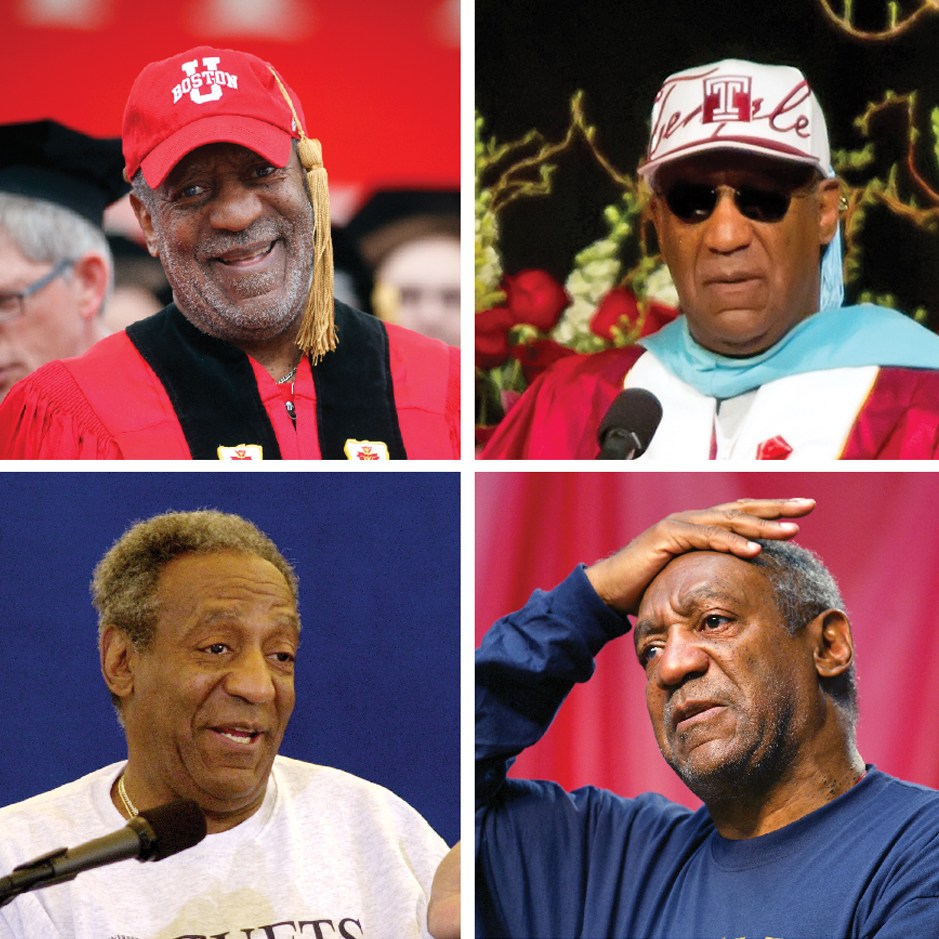
If one good thing comes out of the Bill Cosby Crisis, The Scrapbook is fairly certain what it will be. For as the New York Times reported in a recent story, the 60 or so institutions of higher learning in America that have, during the past few decades, conferred honorary degrees on Bill Cosby are now agonizing about what to do. Some have chosen not to act in response to the allegations against Cosby; others have officially revoked their degrees; still more have rules against such retroactive gestures.
As readers might have guessed, The Scrapbook pleads the Fifth Amendment on this question. What colleges and universities do in these circumstances is their own business; and in any case, honorary degrees are essentially meaningless. No dean is likely to appear at Cosby’s doorstep demanding his diploma, and nobody thinks more or less of Bill Cosby because, say, the University of Pennsylvania once conferred an honorary doctorate upon him. (Indeed, as the Boston Globe’s Alex Beam once memorably demonstrated, even Cosby’s “earned” doctorate in education from the University of Massachusetts is essentially honorary.)
Recommended Stories


No, The Scrapbook’s hope is general, not specific: Perhaps, at long last, and in light of the criminal allegations surrounding Bill Cosby, American colleges and universities will take a good, long look at their contemporary habit of conferring honorary degrees on celebrities—and largely for the purposes of providing “entertainment” at commencement.
A generation ago, the notion of a nightclub comedian and TV sitcom star being granted academic honors by the likes of Oberlin, Yale, Carnegie Mellon, Swarthmore, Brown, Johns Hopkins, Chapel Hill, Haverford, William & Mary, Notre Dame—all of whose diplomas are somewhere in the Cosby household—would have seemed preposterous. But even in academia, we live in an epoch when pop-culture fame trumps historic or cultural eminence, and Harvard University confers an honorary doctorate on Oprah.
To be sure, Bill Cosby is somewhat more than a comic: His study-hard-and-pull-up-your-trousers message no doubt resonated with educators—although it might seem mildly ironic today. Still, the purpose of conferring academic recognition is not, or should not be, a political gesture. As readers know, conservatives, both serious and frivolous, are seldom honored in this way; even worse, the administration of Barack Obama (Columbia ’83, Harvard Law ’91) judges higher education on the basis of potential earning power. So what sort of message is delivered when commencement honorees and baccalaureate speakers are drawn from the ranks of entertainment, sports, pop music, and celebrity culture?
A stronger sense of purpose, a reminder of mission—yes, the restoration of some measure of dignity—would be welcome on campus once the Cosby Crisis is passed.