

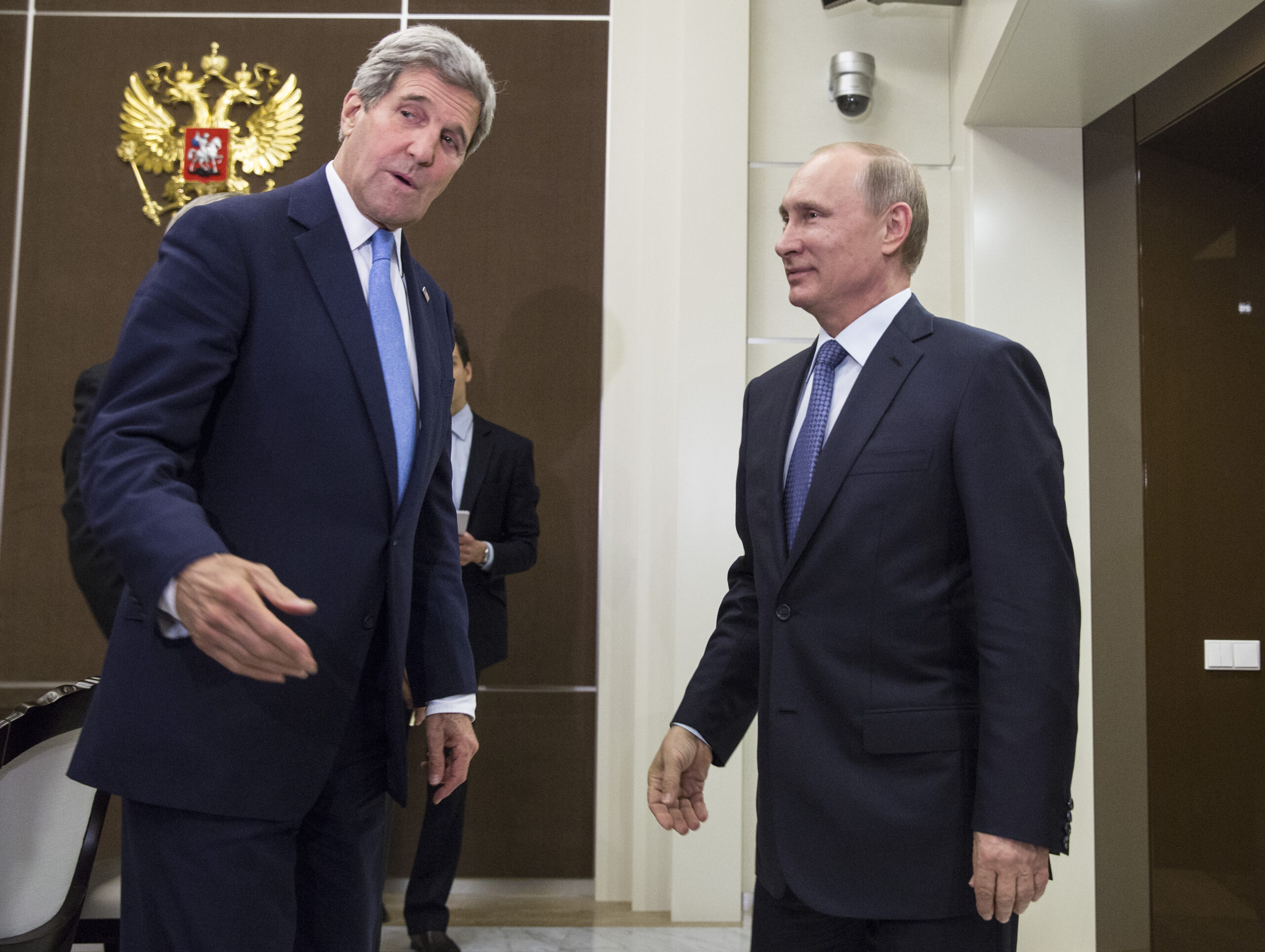
Secretary of State John Kerry will meet with Russian President Vladimir Putin next week in Moscow, and will tell Putin that if Russia wants sanctions relief, it will have to restrict its activities in Ukraine.
Kerry is heading to Moscow next week to continue a dialogue with Putin that Obama opened at the United Nations General Assembly convening in September.
Recommended Stories



“[T]he first item on Secretary Kerry’s agenda is the item that’s been at the top of the president’s agenda in each of his interactions with President Putin, and that simply is Russia’s continued resistance to following through on their commitment to implement the Minsk agreement, that continuing to provide support and encouragement to Russian-backed separatists in eastern Ukraine is destabilizing that country and is undermining their territorial integrity,” said White House spokesman Josh Earnest.
Obama spoke with Putin in September and again in Turkey during the G-20 summit, and in Paris during the U.N. climate change talks recently because it would be “irresponsible not to pursue a resolution to our differences that could available in high-level talks,” Earnest explained. “[A]nd it’s why Secretary Kerry is going to do the same.”
Besides Ukraine, those differences include Moscow’s support of Syrian dictator Bashar Assad.
“I’m confident that Secretary Kerry will also have an opportunity to talk about Russia’s involvement in military actions inside of Syria and repeat our view that Russia should focus their efforts on ISIL and seek to integrate their efforts into the broader international coalition that’s led by the United States to degrade and ultimately destroy ISIL,” Earnest said, using the administration’s preferred acronym for the so-called Islamic State.
On Ukraine, Earnest said international sanctions against Russia for its annexation of the Crimean Peninsula are working. The sanctions are crippling Russia’s economy and isolating Moscow, Earnest maintained.
In the roughly 18 months that sanctions have been in place, two G-8 summits became G-7s because Russia was disinvited in light of its aggression in Ukraine, Earnest said.
“I think is an apt an illustration as any of Russia’s isolation,” he said. “In fact, one of those meetings was actually supposed to take place in Russia and got moved. And I think that is a pretty clear indication of how solid our international coalition continues to be in terms of impressing upon Russia the need to respect basic international norms and the territorial integrity of Ukraine.”
