

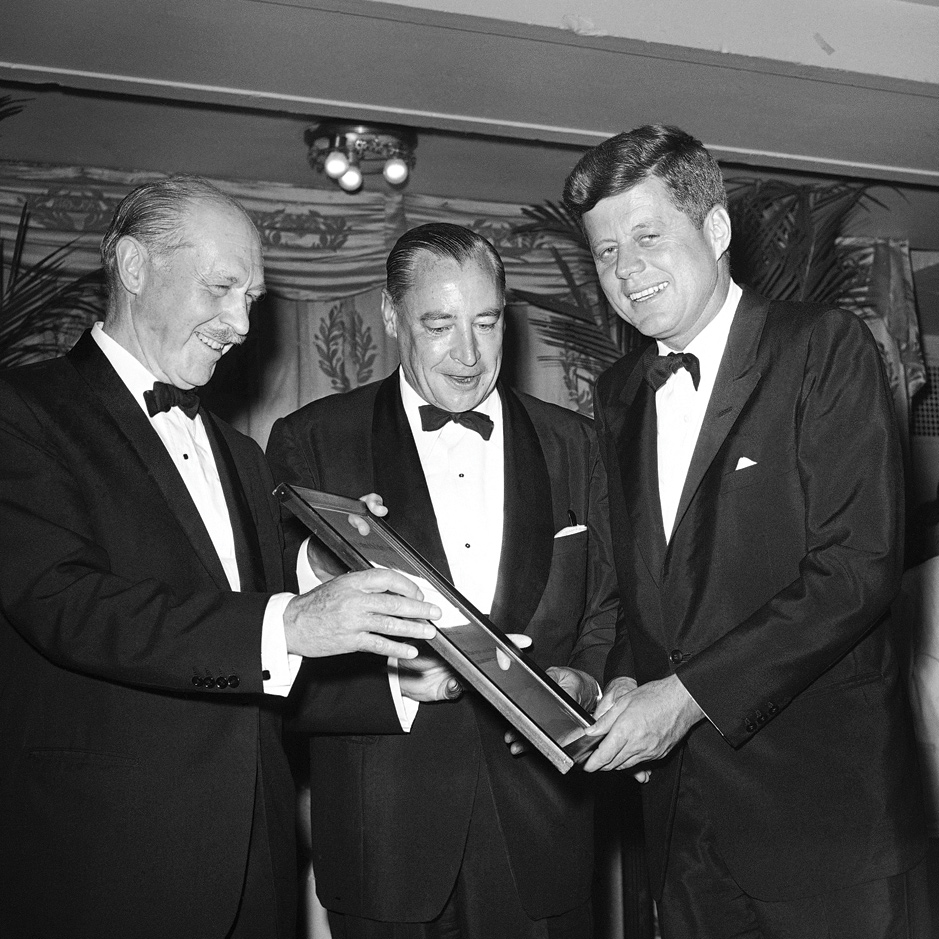
For all but a few, fame is ephemeral—and especially ephemeral for journalists, who are often astute observers of current events but seldom leave a lasting imprint. Drew Pearson, a powerful and much-feared muckraking columnist and broadcaster from the 1930s through the ’60s, is mostly forgotten now; but his columns remain a prism through which to observe that tumultuous era. Wading through Pearson’s columns, however, can be a lengthy and challenging process, as his writing could be ponderous, pedestrian, and preachy.
Fortunately, the late Peter Hannaford combed through Pearson’s diaries, which often summarized his columns and contain lots of behind-the-scenes gossip and insights. The result is a portrait of a smart, influential, and not terribly likable man whose greatest love often seems to be himself. This volume focuses on the last decade of his life, which encompassed the last year of Eisenhower’s presidency, through the first year of Nixon’s.
Stay informed.Stay ahead.
Join Washington Examiner for unlimited access to the news, analysis, and commentary that matter most.
Already a member? Log in
Pearson always felt that he was holding politicians accountable, but often focused not on job performance but on personal peccadilloes. He was especially interested in John F. Kennedy’s extramarital affairs, writing (April 12, 1963) that “I don’t know whether I shall ever write that book on ‘Love in the White House,’ but certainly I have enough material.” He broke a story about gay staff members of California governor Ronald Reagan, which in 1967 was considered scandalous and career-killing. His titillating column also chronicles the fact that Reagan initially took no action when it was revealed that the staffers had been involved in a “homosexual orgy.”
Reagan was angry about Pearson’s column and did what many politicians do when they receive bad news: attack the messenger. He said that “if [Drew] Pearson is going to hang around California anymore, he better not spit in the street.” For his part, Pearson was sensitive about criticism that he refrained from naming the aides: “The fact is that I can’t name names without getting into a libel suit and also being unfair. Furthermore, there’s no use hurting people who are already suffering.”
Yet more interesting than Pearson’s penchant for the prurient is the extent to which he was a walking conflict of interest. As a journalist he did not merely break news and pass judgment, he advised and wrote speeches for several key players, including Lyndon Johnson. In one diary entry he praises a speech Johnson delivered, but admits that he is biased—having written it. In another entry, Pearson matter-of-factly refers to writing parts of LBJ’s State of the Union address. Pearson’s affection for Johnson often came at the expense of the Kennedy clan, whom he frequently disparaged in his columns and broadcasts.
While Pearson relished being a political player—in describing certain civil rights bills he speaks of how “we” got it passed—he loved a good story and didn’t mind angering people. Senator Joseph McCarthy once tried to choke Pearson; the fight was broken up by vice-president-elect Richard Nixon. His exposure of financial misconduct by Connecticut senator Thomas Dodd—father of Senator Christopher Dodd—resulted in the senior Dodd being censured by the Senate.
Pearson, the subject of innumerable lawsuits, did have the capacity to self-edit. Just before the 1968 presidential election, under pressure from editors doubtful about his source, Pearson killed a column reporting that candidate Richard Nixon had once undergone psychotherapy. After the election, the psychiatrist who treated Nixon claimed that Pearson was right but that he had been pressured by the Nixon campaign to deny the story so that the columnist would have second thoughts.
Pearson was well aware that the revelation might have damaged, even destroyed, Nixon’s candidacy. Would such a story be a problem today?
Claude R. Marx is writing a biography of William Howard Taft.
