

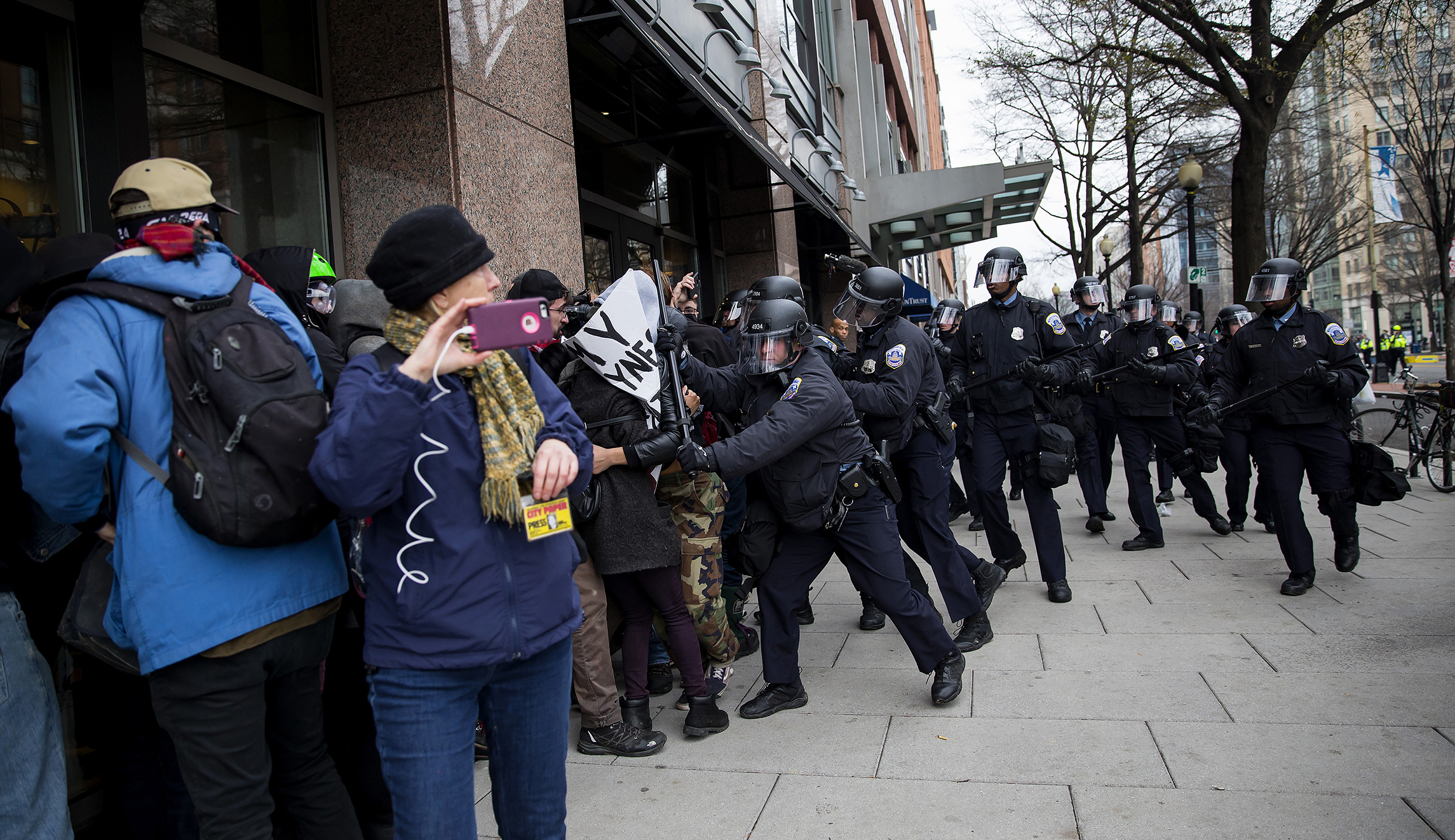
Four men accused of participating in a chaotic anti-capitalism march during President Trump’s inauguration went on trial Wednesday, facing possible decades behind bars for their alleged role in a window-smashing spree that ended in a mass arrest.
The men were arrested alongside about 230 other people on January 20, 2017, several blocks north of Trump’s inaugural parade route, after police cornered largely black-clad participants, journalists, and legal observers on a downtown street corner.
Recommended Stories


Three of the defendants allegedly took a direct role in vandalism, and another allegedly knew of plans for mayhem. Defense attorneys claimed mistaken identity and collective punishment during opening arguments, and said police used unnecessary violence.
Although the march occurred 16 months ago, the trial is only the second group prosecution. An initial trial resulted in six acquittals last year after prosecutors alleged only that defendants attended the march.
Prosecutors dropped charges against 129 people after the first trial, leaving just 59 defendants after jurors rejected an argument that the march was equivalent to a getaway car, making all participants guilty of property destruction and rioting.
The second group trial is expected to last about three weeks, and jurors will have to carefully analyze video evidence, a federal prosecutor and defense attorneys agreed.
Assistant U.S. Attorney Jennifer Kerkhoff said images show Michael Basillas, Anthony Felice, and Seth Cadman wore all black and engaged in vandalism, and that communication records indicate Casey Webber knew in advance of plans.
Kerkhoff said videos show Basillas dragged items into the street to impede police before saying “excuse me” while throwing a brick at a glass bus stop. He allegedly attacked a Starbucks window before hammering the Crowne Plaza’s.
Rich Gallena, an attorney defending Basillas, said grainy images do not depict his client. He said that police and prosecutors “are desperate to pin that damage on someone, anyone” after failing to arrest individual suspects that day.
Basillas, who wore cyan-colored hair to court, had what Galena called “electric yellow” hair during the inauguration. Galena said it was only visible when his client peacefully waited to be taken to a paddywagon.
Cadman, Kerkhoff said, “chucked” an item at a Bank of America location “just before he gives a double middle finger salute.” His attorney argued the image showed only that “someone throws something” and pointed out that an estimated 70 people “who you might assume were the most aggressive people, actually escaped” by breaking through a closing police line.
Kerkhoff said Felice, meanwhile, “attempted” to break Starbucks windows and lit flares. He also “charged through a police line,” Kerkhoff said. In addition to five property destruction and three rioting charges filed against the entire mass-arrest group, Felice and some other defendants face charges for resisting arrest and/or assaulting police.
Felice’s attorney Matthew Rist said he was not guilty and gave a startling re-enactment of how Felice was allegedly plucked off his knees and thrown twice to the ground by police before being given a vindictive “baptism of pepper spray.”
The final defendant, Webber, was involved in planning that included discussion of targeting gentrified areas, Kerkhoff said. She said Webber was “receiving these messages” prior to the event and joined anyhow and tried to “step around the police” at the end of the march.
April Downs, representing Webber, asked jurors: “Have you been part of a group where other people say something you disagree with? My goodness.”
Kerkhoff used an emotive tone throughout her presentation, telling jurors of how people working along the march route were affected, saying local employees were fearful, and that Starbucks customers had to dive for cover when large glass windows were smashed.
The lead prosecutor also sought to distance the anti-capitalism march from broad opposition to Trump in the nation’s capital, where Trump took just 4.1 percent of the vote. She said it was “an emotional day for a lot of people.”
Still, Kerkhoff returned to themes of her presentations in the first trial, referring at least five times to an anonymizing “sea of black masks” during her opening remarks.
