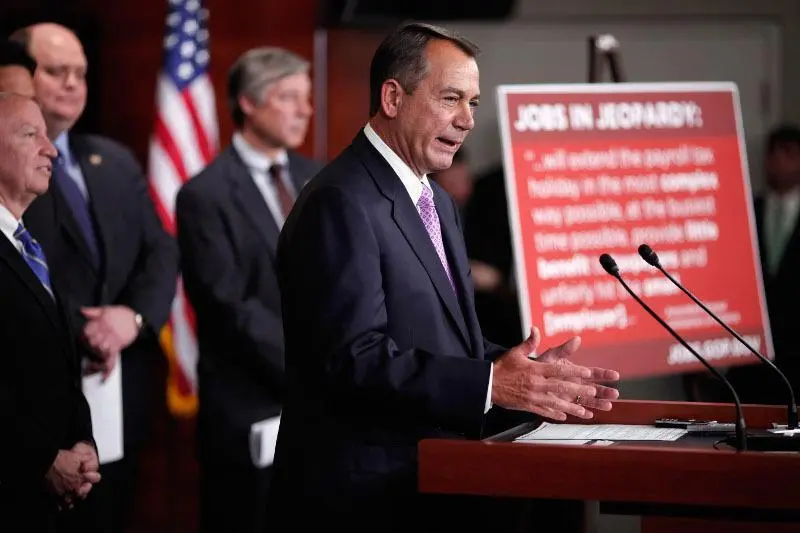
Eager to avoid the blame for a tax hike in an election year, House Republicans announced Monday they will introduce a bill to extend an expiring 2 percent payroll tax cut until 2013, but without providing a way to cover its $95 billion cost.
The bill could come to the House floor as early as Wednesday, GOP leadership aides told The Washington Examiner, and it is expected to pass with broad support among the House Republican majority as well as many Democrats.
The current payroll tax cut, which lowers the Social Security deduction in the paychecks of 160 million Americans from 6.2 percent to 4.2 percent, expires on Feb. 29.
Calling it a “backup plan,” House Speaker John Boehner, R-Ohio, and his GOP leadership team said they are offering the bill because they failed to reach an agreement with Democrats on how to pay for a broader package that included the payroll tax cut as well as a 10-month extension of federal unemployment benefits and a provision to prevent a looming reduction in Medicare payments to doctors.
Republicans said they pitched several ideas to cover the cost of the package, including freezing the pay of members of Congress and federal workers, which would have saved about $26 billion.
“Democrats’ refusal to agree to any spending cuts in the conference committee has made it necessary for us to prepare this fallback option to protect small business job creators and ensure taxes don’t go up on middle class workers,” the leaders said in a statement.
Republicans had initially been cool to the idea of extending a payroll tax cut that adds to the deficit because many believe it threatens the solvency of Social Security.
But Republicans are likely seeking to avoid a debacle like the one they suffered in December when public opinion turned against them for nearly missing a deadline to extend the payroll tax cut, effectively raising taxes on the average worker by $1,000 annually.
Democrats on Monday appeared keenly aware of the political advantage they hold over House Republicans.
“I hope they don’t want to repeat the same kind of story we saw last December when they almost let time run out on 160 million Americans,” Rep. Chris Van Hollen of Maryland, the top Democrat on the House Budget Committee, said.
Van Hollen initially signaled support for the GOP proposal, then backtracked, saying he believes unemployment insurance and the Medicare provision should be joined to the payroll tax cut. Without them, he said, the unemployed and seniors would be left “potentially in the lurch.”
White House spokesman Jay Carney said Monday the President Obama wants all three elements included in the bill.
But it is unlikely the Democratically run Senate or the president would block the Republican bill simply because it includes only the payroll tax cut.
Sen. John Barrasso, R-Wyo., a member of the bipartisan panel trying to work out a deal on all three issues, said Monday, “We are continuing to look for ways to pay for all parts of this.”
A GOP leadership aide told The Examiner that Congress would likely pass short-term versions of unemployment insurance and Medicare payment legislation while the two sides haggle over how to cover the cost of a long term extension for those programs.
