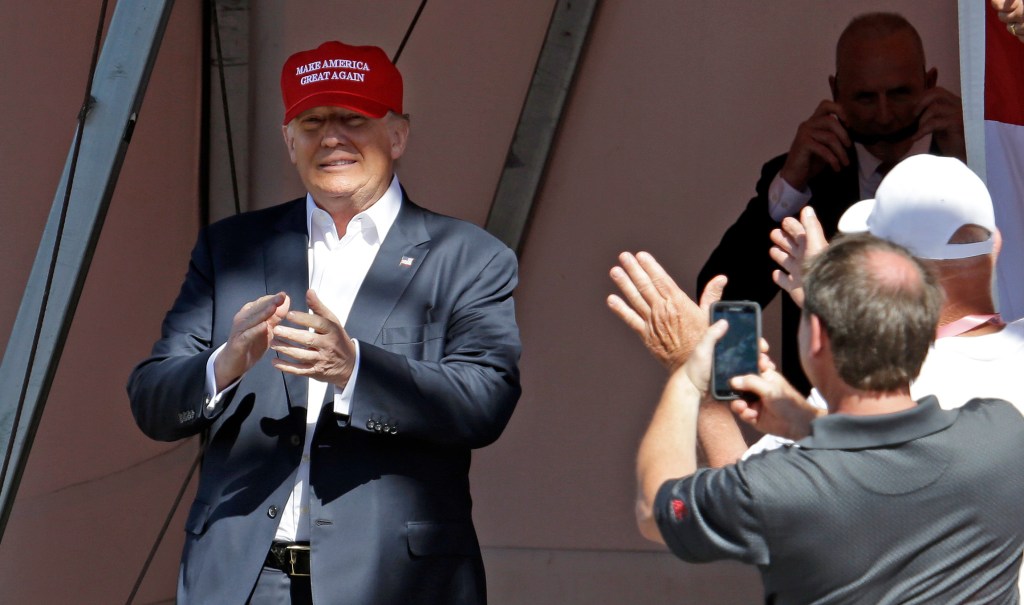
COLUMBIA, S.C. — Stunned Republican regulars were reluctantly coming to terms with Donald Trump’s hostile takeover of the party on Saturday as they gathered for the South Carolina GOP convention.
Trump’s presence predominated throughout the Columbia Metropolitan Convention Center. Campaign signs for the newly minted presumptive Republican presidential nominee monopolized the convention center, and Trump campaign stickers adorned party activists’ lapels and hats.
Recommended Stories
But there was a pall over the quiet, half-empty convention hall, where South Carolina Republicans met to elect delegates to the national nominating convention in Cleveland and conduct other business.
The gathering was, as Trump might say, low energy, underscoring the unusually fractured nature of the party post-primary. In speeches in interviews, few mentioned Trump by name, referring to him as “the nominee,” while exhibiting a palpable lack of enthusiasm for his nomination.
“I think there’s some shock,” said Randal Wallace, 45, a delegate candidate from Myrtle Beach who had supported Ohio Gov. John Kasich, who along with Texas Sen. Ted Cruz dropped out last week after Trump effectively clinched the nomination with a blowout win in Indiana. Wallace said he would support the nominee.
Lee Sims, 69, a Trump campaign volunteer from Greenville, acknowledged that it’s going to take time for Republicans opposed to the New York businessman to embrace him. Sims was manning a convention booth where people could sign a banner pledging support for Trump from South Carolina Republicans that was to be hung inside campaign headquarters in Manhattan.
“I have talked to numerous people here who have not previously supported Mr. Trump. They now say, sure, they are going to get behind the nominee,” Sims said. “I talk to some of the others who will tell you plain out, no they don’t want the Trump sticker yet, they don’t want to sign the banner, but they’ll get there.”
Until Tuesday, anti-Trump Republicans had hoped to deny him the nomination through a contested convention. They assumed the New York businessman wouldn’t collect a 1,237 delegate-majority at least until California voted on June 7. Trump still hasn’t, but his win in the Indiana primary dispelled hopes by his remaining competitors that he could be stopped. Some inside the shell-shocked Republican Party are still resisting.
House Speaker Paul Ryan, R-Wis., the party’s 2012 vice presidential nominee, announced that he could not endorse Trump yet. Other prominent Republicans announced that they would never back him, including governors, members of Congress (Sen. Lindsey Graham, R-S.C., among them;) 2012 presidential nominee Mitt Romney and the last two GOP presidents: George H.W. Bush and George W. Bush.
Trump easily won the Feb. 20 primary in South Carolina, a victory that solidified his status as the national front-runner for the Republican nomination. Yet Gov. Nikki Haley, who previously backed Florida Sen. Marco Rubio, addressed the convention for a full 20 minutes on Saturday morning without once remarking on the upcoming general election or offering the standard rah-rah to beat Democrat Hillary Clinton in November.
Lt. Gov. Henry McMaster, Trump’s top surrogate in South Carolina, was practically pleading for party unity on behalf of the standard bearer to a convention that listened politely but silently. As if to suggest Trump himself is insufficient to turn out the party faithful this fall, activists sported stickers that read: “Defeat Hillary; Vote Trump.”
“We’re choosing between a Democrat and a Democrat,” Tracey Walsh, a Cruz supporter from North Augusta, said. “I may abstain from the presidential vote.”
“I’m not a fan of Donald Trump, because I don’t think he is a Republican,” added Scott Cooper, another Cruz supporter, who attributed low attendance at the state convention to Trump. “When you look at Donald Trump, he has not exhibited our principles in his lifetime.”
Trump has brought new voters into the party. Sims, for instance, said he had never volunteered for a campaign before signing up to help the billionaire developer and reality television star.
But Trump also needs experienced party regulars, like those in South Carolina, which will no doubt vote Republican in November to invest their time traveling to battleground states to knock on doors, man phone banks and perform other important GOTV work for his campaign.
Trump campaign officials were on hand to manage the delegate elections and begin the work of cultivating relationships with grassroots Republicans. In separate interviews, Trump campaign adviser Ed Brookover, and McMaster, said they expect the party to unify behind the nominee after some time has passed and Republicans who supported other candidates begin focusing on Clinton.
“Everybody in this room is going to vote for him — eventually,” McMaster said. “It’s that kind of inner conflict that makes us stronger every time.”
Indeed, most told the Washington Examiner that they will support Trump in November. He won the nomination fairly, they said, and the process has to be respected. And, in a contest between Trump and Clinton, there is no other choice, really, but Trump.
Still, their arm’s length, lukewarm embrace, voting for Trump primarily because it’s what you’re supposed to do, rather than what you want to do, revealed just how deep the divisions run between the new titular head of the GOP and his presumed foot soldiers. Had Saturday’s delegate elections mattered, Cruz likely would have dominated.
“It is likely that many of you in this room may not have voted for Donald Trump,” said Cindy Costa, the Republican National Committee woman from South Carolina, making yet another plea for unity during a speech to the convention. “Our job now is to come together as a party and solidify behind our candidate.”
Much of Trump’s populist agenda is at odds with traditional Republican dogma, both domestically and on foreign policy. The party has historically pushed for free markets and smaller government at home, and robust U.S. leadership abroad; Trump is promising to push the GOP in a different direction. Over the weekend he made the point of saying: “Don’t forget, this is called the Republican Party, it’s not called the ‘conservative party.'”
Trump also said that he doesn’t need a unified Republican Party to win the presidency because he’s assembling a new coalition of voters that will compensate for deficiencies in GOP support.
On that point, even the Trump supporters at the South Carolina GOP convention wished their nominee would reconsider. They said loyalty, and unity is a two-way street. The party, they said, has a responsibility to back the winner of the primary process.
But Trump also has a duty to reach out to those Republicans he vanquished in the just concluded campaign, including candidates, grassroots activists and others, to invite them to join him.
In politics, it’s traditional for winners to tell those he beat in a primary that he can’t win the general election without their help — even if that’s not necessarily the case — and they’d like Trump, clearly an unconventional candidate, to uphold this particular tradition.
“Mr. Trump needs to come around,” said Carroll Duncan, of Summerville, a candidate for delegate to the Cleveland convention. “We’ll do our part, on this end; he needs to do his part.”