

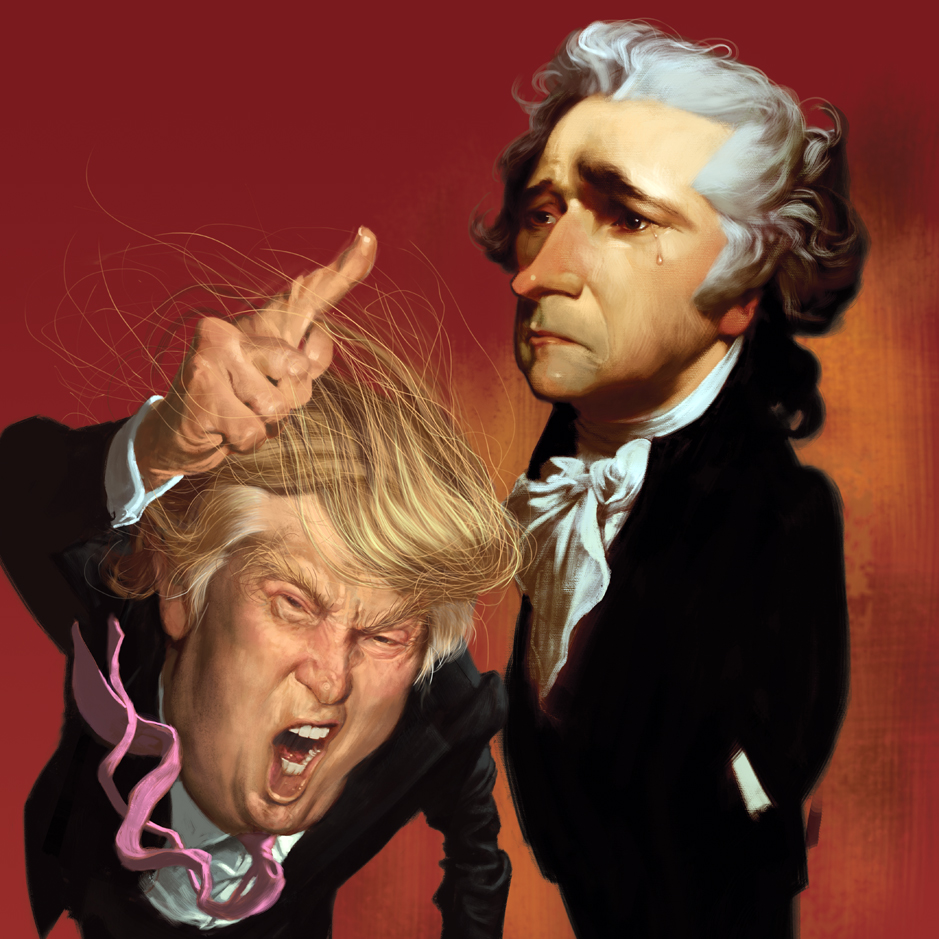
All right, Trump people, you do have a point. A number of policies pushed since the 1990s by the establishment wings of both major parties may have had bad effects on millions of people. The industrial base of this country has changed in ways that eroded the financial and moral lives of lower-middle- and working-class people, through unemployment, underemployment, family breakdown, and similar ills. It may have been unintended, collateral damage, but it was nonetheless damage, and the worst thing one can say about both parties’ leaders is not that they somehow allowed it to happen, but that they have turned a blind eye to what has been happening and have done nothing to assuage the effects.
Yes, we have read Peggy Noonan’s columns in the Wall Street Journal, when she has said that Western governments no longer protect their own people; we have read Charles Murray when he says that the country has broken into two different parts that do not know each other; and we have listened to Henry Olsen, the estimable policy expert at the Ethics and Public Policy Center, when he says the establishments have behaved very badly and possibly deserve the substantial payback it looks as though they may get. In short, your message has been getting through, but it has been overwhelmed by the messenger.
Stay informed.Stay ahead.
Join Washington Examiner for unlimited access to the news, analysis, and commentary that matter most.
Already a member? Log in
#NeverTrump is becoming a popular hashtag. People flood to the polls to vote against, not just for, him. Prominent leaders disown him completely. And the dilemma for you is that the issues — your issues — are being swallowed up in the fracas and firestorm. The arguments over issues that are his strength — free trade, the effects of globalization, and immigration — have been completely subsumed in the ongoing spectacle. Meanwhile there is a moral case that the man is unfit to hold high office — a case most of his defenders don’t even acknowledge, but the public itself can’t ignore.
On February 29, Megan McArdle wrote her Bloomberg View column on the response she received to her request to passionate Republican backers of the #NeverTrump cause that they send her their reasons, assuming they had them, for repudiating the candidate. What surprised her? The numbers— hundreds emailed; the breadth of response — across all regional, social, professional, and class divides and every conceivable wing of the party; and the depth of feeling, with her correspondents being “appalled, repulsed, afraid, and dismayed” at the prospect of Trump being either nominee or president. Their concerns included his authoritarian conduct, his lack of principle, his racism, his conduct toward women, his erratic behavior, and his potential access to the nuclear arsenal. They were party stalwarts who had voted Republican on a regular basis, served in Republican administrations, and raised money for and volunteered in campaigns.
“They question his character and judgment,” she wrote. “They understand that refusing to vote for Trump means that a Democrat will probably win. . . . They understand that a Democratic win means that the Supreme Court will flip liberal, and probably stay that way for a while. . . . They think the GOP is better off losing the election than winning it with Trump at the helm.” They invoked comparisons with the Vichy government and with Quisling. One wrote that he would “ ’tattoo #NeverTrump’ on a rather delicate part of his anatomy” if it prevented Trump’s nomination. As McArdle concluded, “They wrote in the strongest possible language, and many were adamant that they would not stay home on Election Day, but in fact would vote for Hillary Clinton in the general and perhaps leave the Republican Party for good.”
If one were to create a composite character out of the things McArdle’s respondents said, it would tend to go something like this: “I’m a 40-year-old National Review and Instapundit-reading conservative who has voted for the Republican in every election since 1996. I intend to vote for Cruz in the primary and would be happy to vote for Cruz or Rubio in November. My opinions about Hillary Clinton are about what you would expect, and if it’s Hillary vs. Trump, I’ll most likely vote Libertarian. I’ve spoken with many of my friends from my College Republican days and it seems they all have the same thoughts. I will never vote for Trump. Ever. And if that brings about the end of the GOP, so be it. Any party that picks Trump as its voice is not a party I want to be affiliated with. He has no moral compass and no abiding principles except for self-promotion. Being in the wilderness, politically speaking, is preferable to being complicit in the election of Donald Trump, and with it the destruction of the party I have supported my entire adult life.” What is remarkable across the range of her letters are the number of long-term and devoted Republicans, who have worked all their lives against Hillary Clinton, who are willing to vote or even work for her, if that’s what it takes to stop Trump.
‘Sometimes party loyalty asks too much,” John Kennedy said when asked to endorse Democratic hack Foster Furcolo over Kennedy’s colleague and friend Leverett Saltonstall in the Senate race in Massachusetts in 1954. For many, party loyalty asked too much in 1964, when Republicans were asked to support Barry Goldwater, and in 1972 when Democrats were asked to support George McGovern, each of whom were seen as on the outermost fringes of their coalitions. In the latter cases, there was grumbling but no third-party movement, and large parts of the electorate sat on the sidelines or crossed over, while their party’s candidate lost by wide margins. But in these cases, the candidates seemed to be unacceptable because people thought that their ideas and policies could be dangerous— that they would be too prone or too averse to the usage of power — not that they were, as Trump seems to be, unacceptable because they may be bad.
For an example of what can happen when the man himself appears unfit for office, we have to go back to 1800, when under the rules of the day the runner-up in the election became the vice president, and through a technical error Aaron Burr found himself in a dead heat with the intended winner, Thomas Jefferson, alarming no one more than Jefferson’s archenemy, Alexander Hamilton, now in retirement from politics in Burr’s own New York.
“By mid-December . . . it was evident that Jefferson and Burr would garner an equal number of electoral votes, throwing the presidential contest into a lame duck House of Representatives that was still dominated by Federalists,” writes Ron Chernow in his 2004 biography, Alexander Hamilton. And Hamilton was soon hearing rumors that a number of his fellow Federalists had been thinking of voting for Burr.
Some of the arguments urged by the Federalists sound very familiar today: “Federalist leaders pelted Hamilton with letters about the expediency of supporting Burr and ending Virginia’s political hegemony. Because Burr lusted after money and power, they thought they could strike a bargain with him. They worried less about Burr’s loose morals than about what they perceived as Jefferson’s atheism. . . . John Marshall and others thought Burr a safer choice than Jefferson, who might try to recast the Constitution to conform to his ‘Jacobin’ tenets. . . . Fisher Ames feared that Jefferson was ‘absurd enough to believe his own nonsense’ while Burr might at least ‘impart vigor to the country.’ ” Ah, vigor! Burr, these men were saying, could at least be a “winner,” and there was no shortage of energy there.
Hamilton and Jefferson had been the best of enemies ever since they met in 1789 in George Washington’s cabinet, and the Little Lion and the Sage of Monticello did not get along, inadvertently starting the two-party system, which none of the Founders had imagined would develop, and conducting it on a level of personal rancor that seems remarkable even today. By 1792 they were conducting battle through the newspapers. Journalist James Callender would expose both Jefferson’s affair and his children with his slave Sally Hemings as well as Hamilton’s affair with and blackmail by Maria Reynolds, which took place while he was still in the government, in Philadelphia, in 1796.
Praising Jefferson did not come easily to Hamilton, as was evident in his opening words to James Bayard, the Delaware congressman he was lobbying on Jefferson’s behalf: “I admit that his politics are tinctured with fanaticism, that he is too much in earnest in his democracy; that he has been a mischievous enemy to the principal measures of our past administration, that he is crafty and persevering in his objects, that he is not scrupulous about the means of success, nor very mindful of truth, and that he is a contemptible hypocrite,” he began in what is undoubtedly the strangest opening to an endorsement ever made in political history.
But Hamilton went on to say that with all his faults Jefferson was a rational man with coherent ideas who operated within the normative range of accepted behavior in life and in politics, while Burr was something fundamentally different— a man for whom norms, rules, and boundaries didn’t exist. In 1792, Hamilton had taken his measure of Burr and never moved from it: Burr was “unprincipled both as a public and private man . . . for or against nothing but as it suits his interest or ambition . . . determined . . . to make his way to be the head of the popular party . . . and to climb . . . to the highest honors of the state.” Now Hamilton warned friends about Burr’s debts and the scandals involving his business investments, calling him a profligate, a voluptuary, unprincipled, and dangerous.
Embracing Burr, Hamilton said, would sign the Federalists’ “death warrant,” and he warned of the impact abroad: “No agreement with him could be relied on,” he wrote to Theodore Sedgwick. “The appointment of Burr as president would disgrace our country abroad.” Above all, he stressed the shame to the party if it involved itself with a man of Burr’s character and said, according to Chernow, that “if they installed Burr as president” he “would withdraw from the party, or even from public life.”
In the end Hamilton prevailed, at least with Bayard, who on the 36th ballot removed his state’s vote from Burr’s column, sparing the country a President Burr, but not sparing it from the two secession attempts Burr would make. The first was in 1804 when, as vice president, he tried to take New England away from the rest of the country, which was ended only when Burr killed Hamilton in the duel between them. He would try again in 1807, this time to break the West off from the East, an effort for which he was tried for treason in 1807. Hamilton’s decision to go with the political foe as against the loose cannon had proven inspired. Politics is one thing, he had seemed to be saying, but when balance itself appears on the ballot, it is prudent to go with the sane.
“I feel it a religious duty to oppose his career,” Hamilton wrote when he first took Burr’s measure, and something the same might be said of the 40 prominent Catholic scholars who issued an open letter on March 7 on the National Review website to ask their co-religionists — and all other people of good will — to disown and reject Donald Trump, calling him “manifestly unfit to be president,” citing his “vulgarity, oafishness . . . and . . . demagoguery,” his celebration of torture, and “his appeals to racial and ethnic fears.” If such rebukes have been all but unknown since 1800, it’s because of the rarity of men deserving of them rising to the top in American politics.
As McArdle explained, “These are issues that are rarely issues at all in a political campaign because most politicians who become serious contenders pass the basic threshold of not behaving as Trump has. . . . Trump fans should know that the #NeverTrump Republicans who wrote to me are not rejecting you, or even your issues. They are rejecting Donald J. Trump, because they think he is a bad person. . . . If party fracture costs Republicans the general election, you will have lost not because you supported him on immigration, but because you supported him.” This isn’t about “the establishment” vs. “the base.”
Once in a blue moon, or twice in two centuries, a Burr or a Trump comes along who is truly an outlaw, someone outside the normal perceptions of what is acceptable, who marks himself off as not to be trusted. In that case, when and if it should happen, the Hamilton gambit may not be the worst card to play.
Noemie Emery is a Weekly Standard contributing editor and a columnist for the Washington Examiner.
