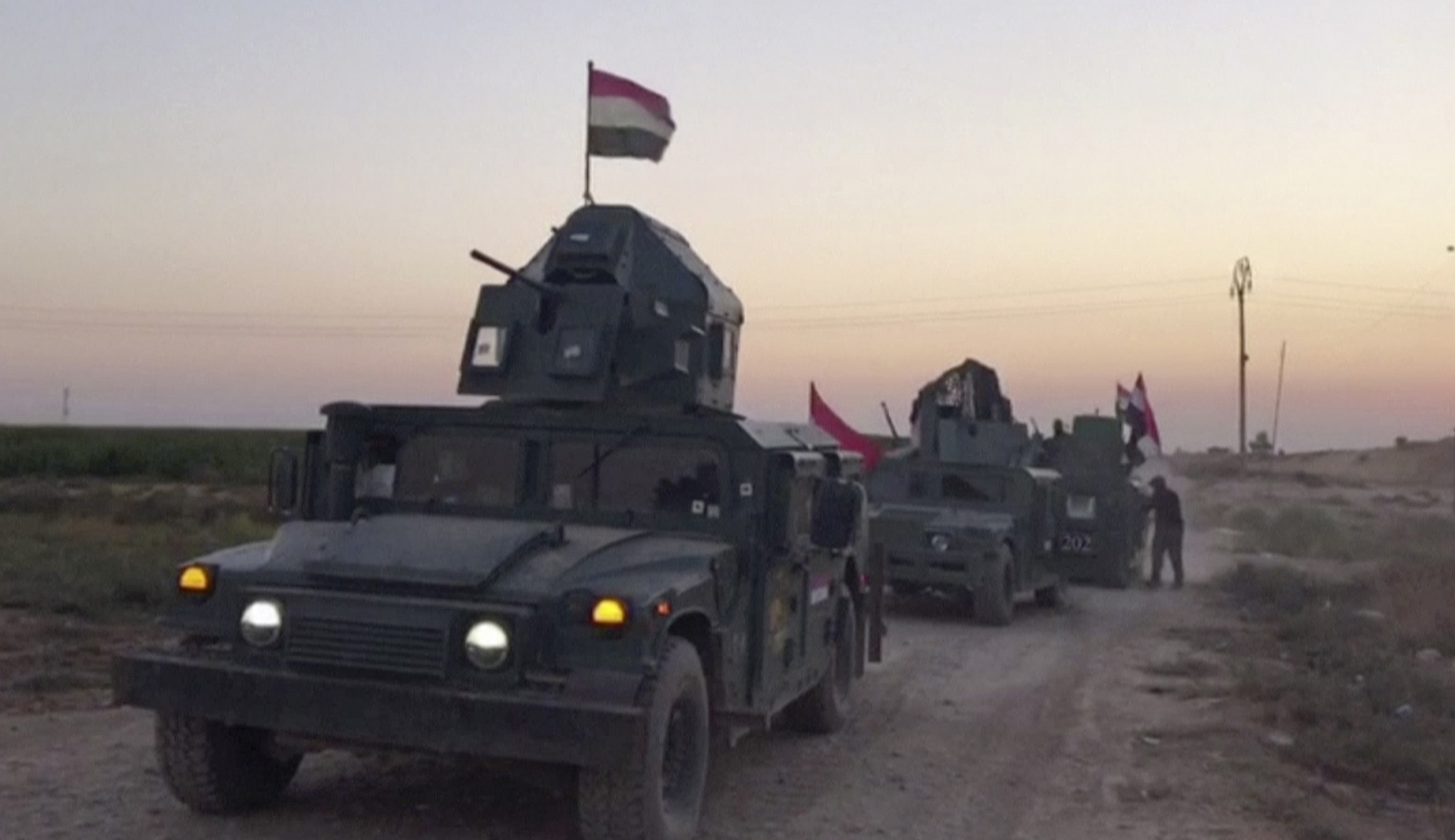
Now that the Iraqi town of al Qa’im has finally fallen to Iraqi forces, the Islamic State has a big problem.
After all, the al Qa’im border crossing with Syria gave the Islamic State a crucial conduit for moving personnel and materiel across its caliphate. Its fall means that the Islamic State is increasingly bereft of territorial mobility. While the terrorist army still holds some areas of the Iraq-Syria border north of al Qa’im and the Euphrates river, those locales are under significant pressure from Kurdish forces in Syria and Iraqi forces in Iraq.
In effect, the Islamic States territory now consists of a few towns along the Euphrates river valley in Syria and pockets of desert. Those deserts are perfect hunting grounds for U.S. and allied air power. As the noose tightens, the Islamic State will suffer escalating supply, mobility, and morale challenges and its senior leaders will struggle to hide.
The Islamic State seems to get this.
Islamic State leader Abu Bakr al-Baghdadi’s late September audiotape, he pushed his followers to refocus on a global insurgency rather than building the Caliphate. That change in messaging reflects Baghdadi’s awareness that the Caliphate, at least in territorial terms, is imploding.
Nevertheless, we would be foolish to claim victory.
For one, the Islamic State retains a credible external attack capability to inspire and direct atrocities far beyond the Middle East.
At the same time, to prevent the Islamic State from rising from the ashes, the U.S. must nudge Iraqi political developments towards multi-sectarian consensus and greater Sunni empowerment. The urgency of this necessity cannot be overstated; Sunni-tribal al Qa’im might have fallen from the Islamic State, but Iranian-controlled militia, Asa’ib Ahl al-Haq, is now driving around al Qa’im in tanks. Their presence is a perfect recipe for sectarian bloodletting. Ultimately, al Qa’im and Anbar province will only hold against an Islamic State revival if the Sunni tribes are empowered.
So yes, al Qa’im’s fall is good news. But only if we use it as a stepping stone.
