
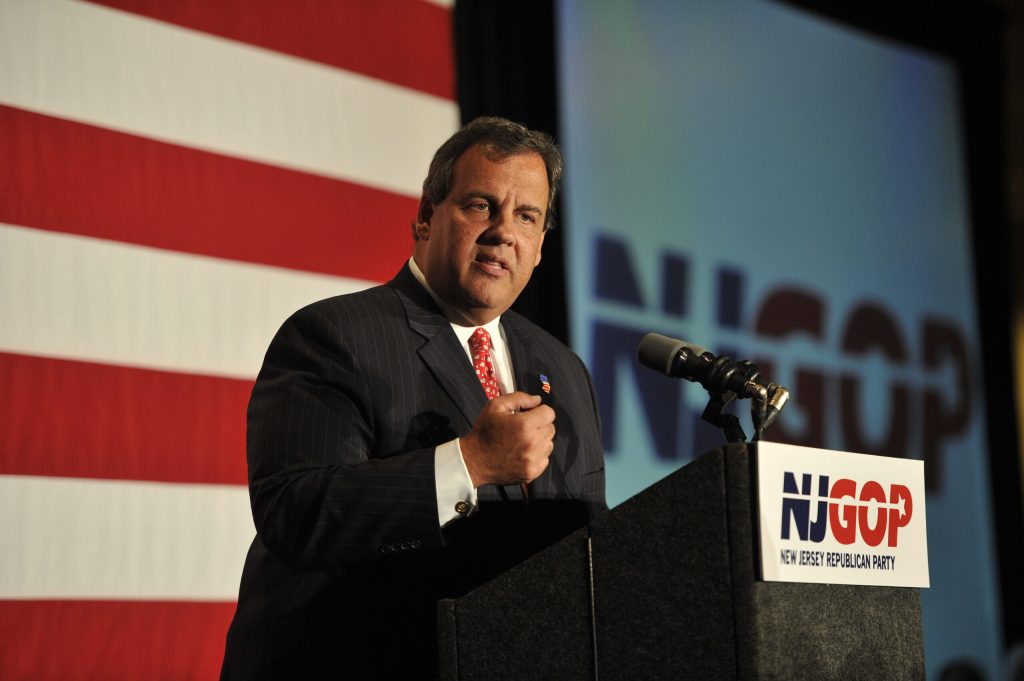
Chris Christie’s signature achievement is at risk.
With Standard and Poor’s following Fitch Ratings in downgrading New Jersey’s debt last week, budget experts say that Christie’s 2011 deal to reform public-sector pensions — an achievement that Christie has made part of his national appeal as a reformer — is in danger of failing.
Real journalism.Trusted by millions.
Unlimited access to in-depth reporting, expert analysis, and the stories that shape our country.
Already a member? Log in
S&P cut New Jersey’s credit rating to “A” because Christie skipped a payment to state workers’ pension plan. The 2011 deal, which required greater pension contributions from state workers and raised the retirement age, also mandated that the state increase its payments into the pension system each year. That included a $2.25 billion payment in July to reduce unfunded liabilities, which Christie said he would partly skip.
“I consider that pretty much a fatal blow to the agreement, which he has widely advertised when traveling outside of New Jersey,” said Gordon MacInnes, president of the left-of center think tank New Jersey Policy Perspective.
Now a national figure and top possible contender for the Republican presidential nomination in 2016, Christie used the 2011 reform to elevate his profile.
“These historic reforms bring to an end years of broken promises and fiscal mismanagement by securing the long-term solvency of the pension and benefit systems,” Christie said after the Democratic legislature voted for the measure in 2011, before later plugging his accomplishments on the Sunday talk shows.
“That was high on Christie’s list when speaking outside the state, that he made tough decisions, did it in a bipartisan way, reached across the aisle, could get things done, blah, blah, blah. It was pretty much his signature accomplishment. Now that agreement, that reform is in tatters. It has basically blown up,” said MacInnes, a former Democratic official.
Steven Malanga, a senior fellow at the right-of-center Manhattan Institute and an expert on state fiscal issues, explained that the downgrades are not due to mismanagement by Christie, but instead the product of years of Democratic and Republican governors over-promising.
“When you look at them, these pension problems are not the result of merely a bad economy. They are not the result of one bad decision,” Malanga said. “They are the result of year after year of bad decisions which politicians were warned not to do by fiscal experts and actuaries.”
Nevertheless, said Malanga, Christie may have created a problem for himself by claiming that the 2011 reforms solved the state’s pensions problem, when in reality they only mitigated it. The state had $47.2 billion in unfunded liabilities in 2012, according to S&P’s latest estimates. According to Malanga, it would take an annual contribution of roughly $5 billion just to keep the unfunded pension liabilities from growing, but state tax revenues are only roughly $30 billion — a product of New Jersey’s especially slow economic recovery.
“He’s given the opposition a chance to say, you said this would be fixed — you must have done something wrong,” Malanga said
New Jersey Senate President Steve Sweeney, Christie’s Democratic partner in the 2011 bill, has said that the state “fixed” the pensions problem in 2011.
“They made some attempts at improving the situation, but it wasn’t sufficient,” said Eileen Norcross, an analyst at the libertarian Mercatus Center who, like Malanga, warned in 2011 that Christie had underestimated the unfunded liabilities of the New Jersey system.
Now, Christie faces few good options for avoiding a fiscal crisis if he wants to fulfill his promises to not raise taxes, according to Norcross.
“The size of these liabilities is huge. I don’t know where the money’s going to come from,” Norcross said.
In August, Christie convened a bipartisan commission to propose a solution for the pension shortfall. But even a proposal that included tax increases as well as spending cuts would likely be hard to find to make up the roughly $5 billion needed to cut into the pension plan’s overhang, Malanga said. “There’s no simple solution here at all.”
Raising taxes, MacInnes noted, would hurt Christie’s chances in a future Republican primary. And Democrats have already previewed the attacks they would launch if Christie were a GOP candidate. In response to the news of the downgrade, Democratic National Committee spokesman Michael Czin called Christie’s administration a “national embarrassment” and said that “from his failed economic record to his administration’s gross misconduct during Bridgegate, Chris Christie has failed his state time and again.”