

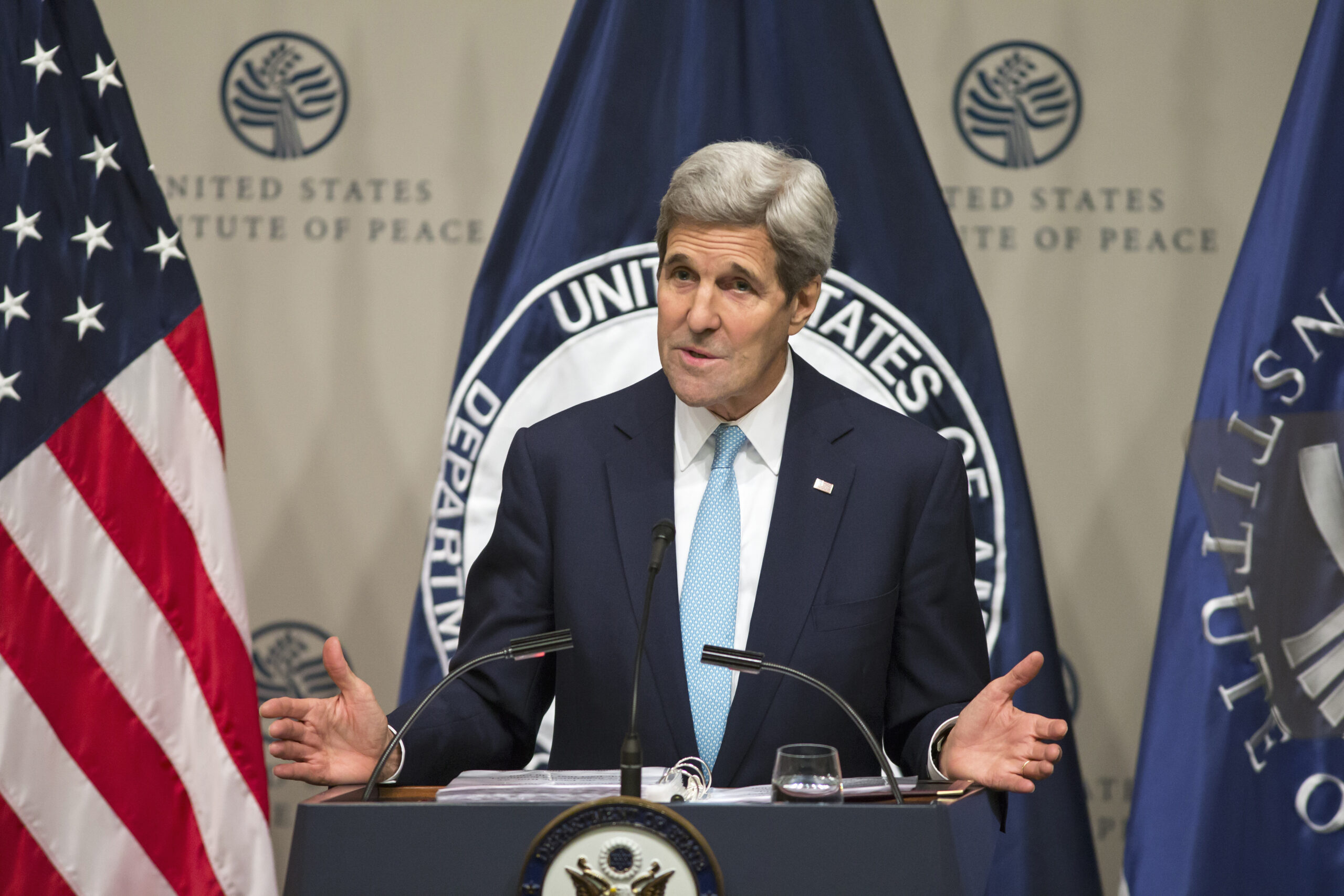
Secretary of State John Kerry on Thursday tried to blunt criticism that President Obama’s strategy in Syria is a hodgepodge, by presenting it as a thought-out, carefully crafted plan that the Obama administration has tweaked here and there to adjust to lessons learned.
Every public idea for resolving the crisis “has been the subject of intense scrutiny within the administration,” Kerry said on Thursday, speaking at the Institute of Peace in Washington. “Whatever questions one might have about the content of our policy, there should be no doubt about the effort made to consider every single option for ending this crisis.”
Recommended Stories



Related Story: http://www.washingtonexaminer.com/article/2575923
The U.S. has three related goals for Syria: defeating the Islamic State, ending the Syrian civil war, and protecting regional allies, Kerry said just days before a new round of talks will start in Vienna on how to resolve the civil war.
The Obama administration started by trying to train up Syrian fighters to battle the Islamic State, also known as Daesh, and recently admitted this program failed and had to be retooled. But in his Washington speech, Kerry downplayed that failure and said recent gains by Iraqi, Kurdish and government opposition fighters have shown “that Daesh can be defeated, even routed, when faced by the combination of coalition airstrikes and effective partners on the ground.”
“We have said from the beginning that this would be a multi-year effort. We are on the right track and we are making gains; and we are clear about the road ahead,” he added, despite new questions about whether Russia’s activity in Syria is hampering U.S. efforts.
He repeated the administration’s line that there is no military resolution to the conflict in Syria, but did admit that military might helps give the 65 nation coalition leverage over the Islamic State.
Kerry said the coalition of Arab and Western countries fighting the Islamic State has only existed for 14 months, and said it already has blunted the Islamic State’s once rapid territorial gains in Iraq and Syria.
“We now know more about what has worked and what has not worked and what can work,” Kerry said. “[W]ith those lessons in mind, we are stepping up our strategy in all its aspects,” he said, ticking off what newer steps the U.S. is taking to defeat the Islamic State.
Washington has given Baghdad heavy equipment such as armed bulldozers and mine-clearing machinery to dislodge the Islamic State from the Iraqi city of Ramadi, he said. Select rebel groups in Syria are receiving more ammunition and supplies from the Pentagon; more U.S. sorties are taking off from a Turkish base than ever; up to 50 special forces personnel have been deployed to Syria to serve as advisers to moderate opposition fighters; U.S. soldiers helped Kurdish and Iraqi forces undertake a “daring rescue” of Islamic State prisoners; and Washington is doling out more money to Jordan and Lebanon to help those countries bolster their security, Kerry said.
All of which “builds on what has worked and to apply pressure on Daesh from as many directions as possible, with as much intensity as possible for as long as it takes,” Kerry said.
Heading into a second round of talks in Vienna in as many months, Kerry said that representatives of the 65-member coalition are undertaking a “renewed political initiative” that is broader “and more action-oriented” than any previous attempts to “isolate the terrorists and set Syria on the path to peace.”
