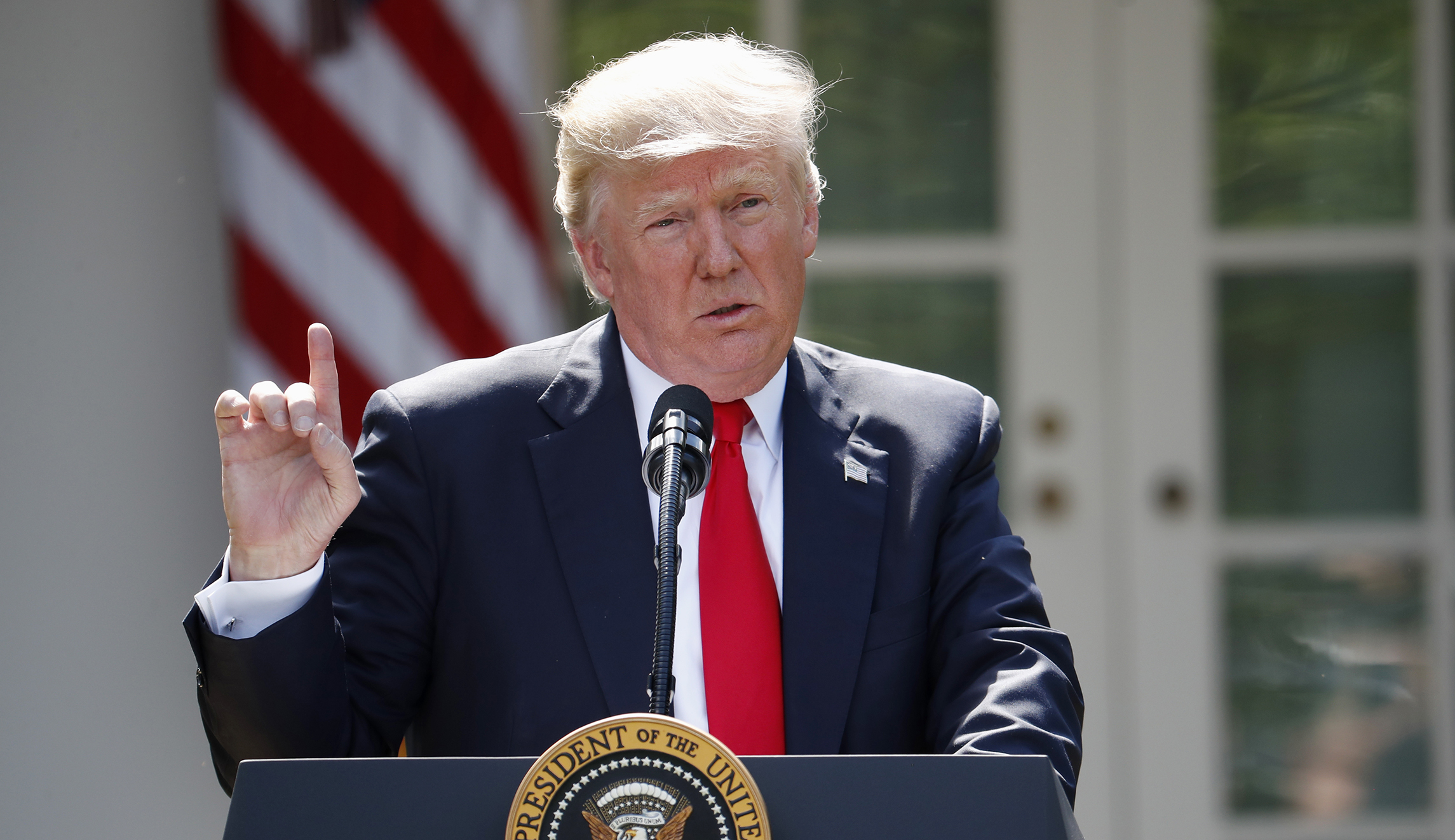
The Trump administration is fighting on two fronts to help justify its deregulatory agenda in court, downplaying both the damage from climate change and the public health benefits of environmental rules.
This month, the Environmental Protection Agency announced plans to propose new rules for regulatory cost-benefit analysis that critics fear could undermine the agency’s regulation of climate pollution by saying it costs too much.
At the same time, the Trump administration plans to reexamine how government scientists study the consequences of climate change by potentially limiting consideration of worst-case projections.
Legal experts critical of the Trump administration’s deregulatory approach say the maneuvers together are designed to weaken legal and public scrutiny of the damages from its pro-business, hands-off approach to climate change.
“This is an across the board effort to find a way to sideline facts and science that are inconvenient to the administration’s thesis that any regulation has some cost to industry,” said David Hayes, executive director of the State Energy and Environment Impact Center, a coalition that assists state attorneys general contesting President Trump’s deregulatory agenda. “They are playing games to obscure the reality of how serious the climate situation is, and how damaging their pro-fossil fuel agenda is.”
The Trump administration has justified its review of cost-benefit analysis and climate change modeling by arguing previous administrations have overstated the cost of carbon emissions and underestimated the impact of regulations to state and local economies.
When making major regulations, the EPA must weigh the public health benefits of a rule and its cost to society at large.
The Obama administration, in writing major regulations such as the Clean Power Plan that aimed to reduce carbon emissions from power plants, relied heavily on counting “co-benefits” resulting from the rule reducing other pollutants. The Trump administration argues co-benefits overstate the intended impact of a rule directed at a specific pollutant, such as carbon.
“The Obama administration misused cost-benefit analysis as a way to promote their regulatory agenda on climate change,” said Jeffrey Holmstead, a former deputy administrator of the EPA in the George W. Bush administration who represents energy industry clients at the Bracewell law firm. “If the Trump administration does a careful job to change the analysis, it will make it harder for future administrations to claim unrealistically high benefits or low costs.”
Other experts said the Trump administration’s effort would be challenged and blocked in court.
Democratic attorneys general have already successfully challenged the Trump administration, with judges finding the government has not always followed proper legal procedures and laws to unwind environmental regulations and has failed to justify its actions.
“This fraudulent attack on co-benefits is also very unlikely to succeed in court,” said Richard Revesz, an environmental law professor at New York University. “It’s totally crazy to promote a rule that says the indirect consequences of a regulation must be taken into account if they are negative, but can be ignored if they are positive. That seems like the textbook definition of arbitrary and capricious conduct.”
John D. Graham, dean of the Indiana University O’Neill School of Public and Environmental Affairs, agrees with Revesz.
Graham said the Trump administration must prove its weaker regulations do enough to fulfill a government legal finding, upheld by the Supreme Court, that says carbon dioxide is a pollutant endangering public health and the EPA must regulate it under the Clean Air Act.
“There are no shortcuts here,” said Graham, a former head of regulatory affairs in George W. Bush’s Office of Management and Budget. “The Trump EPA will have to supply a strong cost-benefit justification for the deregulatory actions on climate change, regardless of what happens down the road.”
Critics say the Trump administration has an uphill battle in proving the cost savings of its weaker regulations outweigh the public health damages.
A report produced by the State Energy & Environment Impact Center in March found the savings to industry of some of the key Trump administration deregulatory moves “are minuscule in comparison to the public costs of these rollbacks.”
Legal experts said the Trump administration could encounter similar problems with its review of climate change modeling.
The Trump administration, the New York Times reported this week, is seeking to ensure worst-case scenario projections “will not automatically” be included in scientific reports produced by the government projecting the impacts of climate change.
The administration is primarily targeting the National Climate Assessment, a report required by Congress and produced every four years by scientists from 13 government agencies.
Trump administration officials have sought to downplay the findings of the latest version of the report released last year, which included scenarios showing that global warming will impose hundreds of billions of dollars of damages on the U.S. economy.
James Hewitt, an EPA spokesman, denied his agency is currently undertaking a “specific effort” to block worst case scenarios from future climate assessments, but he confirmed Administrator Andrew Wheeler is concerned about how the reports are developed.
“The previous use of inaccurate modeling that focuses on worst-case emission scenarios, that does not reflect real-world conditions, needs to be thoroughly reexamined and tested if such information is going to serve as the scientific foundation of nationwide decision-making now and in the future,” Hewitt said.
Legal experts say the Trump administration’s scrutiny of worst case scenarios reflects a desire by the agency to minimize the consequences of its pro-fossil fuel deregulatory agenda, which could worsen climate change.
“The term ‘worse case scenario’ suggests it is highly unlikely to happen, but this is an administration that is hawking fossil fuels left and right,” Hayes said. “They want to take out from the National Climate Assessment the scenario that assumes a continued reliance on fossil fuels.”
Graham also predicted efforts to limit the scope of the National Climate Assessment would backfire.
“Until they have a well-argued position, dropping those scenarios is more likely to hurt rather than help the administration in judicial proceedings, since pro-regulation advocates will point to the dropping as additional evidence that the administration has its head in the ground on climate science,” Graham said.
