Even conservatives who’ve never been hostile to Donald Trump are starting to ask how conservative the Republican front-runner really is. His enemies in the Republican Party have always claimed only one answer is backed up by the evidence: not very.
The Washington Examiner decided to go straight to the source and ask Trump himself. He defended his conservatism, but not always on his conservative critics’ terms.
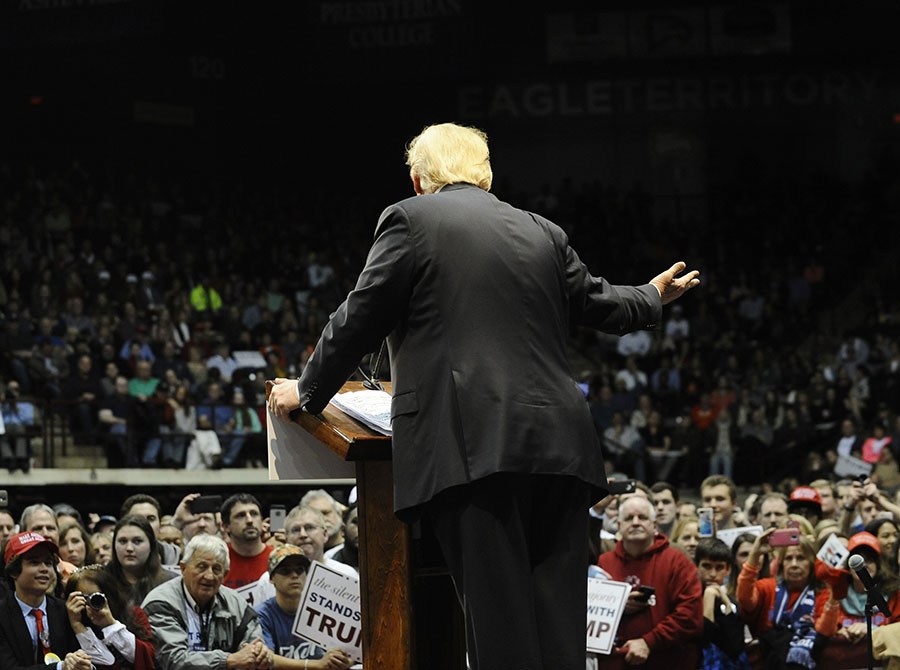
First, the businessman argued he was growing conservatism and its primary political vehicle, the Republican Party. He didn’t mention Ronald Reagan and the Reagan Democrats, but he might have cited his big rallies in Lowell and Worcester — two blue-collar cities in Massachusetts, a Democratic state that twice went for Ronald Reagan but hasn’t come close to voting for another Republican presidential candidate since — as examples. Trump did say he would carry a number of states that haven’t been in the GOP column since Reagan or George H.W. Bush in 1988.
“If you think about it, if you take a look at what I’ve done, I’ve brought millions and millions of people to the Republican Party, and to the conservative party, because, as an example, the debate had 24 million people,” Trump told the Examiner‘s Byron York in an exclusive interview in Iowa. “If I wasn’t in the debate, would it have had three, or four, or two, or what would it have been?”
The former reality TV star characteristically said the television news ratings were proof of his success, but added that the GOP and the right were benefiting too. “[T]hat focus is a very important focus,” Trump said, “because other people are allowed to take advantage of all of the eyeballs that I’m bringing to the screen.”
Asked what conservatism meant to him, Trump didn’t list a litany of policy positions on taxes, social issues or government spending. “Well, I think it’s just a conservative value,” he said. “I’m very conservative fiscally.” He maintained the country was being destroyed in part by its vast national debt, which he promised to get back under control.
Trump’s version of conservatism includes conserving American jobs and interests. “[W]e’re losing our jobs to everybody,” he told the Examiner, repeating his usual riff about China, Vietnam, “Mexico, always.”
Finally, Trump argued he was conservative because he is the candidate many self-described conservatives support. “In terms of conservative, I’ve had tremendous polling numbers with conservatives, I think to a large extent because of the border,” he told the Examiner. In the past, he’s mentioned his polling numbers among Tea Party supporters and evangelicals.
All this seems to reinforce the conservative critique of Trump. While he criticized Obamacare and said he would reinstate the pro-life Mexico City policy (when asked), he mostly didn’t defend his record of conservative policy positions. Perhaps that’s because, as his conservative detractors would argue, he couldn’t. His economic collectivism and implied trade protectionism is opposed by many conservatives. (Trump, for his part, denied being a protectionist and told York he is “a free trader, 100 percent.”)
But before Reagan, the conservatism of many winning Republicans wasn’t especially ideological. No less a conservative than Russell Kirk, in fact, said conservatism was the “negation of ideology.” Richard Nixon appealed to a culturally conservative Silent Majority during his two successful presidential campaigns, but his domestic policies like wage and price controls were arguably to the left of Trump’s greatest statist hits.
In Western countries other than the United States, conservative or right-wing politics is rarely animated by classical liberalism or libertarianism. Instead the right is frequently driven by nationalism. Even in the U.S., where there has been a strong individualist strain and a lot of commonality throughout, conservatism as represented by Robert Taft, Barry Goldwater, Reagan, Jesse Helms and George W. Bush (remember compassionate or big government conservatism?) has evolved over time.
Trump and his conservative admirers tend to point to immigration policy and border control as essential to conserving the American nation-state. “Nobody has that issue like I have it, whether it’s building the wall or closing the border and letting people in but they have to come in legally,” he told the Examiner.
This package — nationalism, a visceral but not especially ideological cultural conservatism, a tough stance on immigration control, pledges to negotiate better trade deals and some more conventionally conservative positions on abortion, guns and the debt — has attracted plurality support nationally and, depending on the polls, all or most of the early states that kick off the GOP nominating contest.
It also sets up an interesting contest between the more familiar movement conservatism of Ted Cruz and Marco Rubio (the latter regarded as a moderate or even liberal by many Trump and Cruz supporters) and Trump’s popular but more idiosyncratic variety, especially in Iowa.
The Republican presidential race has always been more complicated than a simple clash between conservative Trump backers and the moderate party establishment, although there is some truth to that narrative. Many of Trump’s most adamant opponents consider themselves down-the-line committed conservatives and the billionaire actually polls well among self-described moderate Republicans.
Ever since Barack Obama was elected, party reformers said they were looking for a different kind of conservative. They weren’t expecting it would be Donald Trump.