

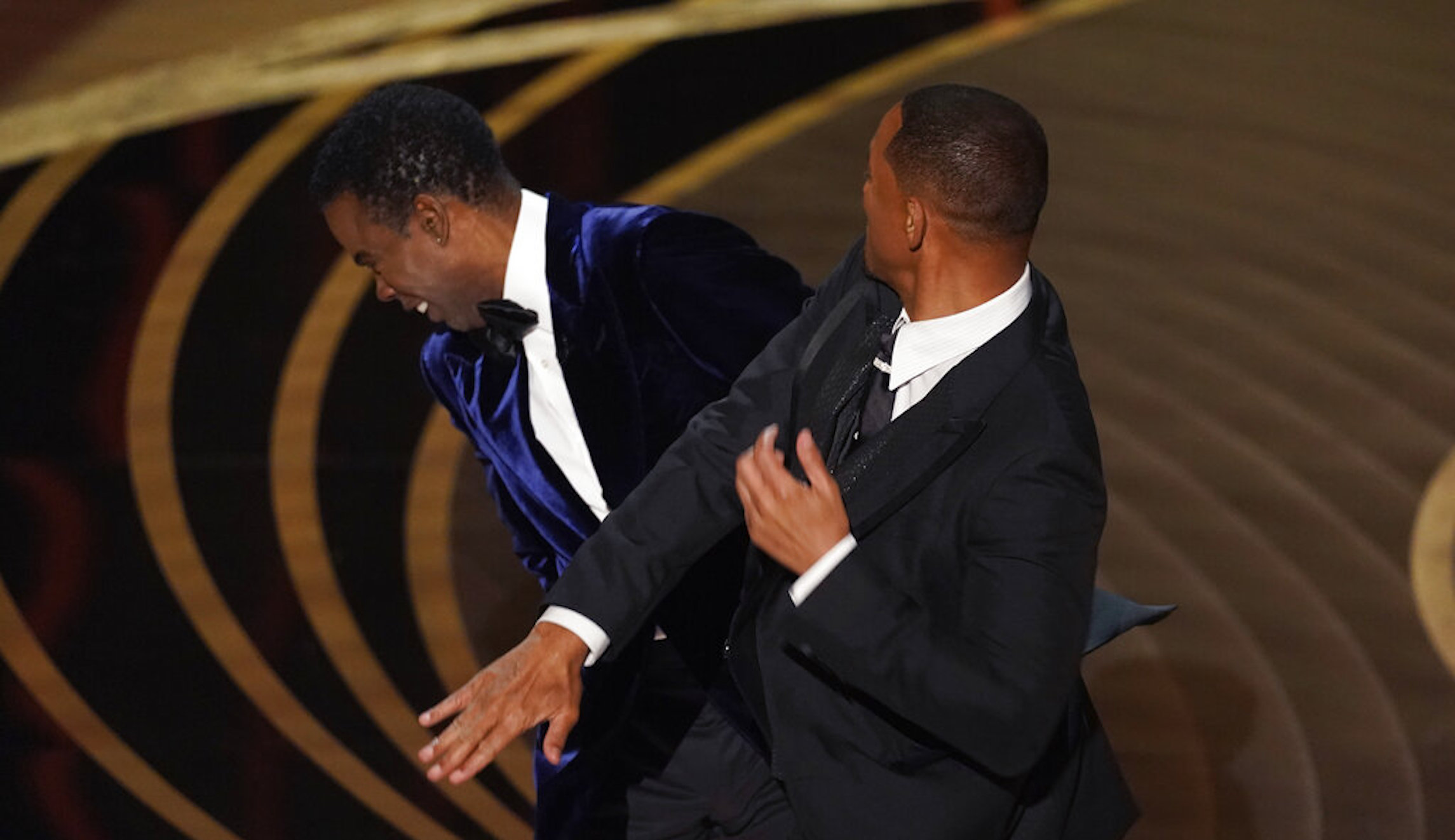
RACE, SEX, MONEY, AND THE OSCARS ASSAULT. What to think of actor Will Smith’s assault on comedian Chris Rock at the Oscars on Sunday night? It seems a pretty cut-and-dried issue. Smith physically attacked Rock, apparently over a joke Rock told about Smith’s wife. But you don’t get to attack someone physically over making a joke. Smith was in the wrong, as he later acknowledged, although not before attending post-Academy Awards parties.
But now a new poll shows a majority of people don’t see it that way. David Shor is an influential pollster in the Democratic world. He was a key figure, at age 20, in the 2012 Barack Obama reelection campaign and now is with the left-wing Center for American Progress. He is also in private business at a company called Blue Rose Research. On Tuesday morning, Shor released the results of an online poll of 2,162 respondents done in the aftermath of the Oscars assault.
Recommended Stories



The bottom line is that 52.3% of those surveyed felt that Rock was more in the wrong than Smith, while 47.7% believed Smith was more in the wrong than Rock. That is precisely the opposite of the belief that the circumstances of the Oscars would never justify a physical attack. For a majority of people, Smith was less to blame than Rock.
Subscribe today to the Washington Examiner magazine that will keep you up to date with what’s going on in Washington. SUBSCRIBE NOW: Just $1.00 an issue!
Granted, the question was worded in a somewhat pro-Smith way. This is what pollster Shor asked: “Last night, there was an incident at the Academy Awards show you may have heard about. The host, comedian Chris Rock, made a comment about Jada Pinkett Smith’s hair loss, joking that she should be cast in a movie as G.I. Jane. In response, her husband, actor Will Smith, stormed on the stage and slapped Rock across the face. Who do you think was more in the wrong?” The phrasing seemed designed to elicit sympathy for Smith.
Still, significant groups of the population were apparently predisposed to side with Smith. Young people, for example. Among people ages 18 to 34, 57.8% said Rock was in the wrong. Another pro-Smith group was people who make less than $50,000 a year. Among those who make less than $25,000, 63.4% said Rock was more in the wrong, while among those making between $25,000 and $50,000, 56.4% said Rock was wrong. Only among those making more than $100,000 per year, and especially those over $150,000 a year, did a majority see Smith as more in the wrong than Rock.
Then there is education, the less formal education respondents had, the more likely they were to believe that Rock was wrong. Among those with less than a high school education, 59.8% said Rock was more wrong than Smith. Among those with just a high school degree, 56.6% said Rock was wrong. The results were dramatically flipped among those who have a four-year college degree: 57.6% said Smith was more in the wrong, while 42.4% said Rock was more in the wrong.
Then there is sex. The short version is that men were more likely to think that Smith was wrong, while women were more likely to think that Rock was wrong. Among women, 56.5% said Rock was more in the wrong, while among men, 52.4% said Smith was more wrong.
Finally, there is race. Both Rock and Smith are black. Among black respondents, 56% said Rock was in the wrong, while 44% said Smith was in the wrong. Among white respondents, it was much closer but still with a slight edge for Smith: 51.1% said Rock was more wrong, while 48.9% said Smith was more wrong. Among Hispanic respondents, 55.7% said Rock was more wrong, while 44.3% said Smith was more wrong. And finally, Asian respondents split right down the middle, with 50% each saying Rock and Smith were more wrong.
In case you were wondering, Shor also divided responses by vote in the 2020 presidential election. It was close. Among Biden voters, 51.1% said Rock was in the wrong, while 48.9% said Smith was wrong. Among Trump voters, 50.8% said Rock was more wrong, while 49.2% said Smith was wrong. (On the other hand, a question like that is notoriously difficult to measure accurately because some people either don’t remember who they voted for or won’t say in light of how the election turned out.)
What does it mean? If you’re one of those who thought the incident was clear-cut — for example, that under the circumstances, Smith had no right at all to attack Rock — you have learned that not everyone sees it that way. Of course, it’s possible the results simply reflect Smith’s greater popularity — he is a movie star who actually won the Oscar about half an hour after the attack, while Rock is a standup comic whose act includes irritating people from time to time.
But the fact is, there is a pretty wide range of opinions on the incident. Many observers were stunned by the fact that no one in the Oscars audience did anything after the attack. No one escorted Smith out of the building, no one expressed disgust with his act, no one did anything. Now, after the poll, perhaps those actions are easier to understand.
For a deeper dive into many of the topics covered in the Daily Memo, please listen to my podcast, The Byron York Show — available on the Ricochet Audio Network and everywhere else podcasts can be found. You can use this link to subscribe.
