
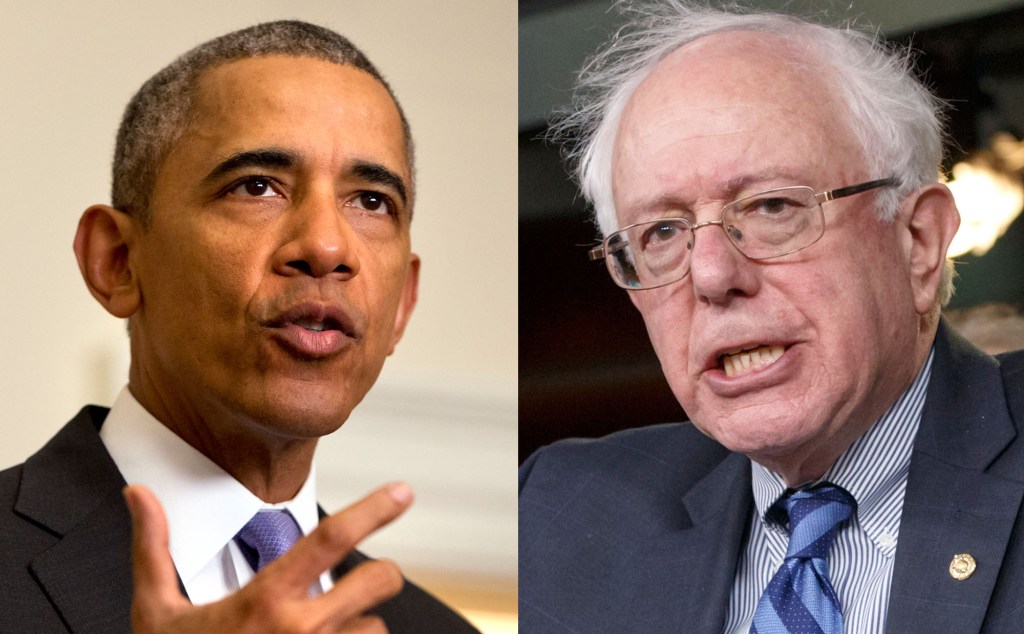
To implement a single-payer healthcare system, Sen. Bernie Sanders would institute a raft of new taxes.
In financing the healthcare costs that would shift to the federal government, the Vermont socialist and presidential candidate would end the United States’ status as a low-tax country.
Recommended Stories

In fact, Sanders has called for tax increases far beyond what President Obama has proposed in recent years.
Since the “fiscal cliff” deal in 2012 that undid parts of the Bush-era tax cuts for high-income earners and reset the top income tax rate to 39.6 percent, Obama has stopped pushing for higher income tax rates.
Instead, he has called for raising taxes on high-income earners through other means, including by limiting their tax breaks, increasing capital gains taxes and raising the estate tax.
Those ideas have been dead on arrival in Congress, all the more so in the current Congress with Republicans leading both the House and Senate.
Nevertheless, Sanders’ campaign proposal suggests that he thinks that Obama isn’t ambitious enough. He would ask Congress for all of the tax increases that Obama sought, plus about 10 times more.
Here’s the rundown of which of Obama’s proposed tax hikes Sanders would copycat, and where he would go much further.
Eliminating tax breaks
Obama economic adviser Jason Furman laid out the case for curbing tax breaks for high earners in an interview in 2014:
“We don’t need to raise tax rates on high-income households,” he said in an interview with CNBC. “We raised them back to what they were in the 1990s. Going forward, you can just cut some of the tax breaks and tax incentives that high-income households get; cut back on the subsidies that high-income households get for a mortgage or health care or retirement savings.”
Obama’s fiscal 2016 budget proposed to do just that by limiting the value of each dollar deducted to just 28 cents for households earning more than $250,000.
With Sanders’ proposed higher income tax rates, deductions would be even more valuable than they are today. This provision, however, would limit the benefit of deductions, mitigating that effect.
Raising estate taxes
Sanders also embraced Obama’s idea for raising estate taxes. The government would revert to the estate tax rules of 2009, raising the estate tax rate from 40 percent to 45 percent and lowering the exemption from $5.45 million to $3.5 million.
That change would bring in an additional $21 billion annually, according to the Sanders campaign, roughly doubling the current estate tax.
In recent years, the debate between Republicans and Democrats over the estate tax has become more heated. Democrats view it as among the most progressive taxes, meaning that raising it goes a long way in addressing inequality. Republicans see it as an added disincentive to investment, slowing growth. While Obama has proposed to raise the tax, House Republicans voted to eliminate it altogether.
Closing the carried interest ‘loophole’
To pay for a youth jobs program, Sanders has advocated closing the carried interest “loophole,” a provision of the tax code that results in some investment management officials paying the lower capital gains tax rate on their income rather than the ordinary labor income rate.
Obama also has favored this move, which would affect mostly financiers and high-income earners. Republicans Jeb Bush and Donald Trump also have called for rolling back the carried interest provision.
Where Sanders would go further
In addition to those similarities and others, including plans to tax multinational corporations’ offshore earnings to pay for infrastructure and instituting a Wall Street tax, Sanders proposes going much further.
- Income tax rates: While Obama has stopped seeking higher tax rates, Sanders hasn’t.
He envisions households earning more than $10 million paying a 52 percent income tax rate, the highest rate since before Ronald Reagan’s tax cuts. All households earning over $250,000 annually would face higher income tax rates if Sanders had his way.
- Capital gains taxes: In his budget, Obama called for raising the top tax rate on capital gains to 28 percent, including an Obamacare tax on investment income, up from 23.8 percent currently.
In his proposal Sunday night, Sanders didn’t state explicitly how high he would raise the tax rate on capital gains, but some guesswork indicates that it would be 58 percent.
Here’s where the 58 percent comes from: Sanders said he would want to equalize taxes on capital gains with taxes on labor income, which top out at 52 percent in his plan. Add in the 3.8 percent Obamacare investment tax and the 2.2 percent health care “premium” that would be added in Sanders’ plan, and the rate reaches 58 percent.
Roberton Williams, a tax expert at the nonprofit Tax Policy Center, said he thought a rate that high on capital gains was unprecedented in the U.S.
With Sanders raising tax rates so high, Williams said, there would be increased concerns about individuals planning their work and tax situations to avoid taxes. Sanders runs into “the obvious problem that if you raise marginal rates then you’re affecting people’s behavior more,” he said.
- Payroll taxes: Sanders would massively raise payroll taxes to pay for several programs. In doing so, he would raise taxes on the middle class, which Obama and Hillary Clinton have aimed to avoid.
For his single-payer health care plan, he would institute a 6.2 percent “income-based health care premium” that would fall on employers. That would be added to the existing payroll taxes of 15.3 percent that go toward Social Security and Medicare. Although it would be collected by employers, it would decrease workers’ paychecks as well.
In addition, he has called for a 0.4 percent payroll tax to finance paid leave and medical leave programs.
Lastly, to expand Social Security, he would lift the cap on income that is taxable under Social Security for income over $250,000. Today, income is untaxed after $118,500.
The result
Taking all his proposals together, Sanders has called for nearly $20 trillion in new taxes over the next 10 years, according to his campaign documents. That compares with the roughly $1.5 trillion in taxes that President Obama has called for, according to the Tax Foundation. It would amount to nearly a 50 percent increase over the roughly $42 trillion in revenues the Congressional Budget Office expects over the next 10 years.
While those tax hikes are guaranteed to be opposed by Republicans and even many Democrats, Sanders’ plans have received a warm welcome from liberal groups that would favor his health care and other plans and that would like to see the tax code reduce inequality.
“Sanders’ proposal to eliminate special tax breaks for capital gains, increase the payroll tax and increase income tax rates for the very best-off would raise needed revenues while moving us closer to a tax system that treats wealth the same as work,” Citizens for Tax Justice director Robert McIntyre said Monday.