

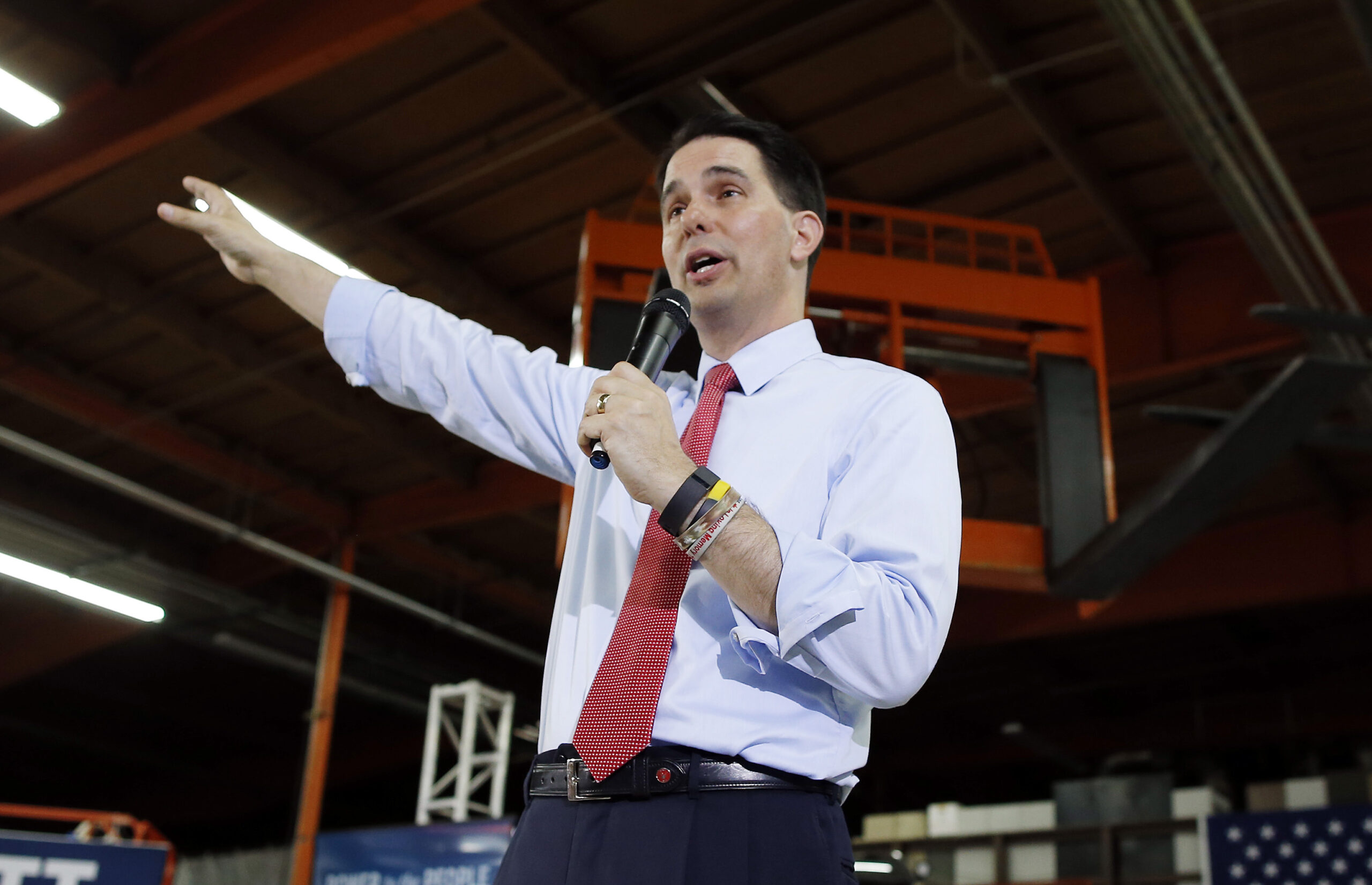
Scott Walker’s presidential campaign has suffered a series of setbacks leading some Republicans to question whether his candidacy has suffered irreparable damage. Walker’s team has a plan to bounce back, but some of the governor’s allies think he should consider making a change at the top.
Since the first presidential debate, Walker’s stock has tumbled. He has fallen from first to tenth in Iowa, dropped five percentage points in New Hampshire, and slid from third to seventh nationally. His campaign hopes September marks the beginning of voters’ decision to focus more on substantive policy issues, but thus far Fall’s arrival has shown voters flocking faster to “outsiders” who lack any political experience.
Stay informed.Stay ahead.
Join Washington Examiner for unlimited access to the news, analysis, and commentary that matter most.
Already a member? Log in
Some Republican strategists think Walker may not have much time left before he needs to make a big change at the top of his campaign. Republican strategist Liz Mair, who left Walker’s team earlier this year after making controversial remarks that questioned “Iowa’s front-running status,” said many voters think Walker’s candidacy now resembles Mitt Romney’s failed 2008 presidential campaign. She said the governor must avoid polling that suggests he should copy Donald Trump’s style and get back to what worked well for Walker in Wisconsin.
“If he can’t figure out how to do that, re-integrating some of the consultants who got him to the governorship, through the recall, and re-elected might put him in a position to better identify a path forward that is more true to who he is,” Mair said in an email. “These people know him far better than a lot of the folks who are involved now.”
Another Republican strategist who remains unaffiliated with any presidential campaign questioned the wisdom of relegating two aides who know Walker well to a super PAC, while looking elsewhere for a campaign manager. Keith Gilkes, who managed Walker’s 2012 recall victory, and Stephan Thompson, who managed his 2014 re-election, formed Unintimidated PAC — which supports Walker’s campaign — earlier this spring.
Rick Wiley manages Walker’s presidential campaign and worked with the governor on his 2014 re-election as an intermediary for the Republican Governors Association. He was a Republican National Committee political director in 2012 and a managing director of Mercury Public Affairs in Washington, D.C.
“From day one I have questioned why Stephan and Keith got sent to the super PAC in place of Wiley,” a GOP strategist told the Washington Examiner in an email. “I like Wiley, but replacing your top two guys who have shepherded you through three tough races in four years doesn’t make sense. Those guys aren’t amateurs. They’re smart and accomplished and going into it I thought they were two of his biggest assets, especially because they knew him/associates/family well and had earned their trust and because they are both no-drama types who wouldn’t tolerate some of the BS games that go on inside of these campaigns or the starf—ers who try to attach themselves to them.”
“I’d bring Keith back from the super PAC immediately. This doesn’t have to be a big shakeup/dismissal of Wiley—they can work together and while Rick focuses on making sure everything is running smoothly on the ground in the early states (and beyond) Keith can make sure everything stays on the rails/serve as an outlet for a candidate who might want to swerve all over the road because of what he’s reading/hearing.”
Asked whether such a change could be forthcoming, Brad Dayspring, a senior adviser to the super PAC, downplayed the possibility that his colleagues would leave.
“Campaign staffing decisions are made by the campaign and outside our purview and control – beyond that I couldn’t comment on such gossip,” Dayspring said in an email. “[W]e’re full speed ahead as planned.”
Rather than consider any such dramatic changes, however, the governor’s team said it has decided to redouble its efforts in the early primary states and will focus on detailing his specific policy proposals. Ed Goeas, a Walker senior adviser and veteran Republican pollster, said he has not heard any talk about bringing in the super PAC’s advisers, and added that the campaign is instead focused on its ‘organizational muscle’ in early nominating states.
“The polls aren’t really reflecting what’s happening on the ground with the grassroots, but that’s a whole other story,” Goeas said. “Where the narrative I think is wrong out there is a lot of people keep saying well this is where Rudy [Giuliani] was in 2008, this is where [Rick] Perry was, so these numbers can come down. It’s not a matter of these numbers coming down, it’s a matter of polls at this point don’t really reflect what’s happening on the ground.”
As evidence of its growing infrastructure, Goeas pointed to the campaign’s Monday announcement that it had expanded its Iowa leadership team, which includes a campaign point-person for all 99 counties.
Walker visited the Hawkeye State this past weekend, including a tailgate of a college football rivalry game featuring the University of Iowa and Iowa State University. His campaign rescheduled and canceled events in Michigan and California later this week so that he could make stops in Iowa and South Carolina instead.
But the governor kicked off the week in Las Vegas, Nevada, where the Walker campaign began its roll out of a new “Day One promise.” Each week going forward, Walker will detail news of a specific action he would take on his first day in the White House. The governor added thwarting “big government union bosses” to his list of promises, which already includes gutting President Obama’s executive action on immigration and deciding to send legislation repealing and replacing Obamacare to Congress.
In anticipation of Wednesday’s presidential debate, Goeas said viewers could expect to see a different Walker take the stage.
“I think what you’re going to see compared to the first [debate] is much more of a focus on that record because we’re in that phase where we’re doing the connection between the record and where he’s going. You’ve already begun to hear it a little bit,” Goeas said. “And we’ve always had this in our plans — that you go through a change at Labor Day that you go from a focus on kind of the broader to a focus on ‘OK, it’s time to get serious now.'”
Goeas added that he knows Walker’s “story sells well.”
But it’s too soon to tell whether voters will want to buy a comeback story.
