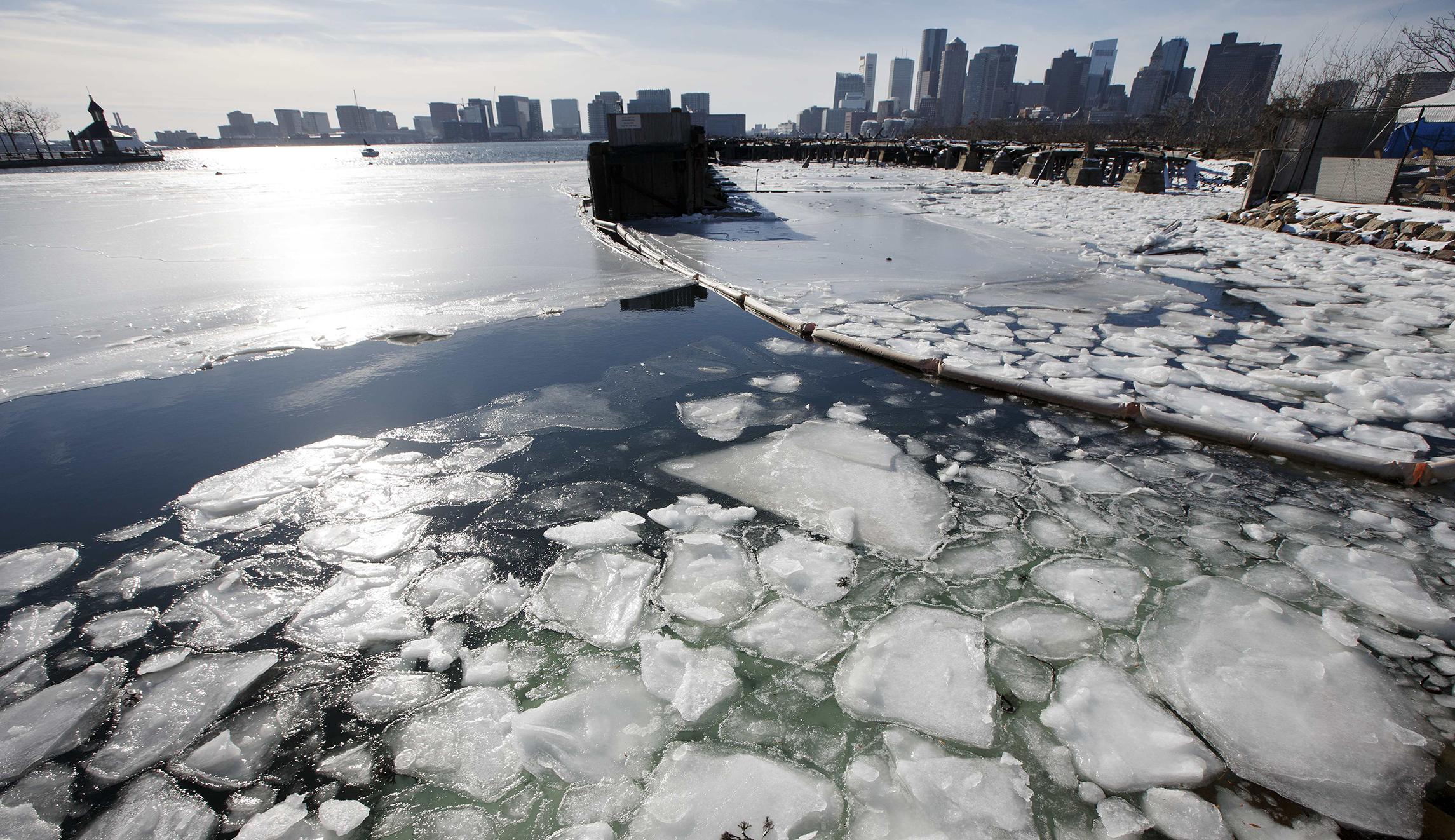
Less than a week after President Trump suggested the U.S. could use some “good old global warming,” rare accumulating snow fell in Southeast states like Florida while the Northeast is bracing for a so-called “bomb cyclone” of intense winter weather.
As flights are being cancelled at a rapid clip, “bitterly cold temperatures and dangerous wind chills” will persist all across the Eastern states into the weekend and winter storm warnings have been issued for parts of New Jersey, New York, and Connecticut, according to the National Weather Service.
Recommended Stories
Snow and sleet fell in Tallahassee, the capital of Florida, on Wednesday, representing the first snowfall there in nearly 30 years. In parts of coastal Georgia, which hasn’t seen much in the way of measurable snow in years, up to three inches of fell. Snow and ice are in the forecast for the Carolinas.
And that’s just the beginning.
Well the last flakes are falling and we are up to just over 5” here at the office. As daylight ends, thanks to everyone who has sent in reports so far. It’s been fun. Now everyone stay safe and warm! #scwx #gawx ❄️☃️? pic.twitter.com/1lKDLru2Il
— NWS Charleston, SC (@NWSCharlestonSC) January 3, 2018
In the days ahead as the storm tracks north along the coast, 6 to 12 inches of snow accumulation is expected along the East coast from Virginia Beach to Boston, and higher amounts, 12 to 18-plus inches are possible in parts of New England, the National Weather Service said. Forecasters are also warning of blizzard conditions and bitter cold air. At least 12 deaths tied to the cold have been reported so far.
Coastal flooding and storm surge is also possible, as are power outages due to wind.
Winter weather will impact the entire East Coast today through Friday. Here are the latest expected snow totals and current winter headlines. Strong winds will accompany the snow in many locations. Stay informed at https://t.co/VyWINDk3xP or your trusted weather source! ???? pic.twitter.com/RqCr3h6XR1
— NWS (@NWS) January 3, 2018
Places in between, like Washington, D.C., might simply be scraped by the storm. Current projections say up to 2 inches of precipitation may fall on the city, but if the storm tracks further to the west, the accumulation total could quickly rise.
With several senators missing roll call, and Sen. Tim Scott, R-S.C., trying and failing to ride a boogie board on the snow to D.C., Majority Leader Mitch McConnell, R-Ky., announced Wednesday that there would be no further votes this week. The House is not in session this week.
The major weather event is a result of cold, dry air plunging south into the U.S. from Canada, ramming into warmer and moist air off the Southeast coast. On Thursday the Northeast could experience what meteorologists are calling a “bombogenesis” or “bomb cyclone,” which happens when there is a rapid drop in barometric pressure, measured in millibars, over a short period of time, resulting in a stronger storm system.
Cyclone rapidly deepening off the US east coast. @NOAA #GOES16 water vapor imagery. pic.twitter.com/ZP8NxplK3y
— NASA SPoRT (@NASA_SPoRT) January 4, 2018
“Bombing is simply the rapid decrease or drop in surface barometric pressure of at least 24 millibars in 24 hours and significations intensification or strengthening of the storm system,” Ryan Maue of Weather.us explained in a blog post. “The jet stream, trough of low pressure and the warm, moist ocean surface provide multiple sources of fuel (diabatic and baroclinic) to transfer the potential energy in the system to kinetic energy or the monster storm.”
What you need to know about a “bomb cyclone”—officially referred to as bombogenesis—as a powerful winter storm bears down on the East Coast. https://t.co/KDL3X1TKt1 pic.twitter.com/5LwzJbl4lE— ABC News (@ABC) January 3, 2018
Bombogenesis is not unheard of; in fact, this weather phenomenon has happened multiple times in the past few years, and not only with winter storms, as Weather.com points out.
Temperatures are expected to rise above freezing, from D.C. to Boston, sometime early next week.
Beyond the East Coast, frigid weather has gripped the Plains and the Midwest too in recent days. Bismark, N.D., which is no stranger to bitterly cold air, tied the record low temperature at minus 13 degrees — a record set in 1874 according to the National Weather Service — and other cities in the state broke their respective records.
Some snowfall and ice accumulation reports received by NWS forecast offices in South Carolina, Georgia and Florida as of 4 pm. pic.twitter.com/qhyyqf9o07
— NWS Eastern Region (@NWSEastern) January 3, 2018
Temperatures are expected to drop to the sub-zero range all across the northern states, and in some cases factoring in wind chill, the air could feel like 50 degrees below freezing in the Dakotas and Minnesota, according to Weather.com.
Meanwhile, for those looking for an escape from winter, Alaska, the northernmost state, has been unusually warm, though temperatures are expected to drop in the coming days.
The weather extravaganza follow’s Trump’s tweet last week jokingly suggesting the U.S. could use some global warming.
“In the East, it could be the COLDEST New Year’s Eve on record,” the president tweeted Thursday before going on to suggest the U.S. is saving trillions of dollars by backing out of the Paris climate deal.
“Perhaps we could use a little bit of that good old Global Warming that our Country, but not other countries, was going to pay TRILLIONS OF DOLLARS to protect against,” Trump added. “Bundle up!”
Trump’s tweet was met with a great deal of backlash from Democrats, the media, and members of the scientific community. Many of Trump’s critics rallied around a map being shared on Twitter from University of Maine’s Climate Change Institute that showed warmer-than-average temperatures in almost all corners of the globe, except the U.S.
Trump thinks climate change isn’t real because it’s cold out.
This map proves him wrong. https://t.co/qXjfazwDdv pic.twitter.com/pwfcZSrhnO
— Vox (@voxdotcom) December 29, 2017
Despite Trump’s record of skepticism, most scientists believe that humans are the largest contributor of greenhouse gases that cause global warming — which has been tied to, among other things, an unusually intense hurricane season and wildfires in California this year.
Data from NASA showed that 2017 was the second hottest year on record.
