

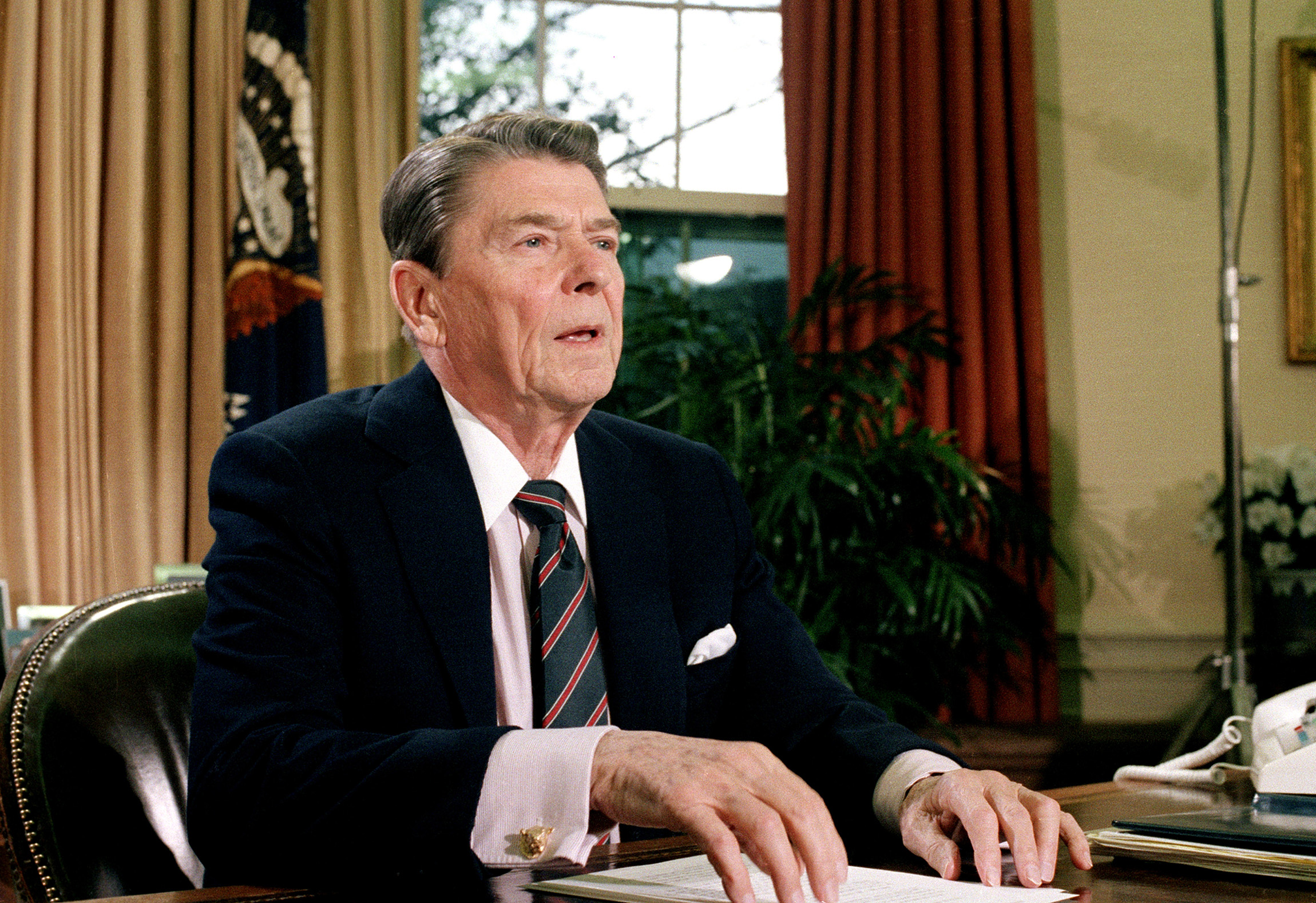
The ghost of Ronald Reagan haunts the Republican presidential primary campaign. Consider that in the GOP debates, Reagan’s name has been uttered 72 times and by 16 of the 17 original candidates.
Reagan’s popularity among Republican presidential hopefuls is understandable. Reagan oversaw an economic recovery and contributed to ending the Cold War. More than anything, his sunny optimism helped many Americans believe that the United States could once again become, as Reagan (paraphrasing John Winthrop) put it, a shining city upon a hill. All of this helps explain why Reagan often ranks near the top of polls asking the public to name their favorite past president.
Recommended Stories


But the manner and frequency with which Reagan’s name is invoked on the campaign trail often does an injustice to the man and his legacy.
For one thing, while the Republican candidates are fond of saying things like, “If Reagan were alive today…” and “As a Reagan conservative, I believe…” in reality it’s not so easy to know what Reagan would do today.
Reagan became president in a much different America that was grappling with a much different set of political issues. Thirty-five years have elapsed since Reagan was first inaugurated — that’s more time than had elapsed between Eisenhower’s inauguration and his own.
Back then, many Americans went to bed at night worrying about runaway inflation and the threat of a nuclear Soviet Union, while debates over issues like school prayer and the Equal Rights Amendment dominated public discourse. Many of today’s issues, such as the rise of the Islamic State, were not even on the horizon.
Entire issue areas have come and gone in the interim. Consider gay marriage, which was not on the political radar during Reagan’s time (in fact, back then the APA still listed homosexuality as a mental disorder). Now it’s a constitutional right that even many conservatives support.
Just as Reagan didn’t attempt to apply the conservatism of the World War II era to the problems of the late ’70s and early ’80s, today’s Republicans shouldn’t necessarily attempt to apply the Republican agenda circa 1980 to today’s political landscape. If four years is an eternity in politics, the Reagan Revolution is ancient history.
The demographic makeup of the country has changed significantly, too. Back in 1980, non-Hispanic whites comprised 83 percent of the population. Today they’re only 63 percent. And in another couple decades they’ll be a minority.
On a more practical level, tens of millions of voters don’t even remember the Reagan era. Like it or not, Republicans must compete for voters in today’s political landscape, not the one their hero prospered in nearly 40 years ago.
A worse problem for many of today’s Republicans is that they often over-simplify or whitewash Reagan’s legacy, usually to justify their own positions.
Consider Ted Cruz, who invokes Reagan’s name most often (16 times in the debates alone). On the campaign trail, he often claims that Reagan’s tax cuts and deregulation helped the economy to recover after the malaise of the Carter years. But he neglects to mention that the Reagan era was also defined by large budget deficits that continued for years after he left office.
And consider Donald Trump’s shameless use of Reagan to justify his shifting position on abortion. Recently, after suggesting that women who procure abortions should face “some sort of punishment,” Trump issued a clarifying statement in which he insisted that just like Reagan, “I have evolved” on abortion.
But nobody doubted that Reagan’s abortion evolution was sincere. The same can’t be said of Trump, who has made it clear not only that he doesn’t understand the pro-life ethos, but also that he has no particular interest in understanding it.
The invocation of Reagan’s name on the campaign trail is sure to deliver a cheap applause line, and it’s easy to claim that this or that candidate is or is not a “Reagan conservative.” After all, who’s to say Reagan wouldn’t support, say, federal climate change legislation? If you look hard enough, you might even be able to dig up some quotes from Reagan or his staff suggesting as much.
But it is unfair to presume what someone else would think, say or do. That’s especially true for a president who’s been out of office for nearly 30 years and dead for over a decade.
Daniel Allott is deputy commentary editor for the Washington Examiner
