

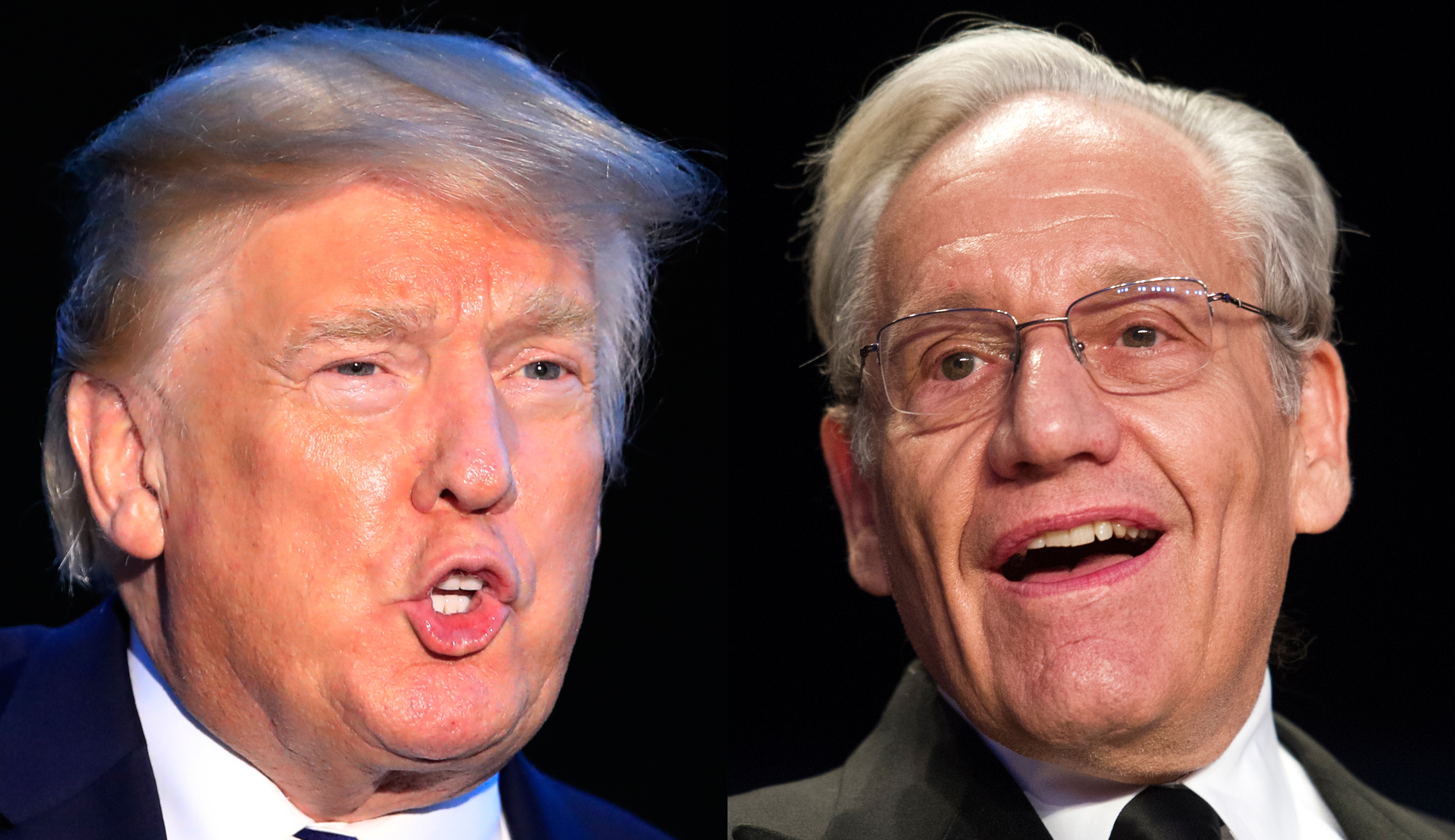
While excerpts from Bob Woodward’s soon-to-be-released book, “Fear,” suggest that President Trump’s knowledge of international affairs is inadequate, they do not present Trump’s foreign policy mindset as fundamentally dangerous.
Don’t misunderstand me, a full reading of the book – and Woodward’s reporting is first rate – may suggest Trump’s mindset is dangerous. It’s also true that Trump wrongly views major treaties such as NATO and NAFTA as business-type arrangements rather than the structural foundations of a U.S.-led international order (an order from which Americans benefit greatly in economic and security terms). Yet we should invoke a sense of proportion to the reaction that has followed excerpts of Woodward’s book as released by the Washington Post on Tuesday. While some of those excerpts are negative for Trump, they do not collectively present the president in the negative light.
Recommended Stories


Let’s consider three specific examples in relation to Syria, North Korea, and Afghanistan.
Syria
Woodward writes that: “After Syrian leader Bashar Assad launched a chemical attack on civilians in April 2017, Trump called [Defense Secretary James] Mattis and said he wanted to assassinate the dictator. ‘Let’s fucking kill him! Let’s go in. Let’s kill the fucking lot of them.'”
Sorry, but this is not as crazy as it sounds. While assassinating Assad would be bad in setting a precedent for the killing of foreign leaders, considering Assad’s slaughter of hundreds of thousands of his own people and his direct role in feeding the recruitment of terrorist groups like the Islamic State, his demise would be positive for Syria’s long-term stability.
Regardless, no assassination effort actually occurred! Instead, Trump authorized a much narrower offensive directly targeting Syrian regime chemical weapons capabilities. That outcome matters because when the U.S. missiles started flying into their Syrian targets, Trump obviously would have noticed that Assad himself was not being targeted. That he didn’t then fire Mattis shows that the president was persuaded by Mattis’ recommendation not to assassinate Assad. If anything, this scenario shows that Trump is amenable to taking good advice against his first instincts. And that’s the definition of good leadership, not bad!
North Korea
Woodward recalls that “One month into his presidency, Trump asked Dunford for a plan for a preemptive military strike on North Korea, which rattled the combat veteran.” Later Woodward adds that: “In the fall of 2017, as Trump intensified a war of words with Kim Jong Un, nicknaming North Korea’s dictator ‘Little Rocket Man’ in a speech at the United Nations, aides worried the president might be provoking Kim. But, Woodward writes, Trump told [former adviser Rob] Porter that he saw the situation as a contest of wills: ‘This is all about leader versus leader. Man versus man. Me versus Kim.’”
I think there’s a lot to be said in Trump’s defense here. For a start, there is absolutely nothing wrong with Trump’s request for pre-emptive strike options. For one, those options pre-existed the Trump administration and are constantly refined: they are nothing new. They are nothing new in that Pentagon planners know the U.S. may one day need to take pre-emptive action. More importantly, asking for a plan does not mean using a plan – it simply means a leader is building maximal opportunity for immediate freedom of action.
In addition, I personally believe that Trump was right to pressure the North Korean leader as he did. In fact, I believe this was the key factor in driving Kim Jong Un to suspend his missile tests. By forcing the North Koreans to believe that Trump is capable of every threat he makes, its hardliners decided that Trump could not be defeated in a simple eyeball-to-eyeball diplomatic showdown. That had always worked for Pyongyang before, but no longer. To be clear, Trump’s variable rhetoric criticizing Kim Jong Un and now politely addressing the North Korean leaders is viewed favorably by top U.S. allies and U.S. intelligence officials. They were nervous about that rhetoric but have seen its dividend in the reduction of tensions and at least the potential of a diplomatic solution to this crisis.
Afghanistan
The Washington Post notes that “At a July 2017 National Security Council meeting, Trump dressed down his generals and other advisers for 25 minutes, complaining that the United States was losing, according to Woodward.” Woodward claims that Trump asserted, “The soldiers on the ground could run things much better than you. They could do a much better job. I don’t know what the hell we’re doing.”
This is exactly the same approach the Obama administration took towards “the generals” over their preferred strategy in Afghanistan in 2009. And in both cases, Trump and Obama were right to challenge military orthodoxy in order to ensure that the best options were presented at their desks. U.S. policy interests and its instruments (the men and women on the ground) demand it.
But Trump’s Afghan strategy is a lot better than Obama’s. Where Trump has committed the U.S. to a long term advise and assist role in Afghanistan and as a corollary has leveraged greater U.S. political influence in Kabul and over the Taliban (and against Pakistani malfeasance), the Obama administration gave a fixed timeline for U.S. withdrawal from Afghanistan. Obama’s approach assaulted the most basic premise of grand strategy: to retain the initiative in objectives sought and flexibility applied, and thus limit the adversary’s range of options.
All of this speaks to a broader issue about Trump’s foreign policy. Yes, while it’s true that Trump too often takes a flippant approach to issues of grave consequence, he continues to ultimately defer to his top advisers. Trump’s critics might point to Mattis saving the world from Trump, but at least Trump listens to his defense secretary.
In contrast, Obama’s first Defense Secretary Bob Gates notes in his book that he could barely get access to the president! Obama was more interested in listening to Ben Rhodes.
Trump’s unique style has also afforded foreign policy opportunities. After all, foreign adversaries view Trump as the antithesis of Obama, as a president who is inherently unpredictable. While this is negative in its impact on allied leaders, it is distinctly beneficial in throwing foreign adversaries like China, Iran, and North Korea off balance.
In short, Trump isn’t perfect by any stretch of the imagination, but the wreckage of Aleppo and MH-17 also suggests Obama’s foreign policy wasn’t that great either.
As we read the foreign policy elements of Woodward’s book, we must focus first and foremost on what actually happened.
