

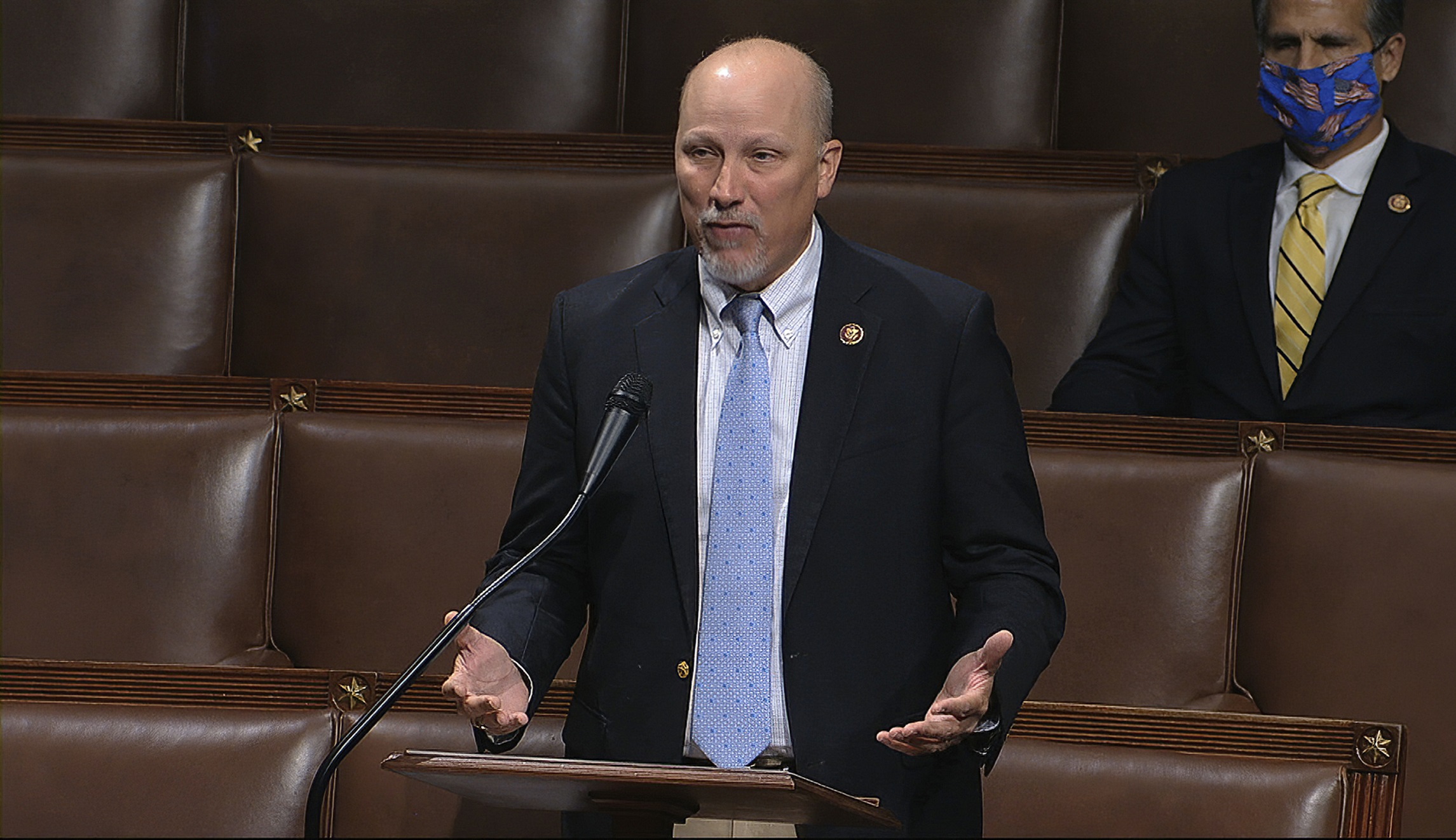
Rep. Chip Roy put fellow House members on the spot Sunday in forcing a vote against seating lawmakers who cite voter fraud in their states but are willing to be sworn into office themselves after winning election on the same ballot.
The Texas Republican’s move, just before House members were about to be sworn in for the 117th Congress, reflects stark divisions among Republicans in that chamber and the Senate about raising objections on Wednesday to the counting of electoral votes. The normally ceremonial event will end with Joe Biden officially being declared president-elect, having beaten President Trump in November by a 306-242 Electoral College count.
Recommended Stories


The effort by Roy, a member of the House Freedom Caucus, failed 371-2. It’s part of a developing split among Republicans about whether to question Electoral College votes from states that President Trump lost. Some Republicans believe that suspicions of fraud should be explored by Congress, and others, like Roy, believe that the matter has been settled by the states and the courts.
On the House floor on Sunday following the election of Democrat Nancy Pelosi as House speaker, Roy objected to seating representatives-elect Arizona, Georgia, Wisconsin, Michigan, Nevada, and Pennsylvania not be formally sworn in.
Roy explained his objection in a statement provided to the Washington Examiner.
“I do not make this objection lightly and take no pleasure in it, but believe that I am compelled to do so because a number of my colleagues — whom I hold in high regard — have publicly stated that they plan to object to the acceptance of electors from those particular six states due to their deeply held belief that those states conducted elections plagued by statewide, systemic fraud and abuse that leaves them absolutely no way for this chamber or our constituents to trust the validity of their elections,” Roy said.
He continued, “Such allegations — if true — raise significant doubts about the elections of at least some of the members of the United States House of Representatives that, if not formally addressed, could cast a dark cloud of suspicion over the validity of this body for the duration of the 117th Congress. After all, those representatives were elected through the very same systems — with the same ballot procedures, with the same signature validations, with the same broadly applied decisions of executive and judicial branch officials — as were the electors chosen for the President of the United States under the laws of those states, which have become the subject of national controversy.”
Roy forced a roll call vote on whether to seat the elected members, and members overwhelmingly voted in favor of seating all the representatives-elect.
The move confused and peeved other representatives-elect on both sides of the aisle.
“I mean, if he wants to be a jerk, he can do that,” Republican Darrell Issa of California told the Washington Examiner.
“He’s just an idiot. And it doesn’t even look like he’s voting for it. No one voted for it. So, I don’t know what he’s about,” said Democrat Peter DeFazio of Oregon.
Republican Jeff Van Drew of New Jersey appeared to reject the premise of Roy’s symbolic objection.
“I don’t really understand why he would do that,” said Republican Jeff Van Drew of New Jersey. “Certainly, I think we need maximum integrity in our elections, but these folks didn’t have an issue, there was no issue there. Those elections were clear-cut. Presidential election is different.”
I am as outraged as anyone about the still-unanswered questions about the election. But the Constitution is clear:
States select electors. Congress does not.
There is only one path to victory for @POTUS on Jan. 6: state legislatures certifying Trump electors in states at issue pic.twitter.com/QypY9Kyk8P
— Rep. Chip Roy (@RepChipRoy) January 3, 2021
North Dakota Rep. Kelly Armstrong, Colorado Rep. Ken Buck, Wisconsin Rep. Mike Gallagher, South Carolina Rep. Nancy Mace, Kentucky Rep. Thomas Massie, and California Rep. Tom McClintock.
According to Rep. Louie Ghomert, more than 100 House Republicans may join in the objection.
Roy’s full statement on his objection is below:
I do not make this objection lightly and take no pleasure in it, but believe that I am compelled to do so because a number of my colleagues — whom I hold in high regard — have publicly stated that they plan to object to the acceptance of electors from those particular six states due to their deeply held belief that those states conducted elections plagued by statewide, systemic fraud and abuse that leaves them absolutely no way for this chamber or our constituents to trust the validity of their elections.
Such allegations — if true — raise significant doubts about the elections of at least some of the members of the United States House of Representatives that, if not formally addressed, could cast a dark cloud of suspicion over the validity of this body for the duration of the 117th Congress. After all, those representatives were elected through the very same systems — with the same ballot procedures, with the same signature validations, with the same broadly applied decisions of executive and judicial branch officials — as were the electors chosen for the President of the United States under the laws of those states, which have become the subject of national controversy. And while the legislatures of those states have sent us no formal indication that the results of these elections should not be honored by this body, it would confound basic human reason if the presidential results were to face objection while the congressional results of the same process escaped without public scrutiny.
While the Constitution and the 12th Amendment do not make Congress the judge of the states’ presidential electors, it does require us to be the arbiters of the elections to this body. If the electors for the office of the president were not in question, neither would be the election certificates of my colleagues present here today.
Free, fair, and credible elections are the bedrock of any legitimate, representative government. If we are to adequately address the controversy that currently surrounds our presidential elections, then we owe it to the American people to be consistent in our dealings to that end. Anything less would strip the current efforts of their legitimacy and make it look like a political stunt, rather than a good-faith effort to restore confidence in our electoral process.
Therefore, rather than merely accept the certification of members from those states by our traditional practice without a vote — in effect, by our consent — I believe our body should vote on the certification of those members to ensure the integrity of the House of Representatives is guarded from all suspicion of illegitimacy. I therefore objected and hope that the House leadership will expeditiously set a roll call vote —en bloc — so that our body can take a recorded vote on seating those members.
It is my sincere hope that my objection is not seen as an affront to any of these members personally — as some affected are among my dearest friends — and I regret that my objection may have disrupted what remains of the majesty of the swearing-in process, particularly for my incoming freshmen colleagues with family present. I further understand if my objection causes a colleague to object to my own seating and would welcome a vote in that event.
The father of our country, George Washington, famously called the Constitution — which his wisdom helped craft and guide to fruition — ‘the guide which I never will abandon.’ The members of this body, bound by oath, owe it the same fidelity in this case and all others.
