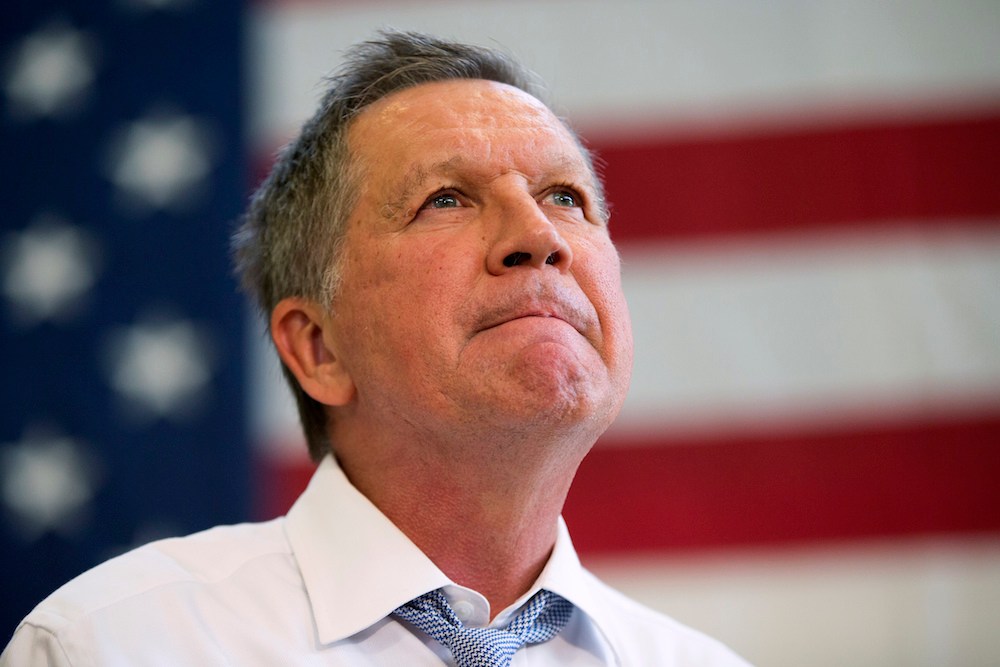
John Kasich flops in friendly territory

John Kasich flopped Tuesday in states where he was supposed to prove his mettle, and further undermined the rationale for his underdog presidential bid.

It was true that the Ohio governor was poised to finish ahead of Sen. Ted Cruz of Texas, and second to Donald Trump, in four of the five primaries held in the mid-Atlantic and northeast. But it was a distant second, and likely third in his native Pennsylvania.

What’s worse, it was in Connecticut, Delaware, Maryland, Pennsylvania and Rhode Island — home to the legions of pragmatic Republicans that Kasich has courted — where the governor was supposed to shine. It was there that he was to accumulate convention delegates and prove that he was more than a spoiler in the race to stop Trump from capturing the Republican presidential nomination.

Exit polling in Connecticut, Maryland and Pennsylvania showed that Trump performed better than Kasich with “moderate Republicans,” a significant failure given how the governor has positioned himself in this campaign. In Maryland and Pennsylvania, Trump’s margin over Kasich among moderates was overwhelming, 12 points and 31 points, respectively.

Overall, Kasich won just five delegates in five states where his campaign had projected strength. In an April 20 memo, Kasich’s chief strategist, John Weaver, said the governor would be competitive in Pennsylvania and beat Trump in as many as seven Maryland congressional districts and four seats in Connecticut, which would have garnered him at least a few dozen delegates.

Instead, Trump won them all.

“When the history of 2016 is written it will be said that the best friend of Donald Trump and Hillary Clinton was John Kasich,” said a veteran Republican operative who requested anonymity in order to speak candidly. “At no point in this election was his campaign competitive and by simply continuing to exist he prevented better candidates from consolidating in time to stop a complete disaster for the Republican Party.”

Cruz also faltered Tuesday, as expected, and won just one delegate. Yet, the senator has managed to win states that stacked up well for him, and combined with a robust delegate operation, he has put himself in position to challenge Trump in the event of a contested convention. After more than 40 primaries, Ohio stands alone as Kasich’s only victory.

Trump’s five-state sweep pushed his delegate haul from 845 to 950; he needs 1,237 to clinch the nomination. Cruz finished the night at 560. The senator’s take in Tuesday’s primaries was expected to be minimal, but there are states voting in May that should be friendly territory and allow him to grow that number.

Kasich was trailing with 148 delegates, where he had been stuck for weeks; he’s now sitting with 153. The map of remaining states in May and June don’t look promising, either, and it’s now possible that he rolls into any contested convention having won only his home states and having accrued no more than around 200 delegates.

That’s not much more than Sen. Marco Rubio of Florida, who exited the race March 15 with 171 delegates.

With Kasich having failed to inflict measurable damage on Trump in states that supposedly shaped up well for him, Republican insiders are not only laughing off the governor’s claims that he could win a contested nomination floor fight, they’re saying his legacy in the race will be that of standing in the way of viable candidates that might have stopped Trump.

“Kasich has proven there is no market for a defiant left of center Republican,” a GOP strategist said.

Related Content