
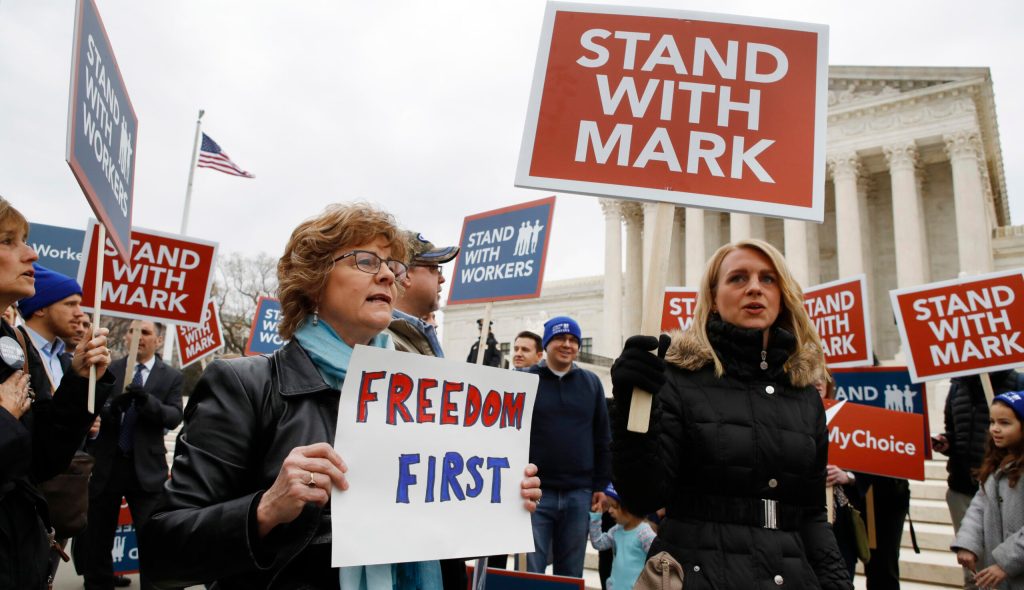
Democratic gains in a number of states have union officials salivating over the prospect of repealing state right-to-work laws. Right-to-work makes it illegal to fire someone for refusing to pay union dues or fees. Currently, 27 states have such laws.
Here in Michigan, where Democrats took the governorship and picked up seats in both the House and Senate, the repeal of our right-to-work law, enacted in 2012, is Big Labor’s number one legislative priority. In fact, two bills were introduced right out of the gate by labor-supported Democratic leaders: one to repeal private sector right-to-work and the other public sector. Union officials in Nevada, Virginia, and Wisconsin also are talking about repeal.
Opponents of right-to-work claim these laws hurt working people, producing lower wages, fewer benefits, greater numbers of “working poor,” and more dangerous working conditions. In fact, the opposite is true. What right-to-work laws do is reduce the power of union officials, making the states that have such laws more attractive for new factories, new businesses, and increased business investment.
Just look at what has happened in Michigan. Since passing right-to-work in 2012, Michigan has added more than 430,000 new jobs, a 10 percent gain. Our neighbor, Ohio, a non-right-to-work state with a population roughly 17 percent higher, added only about half as many new jobs (218,000) during this same time period.
Wages also have increased in Michigan. Weekly wages are up an average of $111, or nearly $6,000 per year since 2012, according to the Bureau of Labor Statistics, or BLS.
Add to this the extra pay bump that comes because workers in right-to-work states aren’t required to pay union dues. They can if they want, but if they choose not to support a union they typically save between $500 and $1,000 annually.
Worker safety has not been compromised, either. According to the latest figures from the BLS, from 2012 to 2017, the latest year for which data are available, Michigan’s workplace fatality rate has stayed exactly the same. And nonfatal workplace injuries requiring time off have declined.
The ban on compulsory unionism also has not increased poverty in Michigan. In fact, since the law went into effect, Michigan’s poverty rate has declined from 17 percent to 14.2 percent.
Every single concern expressed about right-to-work laws when they were passed has turned out to be false in real life. So, why is repeal such a high priority for Democratic lawmakers? It’s because right-to-work laws reduce the power of union officials, who typically support Democrats financially and at the polls.
With the exception of the United Auto Workers, which reports increased membership since our law went into effect, most other large unions in Michigan — including the teachers union (the Michigan Education Association and its local affiliates) and Michigan affiliates of the American Federation of State, County, and Municipal Employees — have lost members since 2012, in many instances by as much as 30 percent.
Decreased union membership has had a major effect on union political spending. From the 2012 to 2016 election, which includes presidential spending cycles before and after right-to-work was passed, the typical Michigan union cut its direct political spending in half. Still, unions continue to be a major player in the state and are core financial supporters of the Democratic Party.
Now that workers have a choice about whether or not to pay union dues, unions should be free to take part in the political process. After all, now nobody is being forced, through compulsory unionism, to support political activities that they personally oppose. If they don’t agree with their union’s political activities, they can resign.
Based on our experience in Michigan, there is little justification for repealing right-to-work, which has yielded none of the ill side effects opponents had predicted.
Workers in Michigan and other right-to-work states should keep their freedom to choose whether or not to join or fund a union, and other states should follow the lead of these states and pass their own laws. The benefits to workers are clear.
Morgan Shields is legal counsel and director of Workers for Opportunity at the Mackinac Center for Public Policy, a nonpartisan research and educational institute headquartered in Midland, Mich.
