

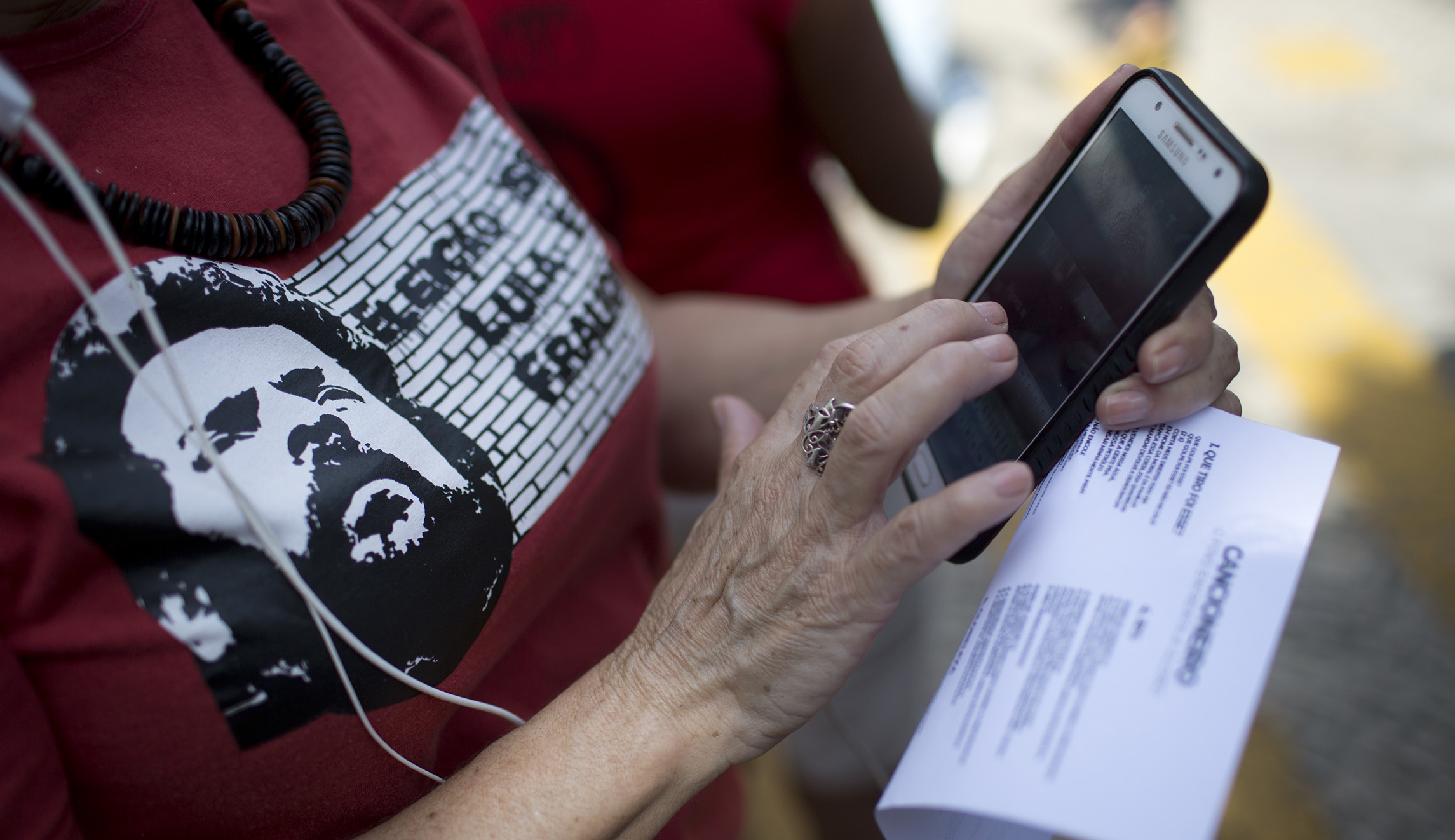
The U.S. Supreme Court ruled Friday in a blockbuster Fourth Amendment case that the government generally must have a warrant to obtain a cellphone user’s location information from a cellphone company.
The court ruled 5-4 in the case, and Chief Justice John Roberts wrote the majority opinion. He was joined by the liberal justices.
Recommended Stories



With its ruling, the Supreme Court reversed a ruling from the 6th U.S. Circuit Court of Appeals and sent the case back to the lower court.
“We decline to grant the state unrestricted access to a wireless carrier’s database of physical location information. In light of the deeply revealing nature of [cell site location information], its depth, breadth, and comprehensive reach, and the inescapable and automatic nature of its collection, the fact that such information is gathered by a third party does not make it any less deserving of Fourth Amendment protection,” Roberts wrote. “The government’s acquisition of the cell-site records here was a search under that amendment.”
Roberts conceded, though, that the court’s ruling was narrow, as it does not express a view on the real-time collection of cell phone location information or conventional surveillance techniques. He also said that while the government generally needs to obtain a warrant to obtain cell phone location information, exceptions exist, such as if that information is needed to pursue a “fleeing suspect” or protect people who may face imminent harm.
The case stems from a string of armed robberies that took place in Ohio and Michigan in 2010 and 2011. As part of its investigation, the federal government obtained cell phone records without a warrant. Those records included the dates and times of calls and cell phone location information for Timothy Carpenter.
The information, called cell site location information, allowed law enforcement to pinpoint Carpenter’s location and movements when the robberies occurred. He was subsequently convicted.
Under current law, the federal government doesn’t have to obtain a warrant to access cell phone location information due to the “third-party doctrine,” which is derived from two Supreme Court decisions in the 1970s. The justices said then that when a customer gives information to a third-party, such as a phone company, the customer loses the expectation of privacy. The third party was able to do whatever it wants with the information, the Supreme Court said decades ago, which includes giving it to the government.
Carpenter’s lawyers argued the government violated his Fourth Amendment rights when it failed to secure a warrant for his cell phone location information. But the 6th U.S. Circuit Court of Appeals ruled a warrant isn’t required.
The Supreme Court agreed with Carpenter, and said that when the government accessed his cell phone location information from wireless carriers, “it invaded Carpenter’s reasonable expectation of privacy in the whole of his physical movements.”
But Justice Anthony Kennedy, who authored a dissent, warned the Supreme Court’s ruling in the case puts criminal investigations at risk.
“The court’s newly conceived constitutional standard will cause confusion; will undermine traditional and important law enforcement practices; and will allow the cell phone to become a protected medium that dangerous persons will use to commit serious crimes,” Kennedy wrote.
The justice also said that millions of Americans choose to share their location daily, either by using location-based services on their phones or by sharing their location on social media, thus making today’s expectations of privacy “even less reasonable” then they were decades ago.
The case united a diverse coalition of stakeholders, from the tech community to privacy organizations to civil liberties groups, who feared a ruling in favor of the government could allow law enforcement to freely obtain troves of digital data.
The Supreme Court seemed to recognize that worry, and said cell phone location information allows police to effectively travel back in time to retrace a person’s whereabouts.
Roberts wrote that because such location information is continually logged by cell phone companies for all 400 million devices in the U.S., “this newfound tracking capacity runs against everyone.”
“Whoever the suspect turns out to be, he has effectively been tailed every moment of the day for five years, and the police may — in the government’s view — call upon the results of that surveillance without regard to the Fourth Amendment. Only the few without cell phones could escape this tireless and absolute surveillance,” Roberts wrote for the majority.
Fifteen tech companies filed a friend-of-the-court brief with the Supreme Court in August calling for the government to obtain a warrant for cell phone data.
But the government and law enforcement groups sought to quiet the concerns of privacy advocates.
In briefs filed with the court, opponents of Carpenter argued cell phone location information lacks accuracy and isn’t any more sensitive than other information relinquished to a third party that can be obtained without a warrant.
The Supreme Court has in recent years placed limitations on the largely unrestricted access the federal government has to digital information.
In 2012, it ruled in the case United States v. Jones the government violated the Fourth Amendment when it installed a GPS device on a vehicle without a warrant to track a suspect’s movements.
In the 2014 case Riley v. California, it ruled police can’t conduct a warrantless search of a cell phone seized by a person placed under arrest.
