GOP insiders worried party’s turnout effort will fall short

Published November 8, 2016 5:01am ET


Republican strategists on Monday dumped all over their party’s voter turnout operation, calling it insufficient to the task and lagging behind Hillary Clinton’s machine.

Some of the criticism was directed at Donald Trump. The Republican nominee de-valued field and data activities and in unusual fashion delegated voter turnout almost entirely to the Republican National Committee.

The RNC also came under fire for its performance, however, although some of the veteran GOP political operatives that spoke to the Washington Examiner said the party did as well as could be expected under the circumstances.

Republican insiders say the RNC battleground field operation and data analytics department are not as robust as those deployed and developed by the Clinton campaign, which has built on the successes of President Obama’s campaigns.

They also acknowledge that the Clinton campaign has an edge because it’s doing everything under one roof for a candidate that buys into the process. That has allowed for seamless strategic coordination.

The Republicans are hampered by the disjointed nature of their presidential operation.

The Trump campaign has made strategic decisions based on an unorthodox approach that doesn’t efficiently utilize the RNC’s data and field army, sometimes ignoring them altogether.

“The improvements the RNC made are good ones,” a Republican strategist said. “But I don’t think anyone there thought that the entire ground operation would be dumped on them and dumped on them pretty late in the election. This will be Trump’s legacy. He thought he could re-write the basics of a campaign.”

Republicans who spoke to the Examiner for this story requested anonymity because they did not want to publicly criticize the party on the eve of the election.

Soon after Mitt Romney lost to Obama in 2012, the RNC began building a permanent field and data analytics programs — tools that aided the president but that the party didn’t have to offer the Republican nominee in that campaign.

The party invested more than $100 million in the operation, and it performed admirably in ensuing special elections for Congress and the 2014 midterms.

But it was never intended to be the sole get-out-the-vote apparatus for the 2016 nominee, but rather a solid foundation for a campaign so that whoever it was didn’t get caught flat-footed against the Democrats.

Trump, a believer in the power of his high-octane, filled-to-capacity rallies, ultimately ceded control of the ground game to the RNC. Some Republicans believe that doing so was more than just a strategic error.

“The reality is that Trump has less than nothing and the RNC has a framework of 2012 filled in with more smoke and mirrors than a haunted house,” a Republican said. “We’re going to find out Tuesday that literally everything the RNC has been selling was focused on improving the perception of their efforts rather than the product.”

In a conference call on Monday afternoon, the RNC touted its performance in early voting in key states, compared to GOP numbers in the 2012 campaign, as evidence that its voter turnout was delivering for Trump.

“We feel like we’re right on target,” said David Bossie, Trump’s deputy campaign manager.

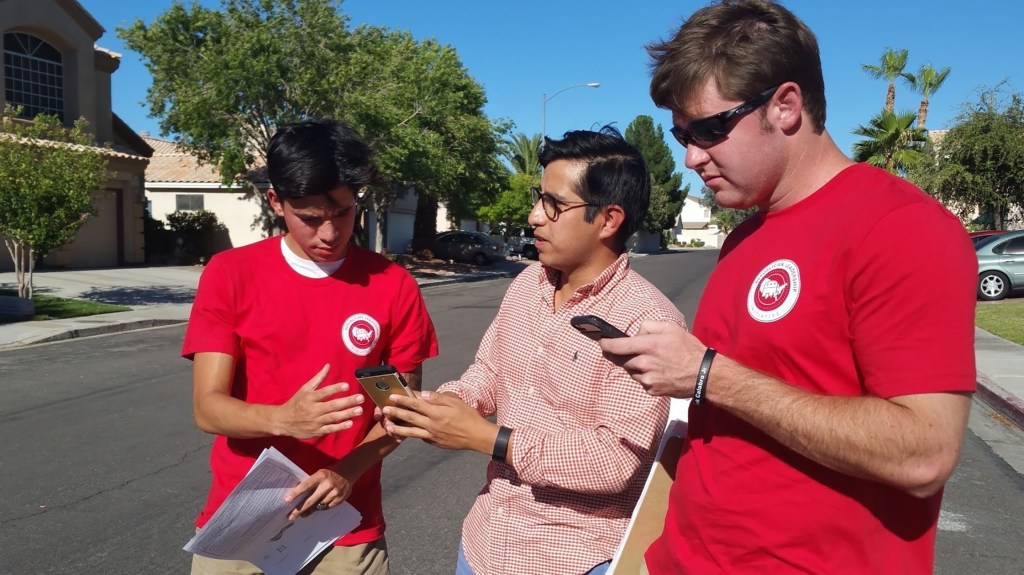
Party officials said that 7,600 “organizers” are working on the ground and that the RNC knocked on door No. 20,000,000 during the campaign’s final weekend.

They said they were pleased with early and absentee voting returns in Arizona, Colorado, Florida, Iowa, North Carolina and Ohio.

  • Arizona: Republicans led absentee ballot returns by more than 95,000.
  • Colorado: Republicans led in ballots mailed in by 7,000 (Colorado is a vote-by-mail state.)
  • Florida: Republicans increased their share of the early vote by 1 percent over 2012; the Democrats’ share decreased by 5 percent.
  • Iowa: Republicans had cut into the Democrats historic early-vote advantage in this state, increasing their share by 2.5 percent; Democrats had cast 20,000 fewer ballots than they had at this point four years ago.
  • North Carolina: Republicans trail Democrats in early ballots cast by 140,000 less than they did in 2012.
  • Ohio: In a collection of four counties that went big for Obama four years ago, 109,000 fewer ballots were cast in early voting. In three counties that went for Romney, ballots were up more than 5,000.

“Republican enthusiasm is off the charts and we’re translating that enthusiasm into action in the field,” RNC national field director Chris Young said.

The Clinton campaign and Democratic insiders monitoring pre-Election Day voting continue to be encouraged by what they’re seeing.

  • Colorado: Republicans led in ballots cast, but by about 25,000 less than they did at the same point four years ago, when Obama won the state easily.
  • Florida: In majority Hispanic Miami-Dade County, which Obama won by 24 points in 2012, more than 750,000 people voted early, a 59 percent increase over four years ago. More than 1 million Hispanics voted early, double the amount who did so in 2012. Democrats also are pleased early turnout among Millennials and African Americans, two groups that Democrats had been concerned about.
  • Iowa: The Clinton campaign is encouraged by early turnout among voters less likely to vote.
  • North Carolina: Early voting among African Americans was down in this state compared to 2012. But in the first week of voting, there were fewer polling places than there were four years ago. In the second week, when additional polling places opened, voting among African Americans “spiked,” nearly matching 2012 levels for the same period four years ago. Also, early voting among Hispanics jumped 86 percent over 2012. Finally, early voting in counties Clinton considers crucial to her prospects in North Carolina was up by about 20 percent.
  • Ohio: Early voting in “strong” Democratic counties has steadily increased during early voting. The average votes per day during early voting was 65,000; four years ago that figure was 51,000.

Per a memo issued by the Clinton campaign on Monday, its ground operation knocked on 6.2 million doors and made 8.1 million calls during the final weekend of the campaign, recording nearly 14.5 million “voter-to-voter” contacts.